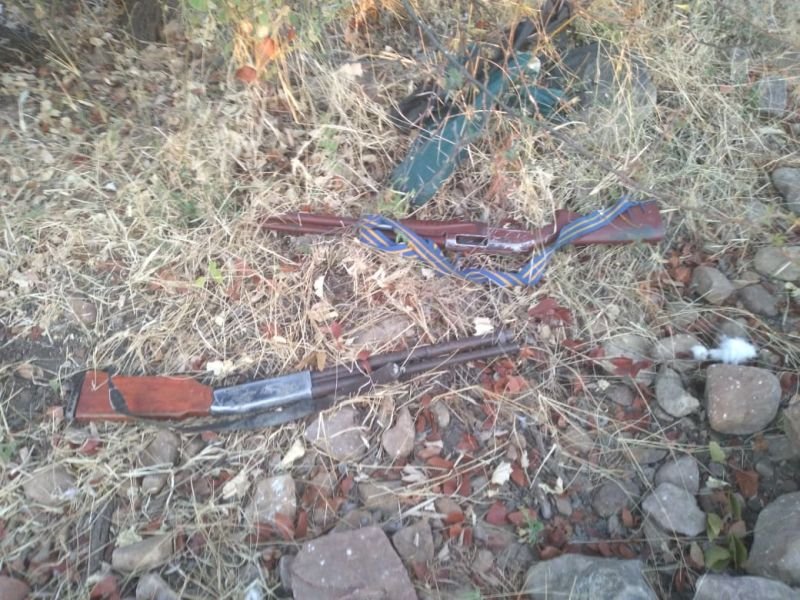

Despite Nigeria’s strict gun ownership laws, the country remains the region’s largest illicit small arms market, adding to the nation’s dire security crisis. Inefficient law enforcement and security services have led to an exasperated citizenry willing to do anything to protect their lives and livelihoods.
The Christmas Eve bandit attacks on farming communities in north-central Nigeria that killed 195 people and destroyed over 1 290 houses further place the issue of private gun ownership at the centre of public discourse.
These events have renewed countrywide calls by groups and individuals for Nigerians to be allowed to carry arms to defend themselves against militias, terrorists, bandits, kidnappers and other criminals. Last year, the Zamfara State government even advised residents to obtain guns to protect themselves against terrorists and bandits in Nigeria’s north-west.
The country’s 65-year-old Firearms Act restricts gun ownership and possession to those with a licence from the president or the Inspector General of Police. It bars anyone under 17; anyone of unsound mind or defective eyesight; anyone with intemperate habits; or anyone who has in the previous five years been convicted of an offence involving violence, to own guns. The law prohibits the production and trade in firearms without a licence from the Inspector General of Police, and punishes any violation with a minimum of 10 years’ imprisonment.
Nigeria’s security forces have been consistently strict in enforcing this gun law. Based on the Executive Order signed by then president Muhammadu Buhari in 2019, which revoked private individuals’ firearm licences, all privately-held guns have supposedly been withdrawn from circulation.
To reinforce this stringent policy, in 2021 Buhari mandated the security services to use lethal force, directing them to shoot and kill those illicitly carrying AK-47s.
These rigorous measures haven’t prevented Nigeria from becoming the region’s biggest illicit firearms market. The country reportedly accounts for 70% of the 500 million illegal weapons in circulation in West Africa. One study puts the number of small arms in the hands of civilians in Nigeria at around 6 145 000.
These guns come primarily from three sources. The first is artisanal manufacturing (73% of weapons seized between 2014 and 2017 in Southern Nigeria were found to be locally manufactured). Second, weapons misplaced or stolen from the security services’ armouries. Nigeria’s Police Force cannot account for 178 459 firearms, including 88 078 AK-47 rifles, 3 907 assorted rifles, and pistols. Third, arms that organised criminal groups smuggle into Nigeria.
Regardless of where they’re from, though, it’s clear that Nigeria is awash with illicit firearms – and this is a critical factor in the current security crisis.
The country’s complex, expanding and sometimes interwoven security situation partly explains the paradox of having strict arms controls and an illicit arms surfeit. A decade-long Islamist insurgency in the north-east has resulted in 35 000 citizen deaths. In the north-west, a humanitarian disaster driven by organised criminal groups, widely referred to as bandits, is proving more fatal than the Boko Haram insurgency.
In the north central region, conflicts between farming communities and armed herder groups are turning Nigeria’s food basket into an expansive wasteland. The south-east has been rocked by separatist violence, and the south-south area contends with the enduring repercussions of a resource control conflict. The relatively stable south-west faces the menace of gang violence.
In the past decade, the government has allocated significant resources to security, expanding the size of its security services. However, the escalation of violence and clashes across the country highlights the government’s failure to guarantee public safety. Non-state armed groups continue to challenge the primacy of Nigeria’s states across all geopolitical zones, hold communities to ransom, and show citizens that the state can’t protect them.
Amid escalating threats from violent militias and opportunistic criminals, citizens’ quest for arms reflects the need for self-preservation. Recent ENACT research points to insecurity as a significant driver of the illicit firearms trade in the West African Sahel. The question is whether Nigeria’s massive illegal arms market is primarily a consequence of pervasive insecurity and citizens’ need for protection, or if the illicit weapons market is the main factor.
Whatever the answer, certain facts stand out: both criminals and citizens source weapons largely from the illicit market. Some vigilante-style state security outfits possess arms without approval from the central government. And informal private security service providers across Nigeria own guns, albeit crude and artisanal ones. In essence, most communities and individuals in the country depend on illicit arms for their protection.
What is clear is that arms proliferation has strengthened fundamentalist insurgent groups, exacerbated resource-based conflict between farmers and herders, increased inter- and intra-communal tensions, and aided the spread of violent gangs across urban centres.
Nigeria’s illicit arms challenges are intertwined with complex themes of constitutionality, public order, local governance, state failure and the constitutional right to protect one’s life and livelihood. If the authorities deny citizens the right to have arms to defend themselves, they must provide them with security. But the government consistently falters in this responsibility.
By the same token, there is no conclusive evidence that liberalising access to firearms would improve security. Considering Nigeria’s multiple conflicts and the challenges of border porosity that enable arms trafficking, campaigns for arming individuals could further jeopardise security and push the country into anarchy.
That leaves the authorities and community stakeholders with one option: Nigeria’s security apparatus must deliver on what it was established to do – protect citizens’ lives and property.
Written by Oluwole Ojewale, ENACT Central Africa Organised Crime Observatory Coordinator, ISS and Tosin Osasona, Senior Research Associate, Center for Public Policy Alternatives, Lagos, Nigeria.
Republished with permission from ISS Africa. The original article can be found here.