


The National Development Plan 2030 (NDP) is an ambitious document that outlines South Africa’s efforts to grow the country’s economy. Part of this includes a revised look into energy and how South Africa can best go about achieving its carbon-neutral goals.
This focus on efficiency and environmental concerns makes buildings, which generally use a lot of water and energy, a top priority for carbon neutrality. Carbon neutrality is centred around efficiently managing resources, and the Energy Efficiency in Public Buildings Infrastructure Programme (EEPBIP) is the guide for how South Africa’s public infrastructure will function as efficiently as possible.
What is EEBIP exactly?

According to the Department of Minerals and Resources and Energy (DMRE), EEBIP’s main goal is to improve the energy efficiency of public buildings and infrastructure and reduce greenhouse gas emissions. To do this, the programme aims to identify financing and implement energy savings and demand-side management measures in place. EEBIP is concerned with:
- Buildings owned by municipalities, provincial departments, and state-owned enterprises.
- Public street and high-mast lighting
- Waste water treatment facilities.
The DMRE states that EEBIP is a mechanism that public building owners and accounting officers will use to improve the energy efficiency in buildings. Depending on the rating a building receives, the building would have to either implement energy-saving strategies to move up the rating scale or continuously minimise its performance to remain highly rated.
These energy-saving strategies will be achieved through technical support to the public sector and investment risk mitigation. The programme is key to the NDP as it promotes employment and supports local enterprise development. EEBIP is used in tandem with other government initiatives such as demand-side management and energy performance certificates.
EEBIP has set up the Energy Efficiency Project Support Unit (EEPSU) hosted by the DMRE, which will action projects that fall under the initiative, like solar and biogas energy generation. EEPSU seeks out bankable projects that will be tendered out to the private sector under energy performance contract modelling. EEPSU’s mandate is to:
- Identify bankable energy efficiency projects
- Support procurement within the guidelines of applicable finance management and public procurement legislation and regulations.
- Build institutional capacity on energy management, project development, and energy performance contracting.
- Measure, monitor, and verify projects.
In the case of all energy-related projects, funding is crucial, and by partnering with the Industrial Development Corporation to provide partial credit guarantee loans. Financial risk mitigation is also available to small, medium, and micro enterprises that are involved with energy-related projects.

Objectives of EEBIP
The programme seeks to increase local economic activities and develop capacity within public entities while involving the private sector, resulting in job creation. While the economic objectives are necessary for South Africa, the environmental objectives will be the means to achieve these goals.
The DMRE envisions EEBIP’s outcomes as follows:
- A 4.3 Metric Ton of carbon dioxide equivalent (4.3MtCO2e) reduction in greenhouse gas emissions.
- A total of 1800 jobs in the energy-saving field.
- Increasing the energy-saving market by 50%
- Generate R380 million in public finance
- Generate R1.1 billion in private finance.
Energy performance certification
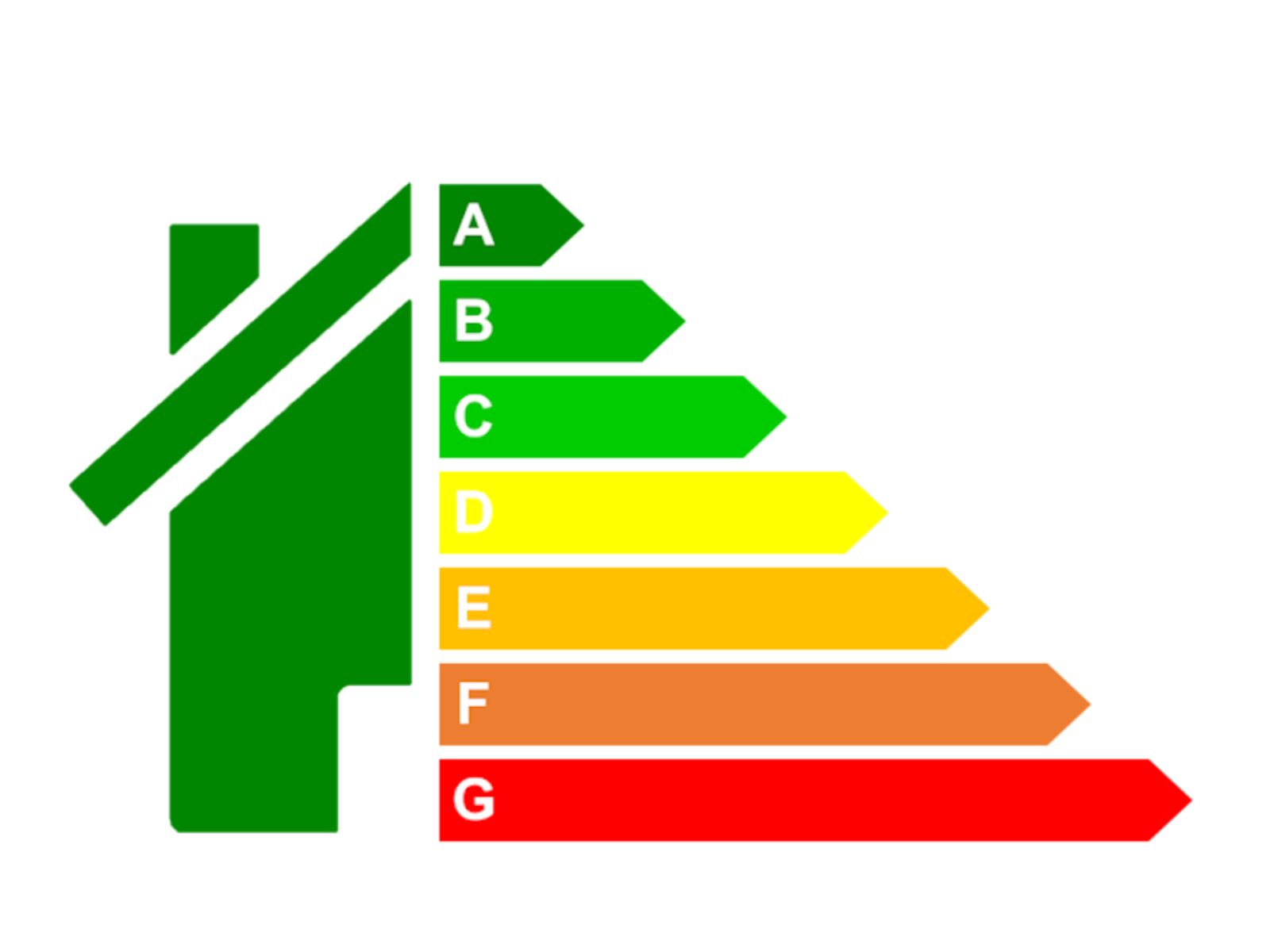
The EPC certificate will have seven ratings, G being the worst performing and A being the best performing
While EEBIP focuses on public buildings, the DMRE also outlines plans for private building ownership. Building owners and accounting officers who own or manage buildings with an area greater than 2000 m2 of privately owned floor space and less than 1000 m2 of government-owned floor space will have to submit a certified copy of their building’s energy performance certificate (EPC) to SANEDI before the 7th of December 2025.
An EPC is a document that displays a building’s net measured energy consumption in kilowatt hours. This performance is then measured against a benchmark of other buildings in the occupancy class and area. This is the first time that accounting officers and building owners will be obligated to publicly share their energy consumption.
The penalty for non-compliance will be either a fine not exceeding R5 million, imprisonment for a period of not more than 5 years, or both.
The EPC process
The DMRE suggest that all building owners determine their need for an EPC. If the building in question falls within the need to submit an EPC, the DMRE recommends appointing a SANAS-accredited professional to conduct the assessment. The registered professional will conduct the assessment in line with SANS 1544:2014 and upload the data onto SANEDI’s system, which will issue a unique EPC number. This must then be displayed on the premises and a certified copy sent to SANEDI within 3 months of the issue date. These will be randomly spot-checked by the DMRE and are up for renewal after 3 years.
Both private and public entities are set to transform over the coming years, and having buildings comply with more stringent laws will be a guiding mechanism in driving energy efficiency.


