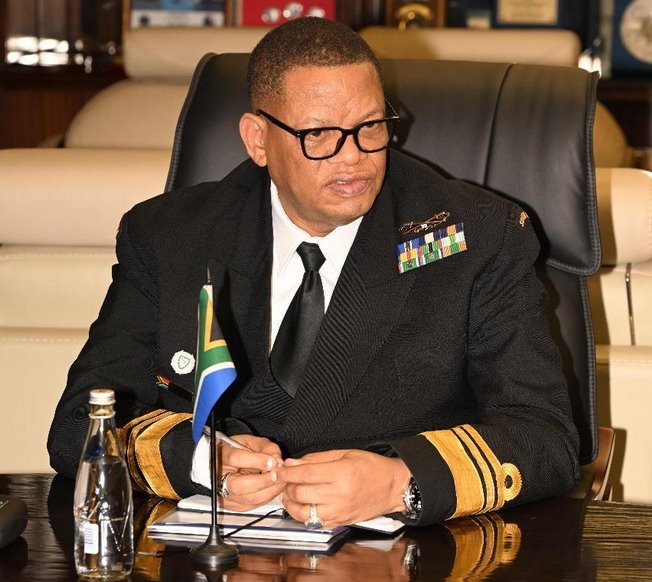

Last week’s remarks by SA Navy (SAN) Chief, Vice Admiral Monde Lobese, were not the first from him criticising the country’s purse holders – Finance Minister Enoch Godongwana’s National Treasury (NT).
In July, addressing the Joint Standing Committee on Defence (JSCD), Lobese accused the NT of “sabotaging” the SA National Defence Force (SANDF) where he put it Treasury’s refusal to release sufficient funds left key naval assets unusable and stockpiles critically under-resourced. “National Treasury…is suffocating the SANDF,” Lobese was reported as saying adding Parliament should intervene and uphold a presidential commitment to increase defence spending.
There was, at that time as far as can be ascertained, no public criticism from the Defence and Military Veterans Ministry, headed by Angie Motshekga.
That was not the case in the wake of Lobese speaking to audiences at the SAN Prestige Evening and Gala Concert last week. He again – although obliquely – referred to Treasury saying “we [the SA National Defence Force] are required to produce Annual Performance Plans and Defence Reviews, one after another and what saddens me is knowing very well that this requirement is just a mind game as these will not be resourced”.
His speech, a copy of which was forwarded to this publication by SAN Public Relations, states in part, “the unpatriotic and what appears to be a sell-out posture of defunding the SAN and SANDF in general leaves me with a question of whether the people behind, what I would like to call ‘nonsense’; if they are not busy with a mission to privatise the SAN and the SANDF.”
Lobese accused unnamed decision-makers of being influenced by criminal networks. “I often find myself questioning whether those responsible for making significant decisions may be directly or indirectly influenced by drug cartels, illegal traders, maritime criminals and human traffickers,” he said.
He qualified his words by saying: “With the responsibility entrusted in me to command the seas of our country and the love I have for our motherland, I find it difficult to separate emotions from my responsibility and I am not apologetic”.
A subsequent Department of Defence (DoD) statement has Motshekga terming what the chief of the country’s maritime service said as “casting aspersions at the leadership of government”. Lobese’s words will “receive attention at all levels, starting from within the department to Parliament”.
Reaction has, to date, come from the African National Congress (ANC) in the form of Portfolio Committee on Defence and Military Veterans (PCDMV) chair Molefi “Dakota” Legoete; Democratic Alliance (DA) Member of Parliament (MP) Chris Hattingh; and the Economic Freedom Fighters (MP) Carl Niehaus, amongst others. Both of the latter sit on the Joint Standing Committee on Defence (JSCD) and the PCDMV.
Newsday has Legoete saying while in agreement with Lobese’s sentiments on SANDF under-funding, he should not have made public the possibility of national security being compromised. The digital publication quotes him as saying: “It’s very wrong because it gives credence to some international espionage and foreign intelligence agencies to understand what is happening in our country” adding Lobese should use “relevant platforms and institutions” to voice his concern.
Hattingh interprets Lobese’s words as being “perilously close to outright insubordination”. At the same time he has it “many issues referred to mirror longstanding warnings repeatedly raised by the PCDMV”.
“The DA understands Admiral Lobese’s frustration, but we cannot support the reckless manner in which he chose to express it. Senior SANDF leaders must uphold discipline and follow the correct reporting channels at all times.”
“We call on the Minister to deal with this matter consistently and transparently, while finally taking seriously Parliament’s longstanding warnings about the SANDF’s financial collapse,” Hattingh said.
“I’ve argued that the SANDF’s shrinking budget is unsustainable. In April 2025, the Chair of the Joint Standing Committee on Defence warned Parliament that persistent under funding ‘threatens not only the country’s ability to defend its borders but also its international credibility and economic growth potential’. Defence spending has fallen from over 2% of GDP in 1996 to about 0.7 %,” said Hattingh. He said the Portfolio Committee on Defence and Military Veterans (PCDMV) had already recommended increased funding for the Navy.
“Underfunding leaves a vacuum that organised crime can exploit,” Hattingh emphasised. “Inadequate funding restricts the SANDF’s capacity to acquire critical combat capabilities, modernise equipment, and respond effectively to internal and international obligations. Without ships at sea, our ability to monitor and interdict criminal activities is severely limited,” he added.
Hattingh called for the Navy to be strengthened, including pushing Cabinet and Treasury to reallocate funds, and the procurement of patrol vessels and surveillance technology.
ANC secretary-general Fikile Mbalula criticised Lobese for his remarks, saying issues of SANDF funding should be addressed through proper channels. “South Africa is faced with a difficult situation of outbursts by people in security positions,” he said. “It’s unheard of that generals address gala dinners and talk big things.”
Mbalula said such comments could lead to the fermentation of coups. “They start like this, when generals become politicians overnight.” He called for discipline and added that “we are a democratic state and we have survived because of who we are. But if our army generals just do as they wish, with due respect, you can’t have generals of the army speaking like that.”
In the wake of the DoD statement which Niehaus called “shameful”, the outspoken EFF parliamentarian maintains Lobese spoke “the truth to power” adding “the time has come to take Motshekga head on without any holding back”.
“In what will go down as one of the most significant public warnings ever issued by a serving South African military commander, Vice Admiral Lobese exposed the systematic and deliberate destruction of South Africa’s maritime defence capability through chronic underfunding,” Niehaus said. “The EFF has repeatedly warned for over a decade that this underfunding is no accident. It is a calculated betrayal, orchestrated by unpatriotic elements within the Government of National Unity.”
“Today hardly any of our frigates and none of our submarines are operational. Naval patrols have been slashed to the bone. Illegal vessels plunder billions of rands worth of marine resources every year, while drug cartels and human traffickers operate with impunity along our coastline.
“The SANDF is being destroyed and our national sovereignty is at stake,” Niehaus continued. He subsequently used the platform provided by a PCDMV meeting to call for a joint JSCD/PCDMV meeting to discuss the consequences of defunding the SAN in the light of Lobese’s “disconcerting remarks”. This was turned down.
Niehaus said the ANC and its GNU partners seem to have learned nothing from the debacle that they are faced with, after Lieutenant General Nhlanhla Mkwanazi spoke out. “Only fools are unable to learn from their mistakes,” he said.
The EFF is calling for the National Assembly to intervene in the 2026/27 budget process to reverse all planned SANDF workforce reductions, restore full operational capability to the Navy and all other components of the SANDF, and allocate no less than 1.5% of GDP to defence.
Political analyst Andre Duvenhage told The Citizen that South Africans should expect more outbursts from senior government officials who are tired of the status quo. “There is a belief by some senior government officials that the status quo cannot continue the way it has been continuing, and there are concerns about our security situation. The navy is the least of our problems; the bigger problem is border control, which is territorial in nature, and we already have problems with air control and with regard to the navy.
“The whole system is falling apart. We are talking about institutional decay; our army is looking like some dysfunctional municipality somewhere in the Free State or in the North West. This general is complaining that he is not being empowered to do his job, he is unable to protect the coastlines because there are illegal things coming into the country,” Duvenhage said.
“It seems to me on a political level as if there is a revolt growing on certain levels even before Mkhwanazi spoke out. I had been picking up rumours of a possible coup d’état, but I do not think South Africa, in any way, is prepared for a coup, and I do not think it will be practical to argue that way. But what we can see is that there is uncertainty coming from the senior echelons and officials in the regime,” he said.
Aerospace and defence analyst Dean Wingrin agreed with Lobese’s general sentiments, but said senior military leadership – increasingly voicing their frustrations – must be careful of crossing the civil-military divide and making accusations against the civil leadership.