By Anne Maina



As a researcher, I have been in the middle of working with the ocean resource for research, and my knowledge can be defeated by what the locals who have grown up seeing and making use of it. The further end comprises the rest of the world, who are ignorant and only see the ocean as a source of pleasure, a place to beat the blues, a playground, or a getaway. One gets to see the ocean for what it truly is, a living component of the earth, one that can ‘speak’ to us and advise on means of solving problems linked to climate change, food insecurity, biodiversity loss, and sustainability.
According to the U.S. Geological Survey (2023), approximately 71% of the Earth is covered by water, with the Oceans containing 97% of that world’s total water. It is a large body of seawater that acts as the Earth’s largest component of the hydrosphere. It has been in existence for longer than the human race, the earth’s oldest and largest storyteller, and it is important to listen to it when it speaks.
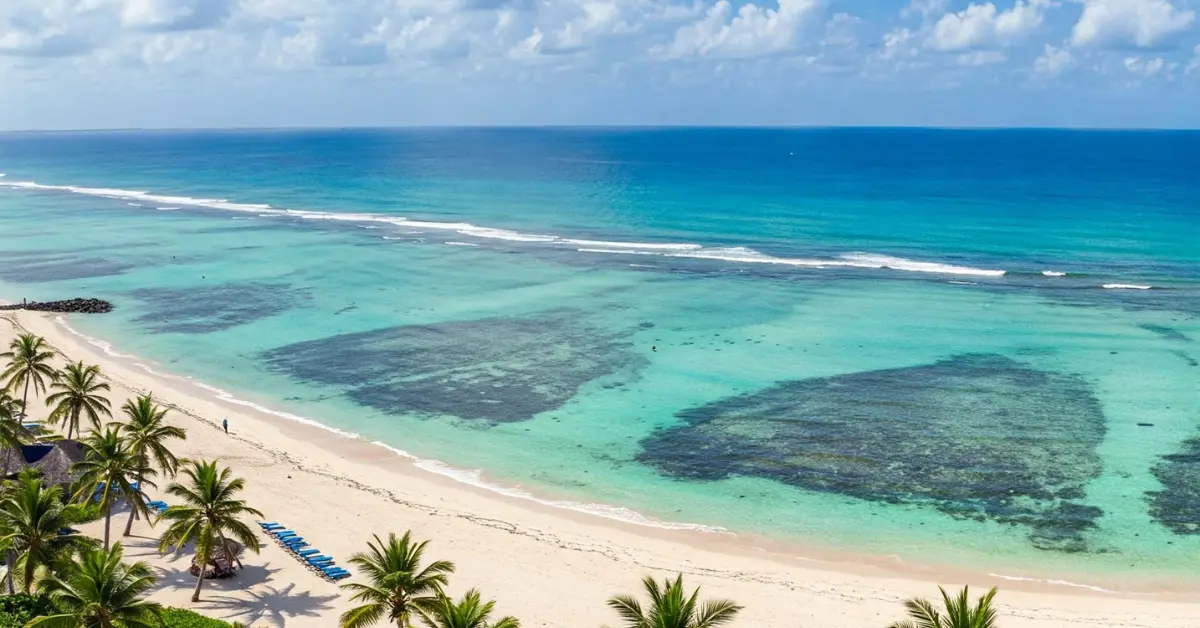
 Figure 1: A coastal view of the ocean and adjacent mangrove forests, highlighting the interconnection between marine and terrestrial ecosystems.
This article provides a perspective shift. The ocean becomes a narrator, illustrating the beauty and biodiversity, the neglect and damage, and the strings of hope which, however fragile, can weave a balance between factors such as climate change and the blue economy. It begs for a listening ear that surpasses mundane hearing towards live actions.
I was here before you: The beauty and biodiversity.
I am not just a body of salt water; I am life. I am a large ecosystem that includes habitats like the coastal areas of salt marshes, mangrove forests, estuaries, and coral reefs, the open ocean comprising the surface waters where the sunlight penetrates, and the deep sea, characterized by cold temperatures and extreme pressure. The biodiversity within me is adapted differently to the varying oceanic conditions; some creatures here would leave you speechless. All these factors contribute towards climate regulation, where the ocean absorbs greenhouse gases like carbon dioxide (CO2) and excessive heat from the atmosphere, providing resources like food and raw materials for your industries, and nutrient cycling. I offer these gifts for free, if only the human race saw it as so.
You Took More Than You Gave: The neglect and damage.
Sea life had it so good before you launched your vessels into the surface water, before submarines, toxic waste dumped, construction, oil spills, and plastics, all of which are crippling my ability to exist, breathe, and help you live your lives optimally. I have become the largest waste basket for humanity. With overfishing, coral bleaching, and rising sea levels, only for you to satisfy your industrial demands. Capitalism will be the end of you, and sadly, me. My ability to contribute towards sustainability in matters of climate, food, and health has been utterly affected. You came with sails, then steel. And with every vessel, you brought harm.
Some Listen: The hope; Innovations around the Blue Economy.
I have seen collective efforts from the majority of you trying to do clean-ups, naturally growing seaweed, replanting corals and seagrasses, which will restore lost or ailing biodiversity. You are developing policies that are directed towards curbing pollution, slowing down over-fishing, and guiding the utilization of my resources. I am very appreciative that not all have turned away.
The ideology of the blue economy is a lifeline. There is hope in climate-smart livelihoods, innovations around seaweed farming, marine protected areas that create sanctuaries, and integrated aquaculture systems that develop a balance, restricting heavy maritime traffic flows, and banning construction around shorelines.
The evolution of farms to integration is quite creative, mimicking me. Once, you grew seaweed on its own and caged fish, solely having the waste produced run through the waters, creating problems like eutrophication. You are taking advantage of the cyclic nature within trophic levels and the ocean by combining different sea life into one system. You are now pairing finfish like rabbitfish with seaweed and shellfish or sea cucumbers, each element doing its part in cleaning or feeding the next one. The seaweed takes up the excess nutrients, the bivalves work on what floats by filtering it, the fish develop, and the waste produced acts as a resource rather than a burden on me. You have dabbed it, Integrated Multi-Trophic Aquaculture (IMTA) system, Figure 2, I refer to it as restoration.

Figure 2: Conceptual diagram of an Integrated Multi-Trophic Aquaculture (IMTA) system.
The illustration shows a structured arrangement of three trophic levels: fed species (fish in cages), inorganic extractive species (seaweed on floating rafts), and organic extractive species (e.g., filter-feeding shellfish). Arrows indicate the flow of particulate organic matter (POM) and dissolved inorganic nutrients (DIN) from fish waste, which are then utilized by the shellfish and seaweed, respectively. This setup demonstrates the ecological synergy within IMTA systems, where waste from one species becomes a resource for another, contributing to environmental sustainability and nutrient recycling.
Source: https://www.researchgate.net/figure/Conceptual-diagram-of-the-integrated-multitrophic-aquaculture-system-Boxes-represent_fig1_276174838
You have incorporated traditional knowledge, looped in the local communities, especially women and experts, to scale up the system, looking at what works, what does not, learn, and ensuring it performs its intended purpose of becoming a bridge between livelihood and preservation and between a healthy ecosystem and food security.
Call to action
I am requesting collaboration, partnerships, restoration, and respect, not pity. I have been a resource since my beginning and request that you build systems that heal, those that enable me to do my job, leaving behind ones that cause me harm. I call on you to work with me and not around me.
Partnerships are needed across coasts, communities, and regions since my currents do not have borders; what affects me in Kenya has the potential to impact China and Australia. Science and research need more investment, but traditional knowledge and wisdom should never be left out of the equation. More people should be looped in to ensure they understand my significance and that what is done inland will affect me in the long run. Blue economy should not just be a colour but a blueprint for survival on a warming planet.
Sources
- S. Geological Survey. (2023). How much water is there on, in, and above the Earth? https://www.usgs.gov/special-topics/water-science-school/science/how-much-water-there-earth
- Zhang, J., Hansen, P.K., Fang, J., Ma, S., & Jiang, Z. (2015). Conceptual diagram of the integrated multitrophic aquaculture system. ResearchGate