Lessons From Kibaki’s Cabinet Purge Of 2005: What is Next?
DIASPORA MESSENGER NEWS MEDIA

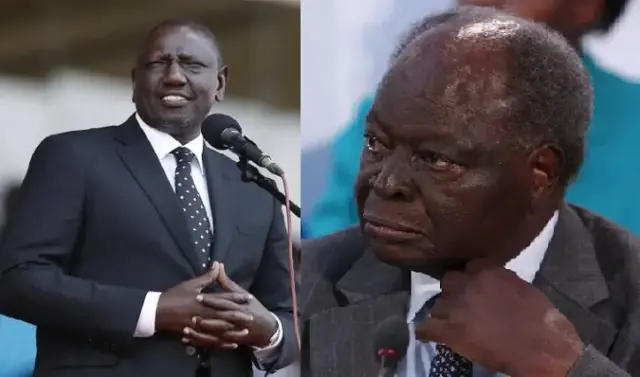
In an unprecedented move, President William Ruto has resolved to fire his entire Cabinet following weeks of anti-government protests that rocked the nation.
In a 12-minute speech, Ruto announced that the decision would not affect his deputy and Prime CS Musalia Mudavadi.
He explained that he would engage in extensive consultations across different sectors before reconstituting a new cabinet without providing any timelines.
President Ruto’s play to calm the hearts of raging Gen Zs who had threatened to return to the streets mirrored former President Mwai Kibaki’s move in 2005 when he sacked his entire cabinet days after a national referendum.
Background
In the 2005 referendum, over 3.5 million Kenyans rejected the draft constitution that Kibaki had strongly supported.
“Following the results of the referendum, it has become necessary for me, as the President of the Republic, to re-organize my Government to make it more cohesive and better able to serve the people of Kenya,” Kibaki said.
“Accordingly, in accordance with the powers conferred upon me under the Constitution of Kenya, I have directed that the offices of all Ministers and all Assistant Ministers become vacant. Consequently, the occupants of the said offices cease to hold their respective offices with immediate effect.”
The strong opposition against the draft constitution dated back to 2003 when Kibaki’s administration came into power and pledged to provide a more democratic governance within his first 100 days.
This resulted in a proposed Constitution drafted by the governing National Rainbow Coalition. However, at the time, internal wrangles came into play leading to disagreements on several contentious issues within the document.
Prior to the 2002 elections, politicians who formed a coalition with the ruling party made verbal and written agreements on matters governance and were aggrieved when some of their issues were not honoured. This resulted in deep rifts between individuals and parties.
A section of the CSs who opposed the law argued that it provided the presidency with utmost powers, something that they sought to get rid of especially following the Daniel Moi regime.
On the other hand, supporters of the draft document dismissed the claims of supremacy in the presidency and noted that powers such as appointments would be subject to vetting and approval by parliament.
Despite a wide campaign for the draft Constitution, Kibaki failed to convince Kenyans to vote for the draft Constitution, with critics saying that the former president sought to ease the tension that succeeded the 2002 elections.
At the time, President Ruto, who was in the opposition, said that Kibaki had his work cut out for him to appeal to Kenyans.
“I don’t think the president has an option, but to begin to respect the institutions of governance that are there. The major split and confusion and quarrels over the last three years have basically been the president ignoring the institutions that are there. He needs to respect the agreements he has with his coalition partners,” Ruto told VOA in 2005.
What happens next?
During Kibaki’s era, former head of Presidential Press Service Isiah Kabira said that former Vice President Moody Awori and Permanent Secretaries would run the government alongside Kibaki for two weeks before he named a new Cabinet.
Ruto in his speech confirmed that the operations of government would continue uninterrupted under the guidance of Principal Secretaries and other relevant officials.
By Brian Kimani
Read the Original Article onhttps://citizen.digital/
Lessons From Kibaki’s Cabinet Purge Of 2005: What is Next?
The post Lessons From Kibaki’s Cabinet Purge Of 2005: What is Next? appeared first on DIASPORA MESSENGER NEWS MEDIA.