

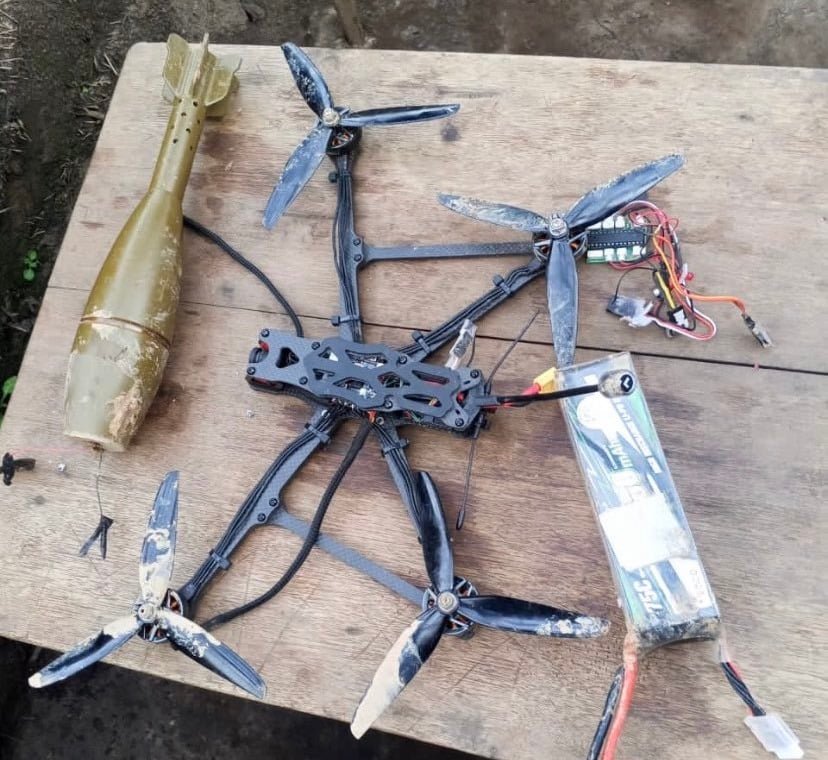

The 24 December 2024 attack on Nigeria’s Forward Operating Base in Wajiroko in the country’s north-east, marked the first known instance of a terrorist group in the region using drones in direct combat.
Islamic State West Africa Province (ISWAP) deployed four armed drones carrying locally made grenades in a coordinated assault, injuring at least five soldiers. Two more such attacks have happened in Damaturu, Yobe State, and Abadam on Lake Chad.

The use of armed drones in battlefield operations is a dangerous new phase in ISWAP’s insurgency that challenges existing counter-terrorism strategies in the region.
While state armed forces in Africa have for years used drones, including in Ethiopia and Mali, observers have long warned about the danger posed by non-state actors acquiring and adapting the technology. The Institute for Security Studies (ISS) warned in 2023 that ISWAP was close to using drones for attacks.
The shift in tactics was highlighted during January’s Lake Chad Basin (LCB) Governors’ Forum in Maiduguri, and signals a turning point in the fight against violent extremism in the region. ISWAP’s increasing capabilities demand immediate attention from the region’s security forces, governments and partners to counter the evolving threat effectively.
The group first used drones for propaganda and surveillance, following in the footsteps of extremists and insurgents in Somalia, Libya, Mozambique and the Democratic Republic of the Congo.
The weaponisation of drones in Lake Chad Basin means non-state actors are now using aerial technology to enhance their operational capacity. That represents a disturbing evolution in tactics and sophistication, and raises the question of how regional forces can adapt to this new warfare.
It is not only ISWAP’s tactics that are evolving; worrying signs point to an enhancement in weaponry. In a recent video made after the Wajiroko attack, ISWAP demonstrated its ability to recruit, train and equip young fighters with advanced weapons. The footage shows young recruits undergoing training with sophisticated firearms, including the American-made ArmaLite AR-10 Super SASS and Russian Orsis T-5000 sniper rifles.
The presence of foreign trainers in the video confirms the provision of external technical support. Recent ISS interviews with ex-ISWAP fighters in Borno, Nigeria, revealed that the group’s advancement in military capabilities – and even tech-enhanced communications – have been assisted by trainers deployed by Islamic State.
The video also reinforces ISWAP’s strategic planning. The group uses tactical specialisation – with combatant categories including snipers and ambush strike militants – and is committed to indoctrinating and training a new generation of fighters to sustain its insurgency.
Despite efforts by national forces and the Multinational Joint Task Force (MNJTF), which comprises Cameroon, Chad, Nigeria and Niger, addressing ISWAP’s evolving tactics requires more dedicated attention and resources.
Speaking at the Maiduguri forum in January, MNJTF commander Major General Godwin Mutkut, acknowledged the lack of counter-drone technology, including jamming systems, which leaves security forces and civilians vulnerable to aerial threats.
This raises three urgent questions. First, how has ISWAP acquired drone technology, which the MNJTF openly admits is a major challenge? Ongoing counter-terrorism measures should have frustrated the insurgents’ financing and access to capability-enhancing materials of this nature.
Second, what are the potential transnational and supply chain networks supporting the provision of drone technology to ISWAP? And third, how can regional forces swiftly adapt to prevent drone warfare becoming the new standard for insurgents in the region?
According to ISS interviews with ex-fighters, ISWAP’s ability to acquire and weaponise drones stems from a combination of smuggling routes, arms trafficking networks, and modifications of commercially available drones.
With drone-enhanced precision, ISWAP – if not quickly stopped – could conduct high-impact assaults while minimising their casualties. The group could transform military outposts and relatively secure civilian locations into precarious targets.
This could deepen psychological warfare, inducing fear among communities and even military posts under-equipped to defend against such aerial assaults. The resulting erosion of civilian confidence in state protection could inadvertently bolster support for insurgents, creating a dangerous cycle of instability.
The tapping of external networks evident in its drone programme and video highlights ISWAP’s ability to adapt and withstand security forces operations. The group also continues to recruit and radicalise young fighters to ensure the survival of its extremist ideology across generations.
Addressing ISWAP’s escalating threat requires a robust and coordinated multi-pronged strategy. First, governments in the region must prioritise the deployment of counter-drone technology, including jamming devices and air defence systems, to disrupt insurgents’ drones before they inflict damage. MNJTF made this requirement clear at the Maiduguri conference.
Strengthening intelligence sharing between security agencies in Nigeria, Chad, Niger and Cameroon is also critical. A coordinated effort to track and disrupt ISWAP’s supply chains and external support networks could significantly weaken its operational capacity.
ISS research has revealed how ISWAP exploits trade routes in the Lake Chad Basin for vital supplies such as fuel, vehicle parts, weapons, materials for explosives and food. Security forces should conduct enhanced checkpoint searches to detect suspicious movements of equipment and accessories.
Preemptive strikes targeting ISWAP’s drone assembly and launch sites are also important. Identifying and dismantling these facilities must be treated as a priority to prevent the insurgents from advancing their drone warfare capabilities.
Although the threat is real and demands immediate action, governments should not lose sight of equally important longer-term interventions. ISWAP thrives on socio-economic vulnerabilities and governance gaps, which it uses to recruit, radicalise and set up bases.
These drivers must be tackled by expanding the state’s presence in rural and remote areas through better security and governance, socio-economic opportunities and counter-radicalisation programmes.
Enhanced collaboration with international partners could also provide the technical assistance and intelligence support needed to address ISWAP’s evolving tactics.
Written by Taiwo Adebayo, Research Consultant, Lake Chad Basin, ISS.
Republished with permission from ISS Africa. The original article can be found here.


