

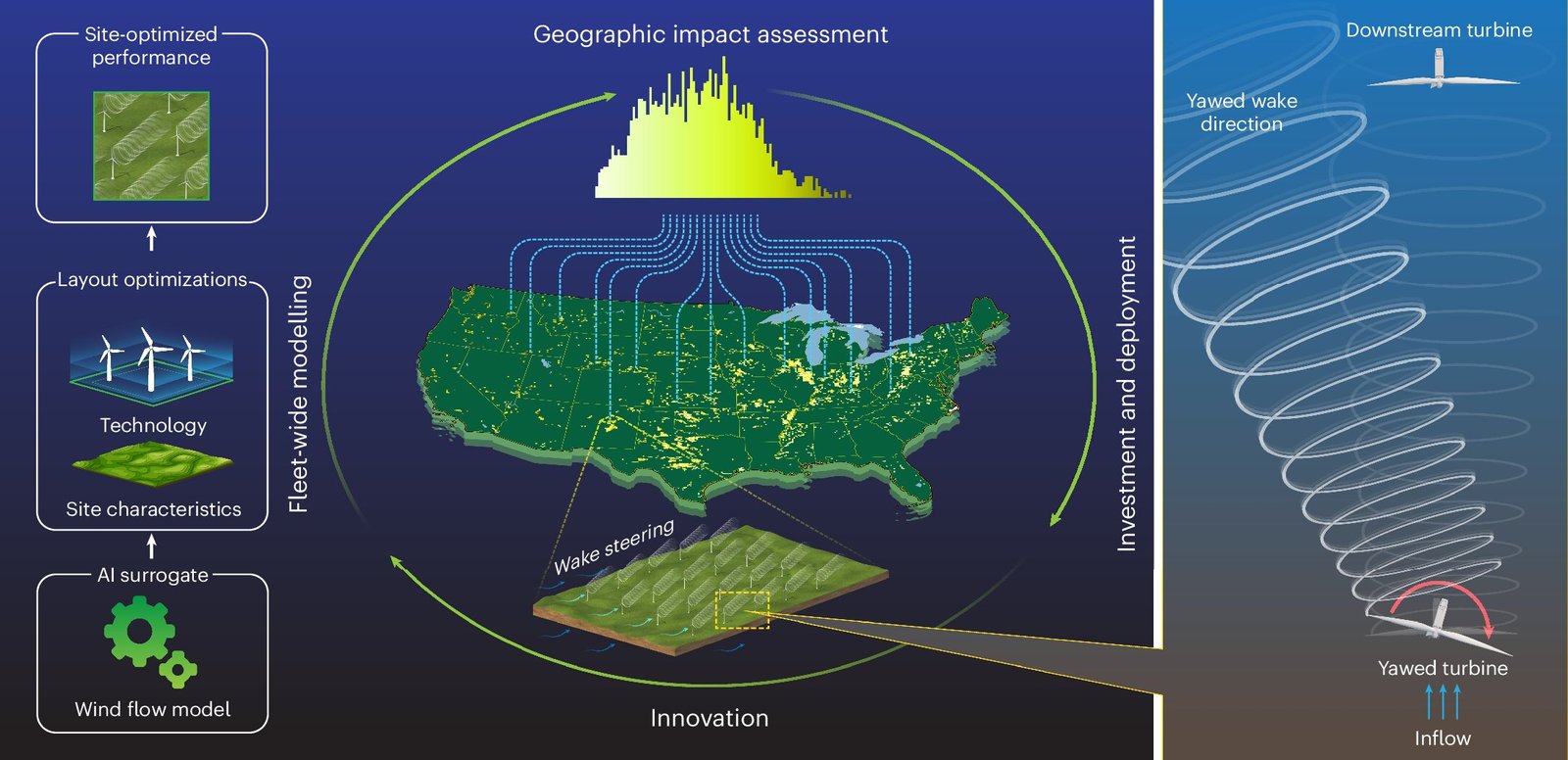
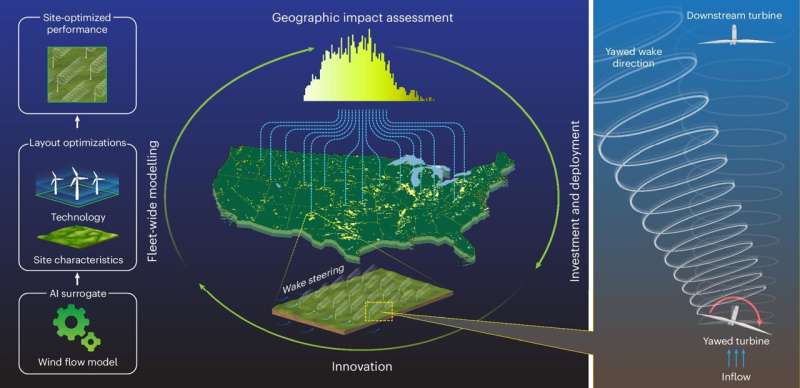
The wind industry could benefit from the use of artificial intelligence (AI) to design and deploy wind plants, according to an article in Nature Energy written by researchers at the U.S. Department of Energy’s National Renewable Energy Laboratory (NREL).


The researchers developed an AI-based surrogate model called the Wind Plant Graph Neural Network (WPGNN), which was trained on simulations of more than 250,000 randomly generated wind plant layouts under various atmospheric conditions, plant designs, and turbine operations. The simulations data was generated by another NREL-developed model, the FLOw Redirection and Induction in Steady State (FLORIS) tool.
The AI then took that information to determine the optimal design of a wind plant. The AI facilitates the calculation of ideal plant layouts and operations to achieve different outcomes, such as reducing land requirements or increasing revenue.
The research focused on a strategy called wake steering, which optimizes the amount of energy a plant can produce by controlling the wake moving from an upstream turbine away from a downstream turbine.
The use of AI enabled the researchers to determine the impacts wake steering would have on three different objectives: land use, cost, and revenue.
The benefits of wake steering have previously been demonstrated at a plant level, but most studies have been limited in spatial scale and in the range of optimization objectives considered. The WPGNN used by the NREL team efficiently represented wake interactions as a directed graph, which allowed for a comprehensive investigation into the optimal settings for both the turbine location and the yaw of the nacelle across a nationwide wind energy portfolio.
“Previously, site-specific wake steering optimization studies were very difficult, but the graph representation in the WPGNN dramatically improved our ability to represent flexible layouts, changing wind directions, and perform gradient-based optimization,” said Ryan King, co-author of the paper, “Artificial Intelligence-Aided Wind Plant Optimization for Nationwide Evaluation of Land Use and Economic Benefits of Wake Steering.”
The crosscutting effort involved researchers from the laboratory’s Strategic Energy Analysis Center, the Computational Science Center, and the National Wind Technology Center.
King is a senior scientist in the Computational Science Center, while co-author Andrew Glaws is a researcher in applied mathematics there. They wrote the paper with two colleagues who have since left NREL, Dylan Harrison-Atlas and Eric Lantz. Formerly a group research manager at NREL, Lantz is now director of the Department of Energy’s Wind Energy Technologies Office.
The use of wind as a renewable energy source is expected to become increasingly important in decarbonizing the nation’s power sector, but obstacles remain as some communities have restricted where wind turbines can be erected. The AI-guided scenario considered a nationwide deployment of 6,862 plant buildouts with a cumulative 721 gigawatts of generated power, with the goal of reducing 95% of carbon emissions from the energy sector by 2050.
The adoption of wake steering strategies could reduce the land requirements for future wind plants by 18% on average and by as much as 60% in some instances. Nationally, the land savings total about 13,000 square kilometers, which is equivalent to 28% of the wind energy footprint in the United States.
Wake steering is valuable because simply spreading out turbines is often not enough to avoid wake losses and some wind plants lack the space required to expand further. Besides, wind plants optimized for wake steering would allow for a larger concentration of turbines, thereby satisfying the desire of some local communities to limit how much land the industry is allowed to use. The installation of more turbines in a smaller footprint would offer increased flexibility from a site-planning perspective, potentially allowing developers to tap into economies of scale for larger projects.
The researchers also found the use of wake steering consistently reduces the cost of energy for wind deployments. The AI allowed the researchers to uncover regional differences where the strategy would be best put into place.
“We found that different areas of the country are more or less amenable to the benefits of wake steering and the outcomes of those benefits can be realized in different ways,” Glaws said. “This can be important for helping to understand how and where we should be investing in this new technology.”
NREL’s high-performance computing resources enabled researchers to train the WPGNN.
More information:
Dylan Harrison-Atlas et al, Artificial intelligence-aided wind plant optimization for nationwide evaluation of land use and economic benefits of wake steering, Nature Energy (2024). DOI: 10.1038/s41560-024-01516-8
National Renewable Energy Laboratory
Citation:
Lab’s AI work results in increased revenue, decreased land requirements for wind power industry (2024, May 8)
retrieved 9 May 2024
from https://techxplore.com/news/2024-05-lab-ai-results-revenue-decreased.html
This document is subject to copyright. Apart from any fair dealing for the purpose of private study or research, no
part may be reproduced without the written permission. The content is provided for information purposes only.


