
KCB Powers Kenya’s Green Transition with KShs. 53.2 Billion in Sustainable Loans


KCB Powers Kenya’s Green Transition with KShs. 53.2 Billion in Sustainable Loans
KCB Group has strengthened its leadership in sustainable finance by screening loans worth KShs. 578.3 billion for environmental and social risks in 2024, reinforcing its commitment to green and inclusive growth.
Since 2020, the bank has assessed over KShs. 2.5 trillion under its Environmental and Social Due Diligence (ESDD) framework, ensuring responsible lending and investment decisions.
During the year, KCB disbursed KShs. 53.2 billion in green loans, expanding its sustainable portfolio to 21.3 percent from 15 percent in 2023. The financing supported initiatives in renewable energy, the blue economy, electric mobility, and climate adaptation.
Nearly half of this amount, KShs. 24.1 billion, was verified using the Climate Assessment for Financial Institutions (CAFI) tool, enhancing transparency and accountability.
KCB Group CEO Paul Russo said the bank remains focused on creating long-term value for communities while driving economic growth. “We are aligning our priorities with global sustainability goals to deliver impact for people and the planet,” he said.
“The private sector has the capacity and responsibility to drive sustainable growth, and that starts with adopting practices that are both impactful and economically viable.”

KCB Powers Kenya’s Green Transition with KShs. 53.2 Billion in Sustainable Loans
Investing in a Low-Carbon and Inclusive Future
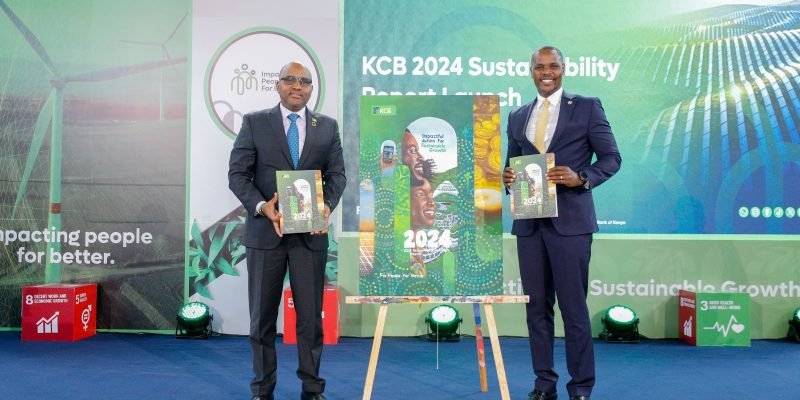
The 2024 KCB Group Sustainability Report, launched in Nairobi, details major progress in climate action, financial inclusion, and community empowerment.
The report, independently assured by Deloitte for the second year, is the only one of its kind among Kenyan banks and has been prepared in reference to the IFRS S1 and S2 sustainability standards ahead of the 2027 adoption deadline.
KCB reduced its overall resource consumption by 4 percent and offset 1.3 metric tonnes of carbon through conservation efforts, including the planting of more than 1.3 million trees.
Beyond its own operations, the bank is addressing financed emissions in key sectors such as motor vehicle loans, real estate, and business lending.
Dr. Eng. Festus Ng’eno, Principal Secretary for Environment and Climate Change, commended KCB’s leadership in financing green solutions. “Finance today is a lifeline for sustainable livelihoods,” he said.
“KCB has shown how financial institutions can empower farmers, small businesses, women, and youth to innovate through climate-smart solutions.”
To date, KCB has financed green projects valued at over KShs. 160 billion, confirming its role as a key player in Kenya’s green transition.
Empowering Communities and Shaping a Sustainable Economy
KCB’s social investments continue to empower individuals and communities across Kenya. Through the 2Jiajiri programme under the KCB Foundation, the bank disbursed KShs. 2.58 billion in loans to 4,000 youth-owned MSMEs, 38 percent of which were women-led.
The initiative also trained 9,699 youths, supported over 37,000 businesses, and created more than 60,000 jobs.
In Kenya’s arid and semi-arid regions, the Mifugo ni Mali initiative has enhanced livestock productivity while linking poultry and blue economy entrepreneurs to new market opportunities.
The Group also promoted supplier diversity by awarding KShs. 913 million 7.5 percent of total contracts to enterprises owned by women, youth, and persons with disabilities.
Kenya Bankers Association CEO Raimond Molenje praised KCB’s transparency in sustainability reporting. “When institutions share their progress and commitments openly, they raise the bar for the entire industry,” he said.
“KCB’s integrated approach, where growth aligns with environmental integrity and social inclusion, is the future of responsible banking.”
Supported by a KShs. 69 million Project Preparatory Facility from the Green Climate Fund, KCB aims to unlock an additional KShs. 15.5 billion in climate financing to benefit more than 100,000 small and medium-sized enterprises.
From financing renewable energy to empowering youth entrepreneurs, KCB continues to prove that sustainability and profitability can go hand in hand.
“The conversation today must focus on how we safeguard the planet and people even as we pursue profits,” Russo said. “That is how we will build an economy that works for all.”