Laramide Resources (TSX, ASX: LAM), one of the few Western companies to explore for uranium in Kazakhstan in recent years, is leaving the country as regulatory changes tighten restrictions on foreign participation.
State miner Kazatomprom (LSE: KAP) – the world’s top uranium producer – confirmed in late December the Kazakhstan government changed its Subsoil Use Code, giving the miner priority rights to exploration licences in prospective areas. Most projects must be done in joint ventures and the new law states that Kazatomprom gets at least 75% in them.
“This rule is going to keep any company from wanting to explore in Kazakhstan, not that there were a lot before either,” Red Cloud Securities analyst David Talbot told The Northern Miner by email. The changes amount to “de facto nationalization of the uranium industry in Kazakhstan,” he said.
Kazakhstan, historically integrated into the Soviet system with production largely directed to Moscow, now supplies much of the Western uranium market. Its move to strengthen state control over the sector through legal channels is a potential risk to supply that could support higher prices.
Laramide’s hopeful entry
In 2024, Laramide entered a three-year option agreement with Kazakh company Aral Resources to explore on more than 5,500 sq. km in the Chu-Sarysu Basin in southern Kazakhstan. The site is adjacent to Kazatomprom’s Inkai JV mine it holds with Canadian producer Cameco (TSX: CCO; NYSE: CCJ) and the Budenovskoye JV the state miner holds with Russia.
On Dec. 24, the Toronto-based explorer received the final permits to start drilling its 15,000-metre program. But two days later, Kazakh President Kassym-Jomart Tokayev signed into law the Subsoil Use Code changes.
“We had three rigs ready to go, basically on standby, we had all the people ready to go, we had the targets and unfortunately we never went out and drilled anything and had to walk away,” Laramide CEO Marc Henderson told The Northern Miner in an interview. The company announced on Jan. 20 it had ended its option agreement with Aral.
Henderson had heard rumours about the legal changes for a while and he realized last fall that the “dramatic decision” was going to be enacted.
“It would be like Newmont going to the U.S. government saying there’s a lot of gold here, why don’t you ban everyone else in Nevada except us. Except [in this case] it’s not for gold, it’s something critical that the world needs, like uranium.”
Asked to specify which part of the law spurred Laramide to leave the country, Henderson responded with a scenario where the company made a major discovery and approached Kazatomprom about its interest in a JV to potentially mine uranium.
“We thought the range that we were going to end up negotiating would be 30% to 50%,” he said. “[But] they made it law that the new terms that they had to have were between 75% and 90%. That was just a completely different deal.”
Why the amendments?
The code changes are “essential for the systematic modernization of Kazakhstan’s subsoil use regulations,” a Kazatomprom spokesperson told The Northern Miner by email.
“The revisions are intended to optimize the management of strategic resources, providing the framework necessary to reinforce Kazakhstan’s global market presence.”
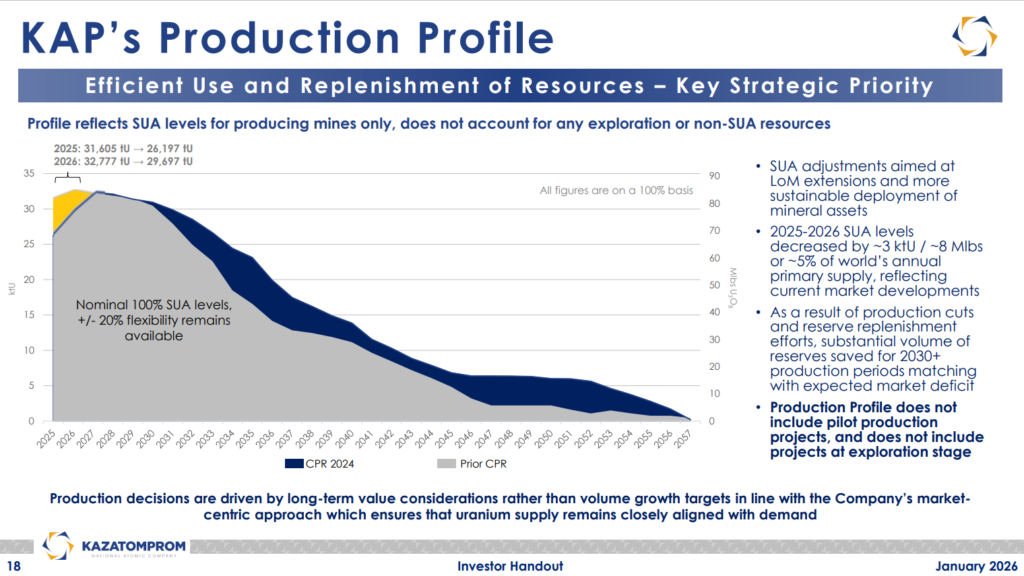
Henderson noted that Kazatomprom revealed its dwindling reserves in an investor’s presentation deck. A January deck showed that its production resource base would peak this year, then begin a rapid decline in a few years, with complete exhaustion by 2057.
Credit: Kazatomprom
Kazatomprom board chair Meirzhan Yussupov suggested as much to the Central Asia-focused Kursiv business publication in December.
The amendments are needed, Kursiv reported, as higher prices could attract higher-cost producers, reducing Kazakhstan’s advantage and depleting its reserves.

In addition, Kazakhstan’s Atomic Energy Agency said it needs the underground use amendments so it has enough fuel sources for planned nuclear power plants, according to reporting from Radio Free Europe’s Russian service on Feb. 9.
Greenfield exploration loss
Laramide incurred no costs to leave Kazakhstan and for now plans to re-focus on its projects in Australia and the southwest U.S.
Still, Henderson thinks it’s a loss for global greenfield uranium exploration that one of the world’s most prospective jurisdictions is now effectively closed to Western investment.
“The uranium sector is woefully behind on greenfield exploration,” he said. “The prospectivity in uranium to find things of any scale is very, very small. And not all of those are jurisdictions where you want to go on vacation, or where you’re comfortable with the politics.”
Australia’s C29 Metals (ASX: C29) is another Western company that was exploring for uranium in Kazakhstan. It acquired the Ulytau project in 2024. But C29 announced it was ending operations there in late November after regulators rejected its application for exploration rights, according to Minex Forum, a U.K.-based mining conference platform focused on Eurasian markets. C29 did not respond to a request for comment from The Northern Miner.
How will producers fare?
Western majors like Cameco, France’s Orano and Japan’s Sumitomo Corp. and Kansai Electric Power could face similarly difficult conditions in Kazakhstan.
Cameco’s contract in the Inkai JV – in which it holds a 40-60 interest with Kazatomprom – ends in 2045. Orano is in a 51-49 interest arrangement with Kazatomprom in Katco, made up of the South Tortkuduk/Muyunkum operation.
While Kazatomprom said existing subsoil use agreements are unaffected, contract extensions or production increases would require Kazatomprom to hold at least 90% of the JV. Alternatively, the foreign partner could keep its interest by transferring uranium conversion and enrichment technologies to Kazatomprom and build downstream capacity.
Of the non-Western producers in the country, seven are Kazakh, two are Russian, two are Chinese and one is Kyrgyz. Most production projects are held in JVs.
“This is part of the ongoing expectation that Kazakh uranium will be increasingly destined for eastern destinations (Russia, China), and less available to the West,” Red Cloud’s Talbot said. “It would impact the Chinese, Russians, Orano, Cameco and others – essentially reducing their interest and production.”
A Cameco spokesperson said in emailed comments to The Northern Miner that the company’s subsoil use agreement in the Inkai JV is valid until 2045 and Cameco has transferred refinery and conversion technology to its partner.
“Foreign interests requiring a new subsoil use agreement or an extension of a current agreement will face the requirement to increase state ownership,” the spokesperson said. “While the change in legislation is certainly impactful more broadly in the market, our agreement remains in place for the next 20 years.”
Pivot to East, spot prices
Talbot noted that global production as such might not be affected by Astana’s legal changes, and he expects all long-term uranium sales contracts would be intact, “but future contracts would likely be focused to an even greater extent on Chinese and perhaps Russian customers.”
In terms of the uranium spot price, which soared about 33% from late November until late January, when it peaked at $101.55 per lb., Talbot suggested Kazakhstan’s policy change could play a bullish role.
“Uncertainty surrounding uranium security of supply is often a catalyst for rising uranium price,” he said. “This could be very good for uranium prices, and potential M&A as western producers scramble for future production.”