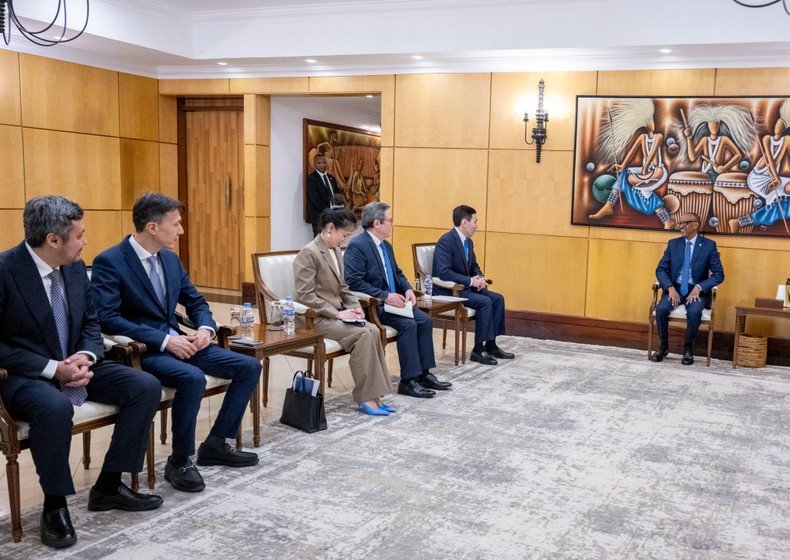
The delegation, led by the fund’s chief executive Nurlan Zhakupov, met Kagame at Urugwiro Village in Kigali to discuss the implementation of a cooperation agreement on critical minerals signed between Rwanda and Kazakhstan in May 2025.
“Discussions focused on the recently signed cooperation agreement between Rwanda and Kazakhstan on critical minerals, exploring opportunities for collaboration in geological exploration, mineral resource development, and mining investment, with particular emphasis on strengthening Rwanda’s role in the global critical minerals value chain,” the presidency said in a post on X.
The agreement was signed during Kagame’s visit to Astana last year, where he held talks with Kazakh President Kassym-Jomart Tokayev. Both leaders witnessed the signing of the deal between the Rwanda Mines, Petroleum and Gas Board and Samruk-Kazyna, opening the door for joint work in mineral exploration, mining development and knowledge exchange.
During that visit, Kagame said Rwanda hopes to benefit from Kazakhstan’s experience in mining, energy and mineral processing.
“Our two countries are good friends and partners, and we want to build on this strong foundation to further deepen our partnership,” he said.
Rwanda has increasingly positioned its mining industry as a strategic sector as global demand rises for critical minerals used in electronics, batteries and clean-energy technologies.
Officials from the Rwanda Development Board and the Rwanda Mines, Petroleum and Gas Board were also present at the meeting. The discussions focused on investment opportunities in Rwanda’s natural resources sector as well as potential collaboration on research into rare and rare-earth metals.
Kazakhstan has also stepped up its search for strategic minerals abroad. Following the 2025 agreement, Tau-Ken Samruk, a mining subsidiary linked to Samruk-Kazyna, launched geological exploration projects for rare metals in countries including Rwanda and Afghanistan.
Mining remains one of Rwanda’s top export earners. The country produces minerals such as gold, tin, tungsten and tantalum, which are widely used in the electronics industry.
According to the Rwanda Mines, Petroleum and Gas Board, mineral exports generated about $1.7 billion (2.4 trillion Rwandan francs) in 2024. The government aims to increase annual mineral export revenues to around $2.17 billion (3.15 trillion francs) by 2029.
The sector currently employs more than 92,000 people and contributes roughly three percent of Rwanda’s gross domestic product.
Authorities say 52 sites across the country have been identified for further exploration of minerals including lithium, beryllium and gold using modern geological technologies.
As global competition for critical minerals intensifies, Rwanda hopes partnerships such as the one with Kazakhstan will help expand exploration, attract new investment and strengthen the country’s role in the global mineral supply chain.