

The team at AI notetaker and meeting automation platform Jump has analyzed a veritable mountain of unstructured data from over 12,000 advisor-client meetings to develop its inaugural 2026 Financial Advisor Insights Report.
The report, released Thursday, takes anonymized data from those meetings held across the U.S. between November 2024 and October 2025 to create actionable insights.
“For this report, we analyzed the conversations themselves, how long things were discussed when in the call, whether the client brought it up or the advisor, and we were able to see how that affects specific recommendations,” said Liam Hanlon, head of insights at Jump.
“On average advisors are giving more than three recommendations in any one call, clients accept on average only one to at most two of those,” Hanlon said.
Extracting the why or most likely reasons behind those findings and many others through conversation analysis using natural language processing and a more in the way of methodology is at the heart of the study.
This effort has gone beyond basic metrics like meeting volume or duration and measures client sentiment, fears, life events, key discussion topics, objections and advisor behaviors within the conversation context.
The report is filled with charts, “Share of Meetings Containing Select Fears, by Month,” for example, illustrating an obvious peak in fear of market losses or volatility erupting into conversation during late March into April.

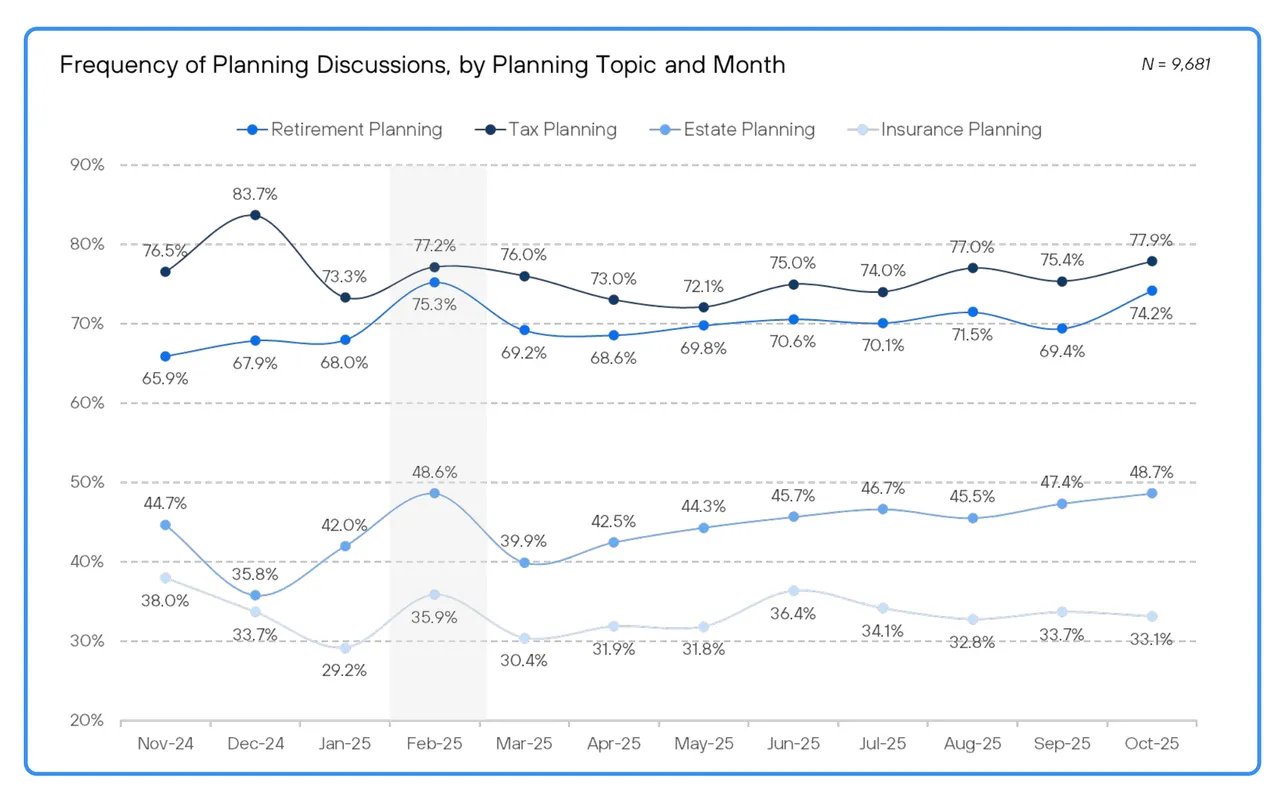
Insights from the Jump report.
And because the data and analysis are based on actual client-advisor conversations, (albeit anonymized) it lacks the bias often inherent in survey-based research.


A prime example, revealed early in the report, is the finding that advisors do, in fact, speak far more than most think they do (at least in the case of Jump-using advisors over the time period studied). Their analysis revealed that advisors spoke more than clients in 84% of cases.
While the advisor technology industry has seen a tremendous increase in interest and adoption of estate planning technology, we have to date seen little beyond surveys regarding the trend.
In its study, Jump found that 46% of client conversations included an estate planning discussion and were able to assess and quantify the eight most common client reasons for not pursuing creation of or re-visiting an existing estate plan. Topping that list was clients stating they wanted to consult an attorney first, followed by the client expressing they needed more information before making a decision.
While only 26% of clients agree to move forward with an estate plan, only about 2% outright decline, but 72% express interest yet defer acting (hence the analysis of reasons why).
Lest advisors conclude that Jump interpreted some of the more technical areas all on their own in a vacuum, the company partnered with several established firms or institutions on key areas. In estate planning, Jump partnered with technology provider EncoreEstate Plans, which contributed subject-matter expertise and collaborated on question formulation, and provided commentary on findings. Similarly, Holistiplan assisted on the tax planning section, as did The American College of Financial Services on a section regarding annuities.
This brief overview can only begin to unpack the findings within this 54-page report, which is free for download, requiring only a short registration.
In addition to a one-page summary on methodology, there is a 15-page appendix that dives into the taxonomies, sampling design, validation procedures and index construction and other underpinnings of this mammoth data analysis effort.


