

ADF STAFF
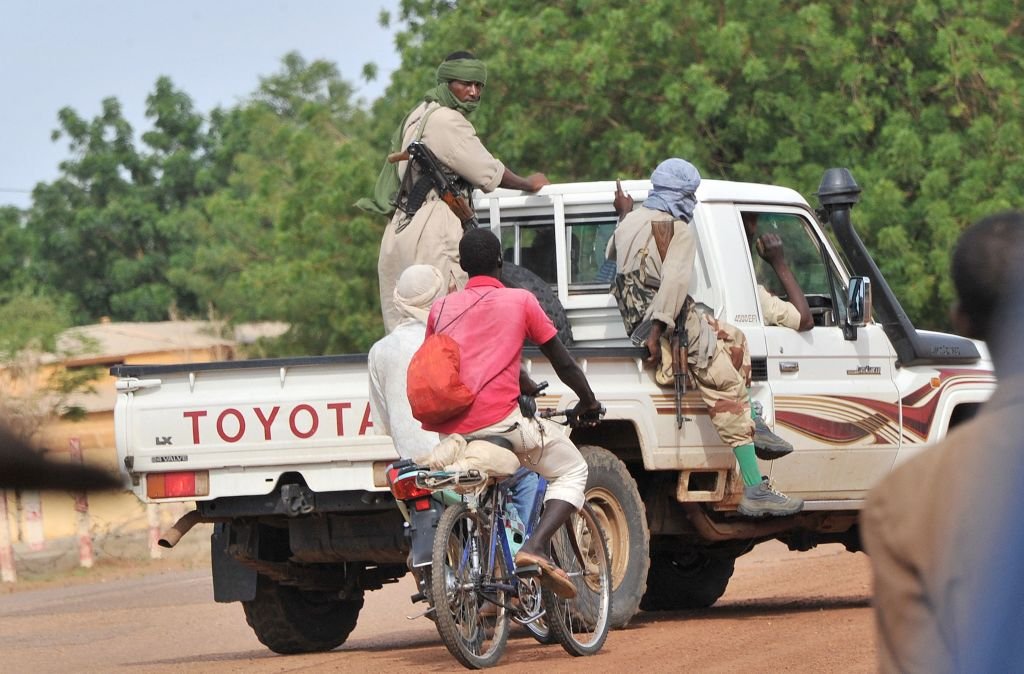
Chaos continues to reign in many parts of Mali, as extremist militant groups terrorize civilians and clash with government forces and Russian mercenaries on a near-daily basis.
Following up on a brazen attack in September against the ruling military junta in Mali’s capital, Bamako, the al-Qaida-affiliated alliance of terrorist groups called Jama’at Nusrat al-Islam wal-Muslimin (JNIM) is pushing to expand its areas of control.
JNIM seized another town in the Timbuktu region, Léré, on November 29 and has since kept it isolated — a familiar tactic that the group has used to choke local economies, thwart the movements of civilians, disrupt critical supply routes and continue to expand stretches of land under their control.
“Trucks were stuck at the town’s entrance and eventually turned back,” some area residents told Radio France Internationale, describing JNIM’s actions as a “total blockade.”
Six days before seizing Léré in central Mali, militants began to isolate the town by destroying the Dabi bridge, which connects it to Niafunké, the administrative district’s capital to the east.
More recently, JNIM has completely cut off the road west from Léré to the town of Niono in the Ségou region — which then connects south to the capital, Bamako — to Malian and Mauritanian traffic, according to a transportation worker in the region.
“Goods must be transported by pinnace boats from Mopti via the river,” he told RFI.
JNIM has increasingly used blockades as it expands its territory. It has laid siege to important cities such as Timbuktu and Gao and encircled several towns and villages, including Menaka and Boni.
“JNIM has consolidated support zones in northern Koulikoro region and western Ségou region, which it uses to degrade Malian lines of communication, isolate bigger population centers, and expand southward toward Bamako,” analyst Liam Karr wrote in the November 24 edition of the Critical Threats Project’s Africa File.
“JNIM controls most rural areas of northern Koulikoro and along the Koulikoro and Ségou regional border north of the Niger River. JNIM control in these areas is characterized by zakat taxation, school closures, voting prevention and targeted abductions of local leaders with no government response.”
Sahel analyst Corinne Dufka said JNIM has succeeded in pressuring several communities to sign non-aggression pacts.
“The blockades subject villagers to violence, hunger and fear and have long been a tactic used by these jihadist groups to punish communities for their perceived support of the government,” she told The Associated Press.
In many cases, the goal is to both undermine the fragile military government in Mali and to establish an alternative system of governance. Civilians caught in the middle are frequently suspected of aiding security forces, Africa Corps mercenaries and violent extremist organizations.
“Our area is dominated by the JNIM, and you must deal with them,” a 30-year-old man from Ndorgollé, in the central region of Ségou, told Human Rights Watch. “They give you permission to graze cattle and to fish. It’s a matter of survival not collaboration. But when you deal with them, you become a [government] target, even if you are not a jihadist.”
The human toll of JNIM’s sieges is far reaching, each assault leaving a trail of destruction, despair and displacement. As more towns and villages suffer incursions and blockades, the number of internally displaced people keeps rising.
Hundreds of thousands have fled their homes in Mali, part of a worrying trend in the region. As of August 2024, nearly 5 million people have been displaced in the Sahel, a 25% increase from 2020, according to the United Nations.
In the northern town of Gao, which suffered a 2024 blockade, deputy mayor Seyma Issa Maïga pleaded with the junta to deal with JNIM’s siege tactics.
“[This should be a] top priority so that people and their goods can move freely and especially on the roads,” he told The New Humanitarian magazine in 2024. “We were there in 2012 [when the conflict began] and we are still here today. We’re going to be there tomorrow and the day after tomorrow.”


