

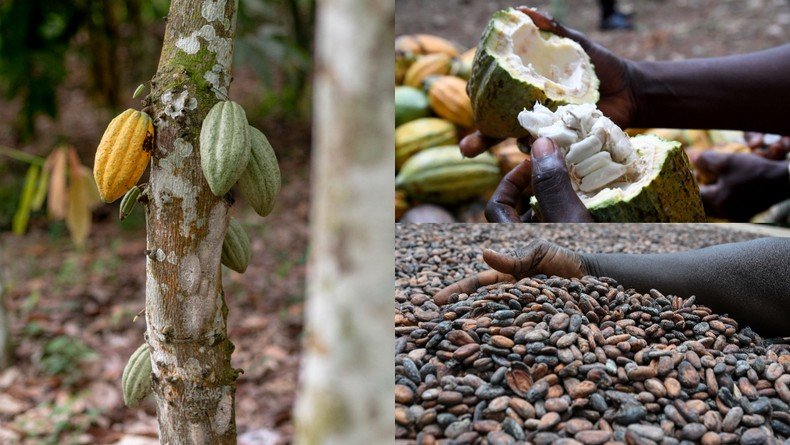
Reuters reported that officials in the Ivory Coast revealed that policymakers are reviewing “all options” amid a sharp decline in global cocoa prices. The review comes after Ghana cut its farmgate price by 28.6 percent for the remainder of the 2025 to 2026 main crop season in an effort to adjust to falling international prices.
The farmgate price determines how much farmers earn immediately after harvest, before exporters, processors, or traders add value. Any reduction would directly affect millions of smallholder growers across West Africa, where cocoa exports remain a major source of foreign exchange.
The two countries, which together account for roughly 60 percent of global cocoa supply, have been coordinating closely through the Ivory Coast–Ghana Cocoa Initiative. One senior Ivorian official said discussions were advancing and that “courageous and realistic decisions will be taken soon”.
Pressure has intensified as cocoa futures on the ICE exchange recently fell to their lowest level in two and a half years. The downturn has been driven partly by concerns over unsold cocoa stocks in both countries, leaving governments with limited room to maintain previously high farmgate prices.
“We must think about the survival of the cocoa sector in Ivory Coast,” a second official said, indicating that policy adjustments are already under way.
An inter-ministerial committee has reportedly met to review the situation, though the government has yet to issue an official statement.
Industry leaders say coordination between regulators remains active. Alex Assanvo, executive secretary of the ICCIG, noted that trading teams at the Coffee and Cocoa Council and COCOBOD are in regular contact as the market volatility persists.
Assanvo also defended the Living Income Differential, introduced in 2019 to boost farmer earnings, arguing that recent price swings highlight the importance of stronger stabilisation tools.
Exporters in Abidjan increasingly expect a price adjustment from the Ivory Coast, with one industry executive saying the key question is “no longer if but when”.
For global chocolate manufacturers and investors, the potential move underscores a deepening structural challenge in the cocoa market, one that could reshape supply dynamics across Africa’s most important agricultural export sector.


