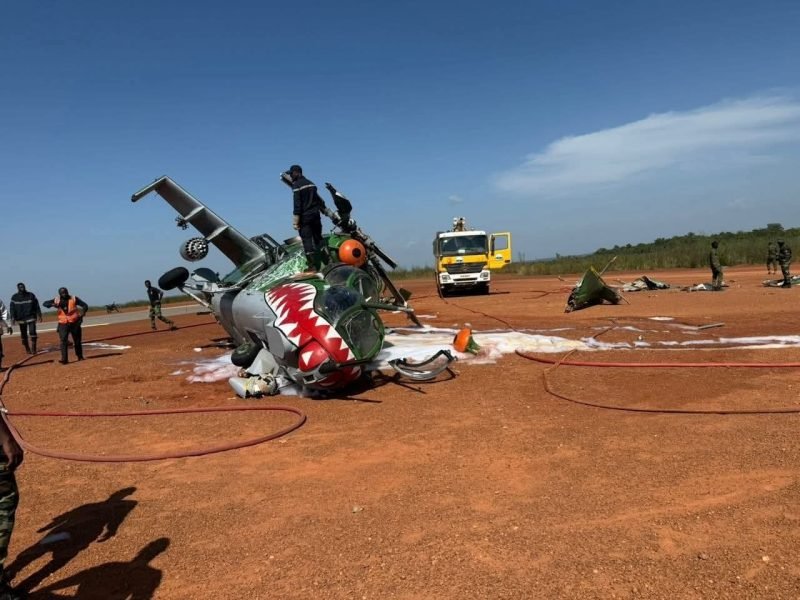
The troubled attack helicopter fleet of the Force Aérienne de la Côte d’Ivoire (FACI, Ivory Coast Air Force) has suffered another serious blow. On Monday, October 27, 2025, an Mi-24D Hind helicopter performed an emergency landing at Korhogo airport in the country’s north. While the crew escaped without injury, the incident has effectively neutralized a critical national security asset and exposed the unsustainability of the small fleet.
According to an official statement from the Ivorian Ministry of Defence, the helicopter experienced a “technical breakdown at takeoff” around 1:00 p.m. local time. The aircraft, which had just entered its ascent, was forced down onto the runway. Photos from the scene show the helicopter lying on its side with substantial damage, including a detached tail boom. The air force command immediately dispatched a technical team to secure the site and begin an investigation to determine the exact cause of the failure.


The location of the incident is as relevant as the crash itself. Korhogo is the main forward operating base for FACI air assets conducting counter-insurgency (COIN) and border security missions in northern Ivory Coast. The region faces a persistent threat from Islamist militant groups, including affiliates of Jama’at Nasr al-Islam wal Muslimin (JNIM), spilling over from neighbouring Mali and Burkina Faso.
These operations place a heavy and continuous demand on the air force’s limited assets. The Mi-24 Hind, a rugged and heavily armed gunship, is the FACI’s only dedicated attack helicopter. It provides essential armed reconnaissance and close air support for Ivorian ground forces deployed to secure the border. The high operational tempo required for this mission puts immense stress on airframes, engines, and crews. This latest mishap removes a key asset from that fight, creating a capability gap at a critical time.
A Troubled History of Attrition
This incident is not an isolated event; it is the latest in a long series of devastating losses that have plagued the FACI’s Hind fleet. The Ivorian Mi-24 force has been trapped in a cycle of acquisition, attrition, and replacement for nearly a decade, suggesting deep, systemic issues with maintenance, training, or the viability of the airframes themselves.
The modern fleet’s story begins in 2017, when the Ivory Coast received three refurbished ex-Bulgarian Mi-24D helicopters to bolster its COIN capabilities. This small force almost immediately began to shrink.
The first loss occurred in 27 November 2019, when an Mi-24D serial TU-VHR was destroyed after a collision between the helicopter and an Mi-17 serial TU-VHM that was parked on the ground at Katiola (Ivory Coast). A March 18, 2020, crash followed, when an Mi-24D (serial TU-VHO) crashed at Felix Houphouet Boigny airport in Abidjan. The Mi-24 helicopter was operated by the Escadrille de Chasse (attack squadron) based at Base Aérienne de Abidjan/Port Bouet.
In response, the Ivorian government acquired two more Mi-24 helicopters as attrition replacements in September 2020. These aircraft were also understood to be refurbished, Soviet-era models, delivered via a Ukrainian Il-76 transport. This briefly restored the fleet to two aircraft.
That new fleet was halved just one year later. In September 2021, an Mi-24 crashed during a reconnaissance mission near the northern border, killing all five people on board. That fatal crash left the FACI with a total active fleet of one Mi-24 Hind. It is this last remaining helicopter that is believed to have crashed in Korhogo on Monday. If confirmed, the FACI’s entire Hind fleet has now been lost to attrition.
The Hind-D: A Capable but Demanding Platform
For the semi-technical analyst, the specific variant involved, the Mi-24D (NATO reporting name: Hind-D), is telling. This is the classic 1970s-era gunship, recognisable by its tandem “double-bubble” cockpit for the weapon systems officer (front) and pilot (rear). It is a formidable machine, armoured against small-arms fire and armed with a 12.7mm Yak-B Gatling gun in a chin turret, 57mm S-5 rocket pods, and potentially anti-tank guided missiles.
However, the Hind-D is also a complex, maintenance-heavy aircraft from a previous generation. The airframes obtained by Ivory Coast were all second-hand, ex-Warsaw Pact machines, meaning they already had decades of flight hours and material fatigue before arriving.
Operating such vintage hardware presents substantial logistical challenges. Sourcing spare parts for Soviet-era systems is a notoriously difficult process, one complicated further by the war in Ukraine, which has disrupted supply chains from both Russia and Ukraine. Without a robust supply of spares and highly specialised technicians, keeping these complex helicopters airworthy under a high op-tempo is nearly impossible.
This pattern of crashes points away from isolated pilot error and toward a systemic failure. The chain of events suggests a combination of ageing airframes, a critical shortage of spare parts, and perhaps insufficient flight hours for crews to maintain proficiency in handling emergencies. When a fleet is reduced to one or two aircraft, pilots cannot fly often enough, maintenance crews are overworked, and the entire system becomes brittle.
The Ivorian Ministry of Defence investigation will determine the immediate cause of the Korhogo crash. The broader strategic question, however, is what comes next. The FACI has demonstrated a clear and present need for an armed helicopter. It must now decide whether to procure more ageing, refurbished Hinds or finally invest in a more modern, sustainable, and supportable platform better suited for its vital counter-insurgency mission.
Russian Response to Frequent Helicopter Crashes
In response to the frequent helicopter crashes in Africa, Russia in 2024 explained that cannot be solely blamed on the helicopters themselves. Unauthorised MRO, subpar parts, and training gaps are the potential culprits. By adopting stricter maintenance procedures, using genuine parts, and investing in proper pilot training, African operators can improve safety and ensure the continued effectiveness of their helicopter fleets, Russia says.