

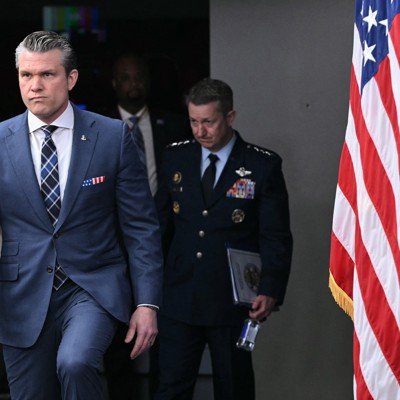
The Pentagon’s $200 billion request to cover the costs of the Iran war will reimburse what the Defense Department has already spent and what is ahead, Defense Secretary Pete Hegseth said Friday as a third week of strikes drew to a close.
That includes replenishing munitions, which have been expended by the thousands since strikes began Feb. 28.
“Obviously, it takes money to kill bad guys,” Hegseth said during a Pentagon press briefing. “So we’re going back to Congress and our folks there to ensure that we’re properly funded for what’s been done, for what we may have to do in the future, ensure that our ammunition is—everything’s refilled.”
Among the weapons that need replacing are 5,000-pound penetrator bombs dropped on underground facilities that housed Iranian cruise missiles, Gen. Dan Caine, chairman of the Joint Chiefs of Staff, said during his remarks.
There have also been “precision strikes against more than 90 targets on Kharg Island, which included all of their military-only infrastructure, which included air defenses, naval base, mine storage and deployment facilities,” Caine said.
Hegseth began his fifth briefing of the war with a different tone: for the first time, he led by mentioning U.S. troops killed in action.
“What I heard through tears, through hugs, through strength and through unbreakable resolve was the same from family after family: they said, ‘Finish this. Honor their sacrifice. Do not waver. Do not stop until the job is done,’ ” he said of Thursday’s dignified transfer of six airmen killed in the March 2 crash of their KC-135 Stratotanker.
Hegseth then turned his attention sharply to the media, calling them “dishonest and anti-Trump,” accusing “our press” of reporting on AI-generated video falsely purporting to show the aftermath of a drone strike on the aircraft carrier Abraham Lincoln. But the White House already acknowledged Monday that credulous coverage of that video came from foreign outlets.
They “will stop at nothing, we know this at this point, to downplay progress, amplify every cost and call into question every step,” Hegseth said of the American media.
“To the patriotic members of the press, nobody can deliver perfection in wartime. This building knows that more than anyone,” he said. “But report the reality: we’re winning decisively and on our terms.”
He then turned his ire to U.S. allies who have refused to send forces to the Persian Gulf—for example, European leaders who have noted that Trump launched the war without consulting them, after threatening to seize European-controlled territory, and without apparent consideration for the ways it might bolster Russia’s war on European soil.
“The world, the Middle East, our ungrateful allies in Europe, even segments of our own press, should be saying one thing to President Trump: ‘Thank you,” the defense secretary said.
Asked how the U.S. intended to fully denuclearize Iran without a protracted conflict, Hegseth dodged, reiterating talking points about a “conventional umbrella” of non-nuclear weapons meant to defend Iran’s development of a nuclear weapon, as well as delays in the negotiating of a new nuclear deal.
When asked whether Israel’s targeting of Iranian oil facilities was counter to U.S. objectives to focus on military targets, the secretary dodged again.
“We have allies pursuing objectives as well, and the truth speaks for itself,” he said. “We can hold anything at issue, anything—the United States military controls the fate of that country. Iran has the ability to make the right choices.”


