


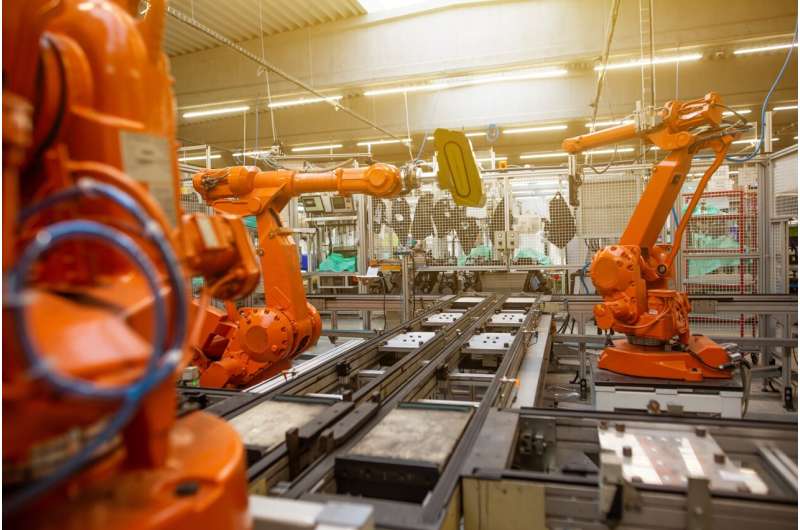
The robots were taking our jobs—or so we were told over a decade ago. The same warnings are regularly heard today about the likely impact of artificial intelligence (AI).


Tech breakthroughs have long stirred fears of workplaces being wiped out by automation, with generative AI platforms such as ChatGPT inspiring the latest round of occupational angst.
We often see this dread of AI replacing our livelihoods in news articles reporting on new worker survey findings, or in online forums talking of AI “job massacres.”
A similar gloom pervaded earlier research speculating about the future impact of automation and an impending robot apocalypse.
At Oxford University, researchers Carl Benedikt Frey and Michael Osborne warned in 2013 that 47% of US jobs were at high risk of automation “perhaps in a decade or two.”
Soon after, the New Zealand Institute of Economic Research estimated some 50% of New Zealand jobs might also be vulnerable.
The media amplified such warnings with alarming headlines such as “You Will Lose Your Job to a Robot—and Sooner Than You Think.”
In 2017, Nobel Prize winner Daron Acemoglu and Pascual Restrepo provided the first concrete evidence that robots had begun displacing jobs and lowering wages in the US economy.
Their findings sparked a global wave of research, as hundreds of scholars began analyzing various datasets in search of further proof.
The robo-revolution that wasn’t
More than a decade on from these forecasts first appearing, was the gloom ever justified? Did this threat to our jobs and wages really play out?
To answer these questions, my colleagues and I carried out a meta-analysis synthesizing the results of dozens of academic papers published since Acemoglu and Restrepo’s landmark 2017 study.
Rather than relying on a single dataset, country or time period, we reviewed 52 studies from around the world, covering a total of 2,586 individual estimates of how robots and automation affect wages.
Across the 52 studies reviewed, we found no strong evidence that robots have a consistent impact on wages—either positive or negative.
Some studies reported wage declines, others found increases, but on average, the effect was close to zero. In fact, the estimated overall impact was so small that it fell below even the minimal threshold for economic significance.
While robots might affect wages in specific industries and countries, or among certain groups of workers, we found little global evidence to support the idea that automation is consistently driving wages up or down.
An earlier University of Canterbury-led meta-analysis found similar results when examining the impact of robots on employment.
While those initial findings by Acemoglu and Restrepo showed robots reduced employment, much of the research since has shown no overall negative effect.
Two other meta-analyses, led by researchers in Italy and Germany, also turned up scant consistent evidence for widespread, robot-driven cuts to jobs and wages.
Focus on opportunity, not anxiety
Despite these findings, we still can’t say there have been no losers—or winners—amid the rise of automation.
Indeed, some job types, such as those performing routine cognitive or physical tasks, have diminished in importance because of robots, while others, such as those requiring creativity, have become increasingly vital.
Our research suggests that upskilling and learning how to collaborate effectively with robots—and AI—is the right strategy for staying competitive in today’s labor markets.
Entrepreneurs and managers should also focus on adapting to and capitalizing on the new opportunities that automation creates.
After all, technology advances one company death at a time.
Finally, for policymakers, our research calls for a shift away from panic-driven regulation aimed at slowing automation, and toward supporting workers in gaining those human skills that automation makes more valuable.
The Conversation
This article is republished from The Conversation under a Creative Commons license. Read the original article.
Citation:
Is AI really coming for our jobs and wages? Past predictions of a ‘robot apocalypse’ offer some clues (2025, November 10)
retrieved 10 November 2025
from https://techxplore.com/news/2025-11-ai-jobs-wages-robot-apocalypse.html
This document is subject to copyright. Apart from any fair dealing for the purpose of private study or research, no
part may be reproduced without the written permission. The content is provided for information purposes only.


