



 Download this post…
Boom asks, “Is it possible that the creators of so-called Agentic AI are actually designing a machine that will take advantage of those 65 % – 92 % of humans who are more susceptible to adopting a Agentic State when put under stress?” When AI barks orders over the best judgment of the subjects, especially when AI Agents are used, then the subjects risk entering into the Agentic State. This shifts the formerly autonomous person into blind obedience, willing to do any evil or stupid act that is suggested. ⁃ Patrick Wood, Editor.
You may have heard the term “Agentic Artificial Intelligence”. It is being called the “Next Big Thing” — the supposed pathway to a technological Utopia in the future. Billions of Dollars are being raised and expended on its development and on massive data centres that use enormous resources.
However, beware, dreams of Utopia are often used, either intentionally or unknowingly, by psychopaths seeking power over people.
A cursory glance at history on Earth reveals that psychopaths often use extreme political or religious ideologies to achieve that power. The force of their convictions is always presented as being “for the Greater Good”. Psychopathic leaders prefer to operate in a period of great stress. These are the major, recurrent themes of human history over thousands of years.
Think of …. Pol Pot, Himmler/Hitler/Goebbels/Mengele, Stalin, Genghis Khan, Vlad the Impaler, the Emperors of Rome, Ivan the Terrible, Atilla the Hun, Robespierre, Marx/Lenin, the Pharaohs of Egypt, the Aztecs. There are many others. All are examples of rather nasty people who worked hard to achieve positions of great power and who demonstrated no empathy or compassion for their victims, the typical behaviour of psychopaths.
The words “Agentic” and Autonomous” are often mistakenly used inter-changeably by some “expert” articles. This is deeply mis-leading. These two words must be well understood to grasp exactly what Artificial Intelligence is all about. They must NEVER be used interchangeably. You need to understand why this distinction is so important to you and your future.
So ……
As always, the story is a little complex but relatively easy to understand. If you do an Internet search for the word “Agentic” on any Search engine, you are likely to see this definition —
The word “agentic” is derived from the noun “agent,” which means “one that exerts power” or “something that can produce an effect”. Combined with the adjective suffix “-ic”, it becomes an adjective — Agentic — where it refers to the ability to act independently and achieve outcomes.
The phrase “it refers to the ability to act independently” seems to sum it up. It sounds helpful, innocent, hopeful. However, the story is not as simple as that.
Agentic can have a much more sinister meaning if you know about its use in Psychological tests.
In this context, “Agentic” means AGENCY — becoming an agent — think of a real estate agent acting for the owner of a property. He/She follows instructions.

Think about that — Milgram described situations where human beings can be placed under great stress and then induced to SURRENDER their principals and values.
Milgram’s obedience experiments were conducted at Yale University in 1961 and were designed to force people to make decisions under stress. In these experiments, participants were advised to follow instructions from an Authority figure to administer increasing electric shocks to another person, believing they weren’t personally responsible for their actions. The Authority was usually a person in a white coat with a clip board and supposed backing from a famous University.
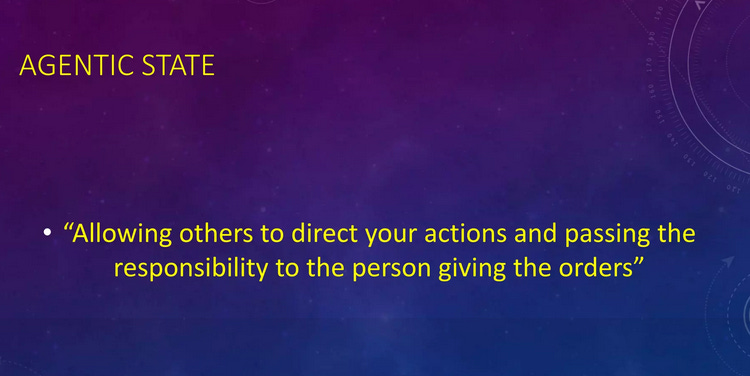
The experiments demonstrated how individuals could enter an AGENTIC STATE (agency) and thereby defer responsibility for their actions to a perceived authority. In the experiments, 65 % – 92 % of the people being studied gave a maximum electric shock to another person when instructed to do so by the Authority figure. Remember those numbers — they are stunning.
These were the questions that Milgram sought to answer in the experiments on unwitting members of the general public.
- Could seemingly normal individuals be compelled to inflict pain on another person simply by an authority figure’s command?
- How powerful is the social pressure to obey within a structured environment?
- What factors might influence the level of obedience or defiance in such a scenario?
The participants were found through advertisements and were told the study was about “memory and learning” at Yale University, and they were paid a small fee for their participation, regardless of whether they completed the experiment.
- Participants were diverse in occupation and education.
- The stated purpose was a scientific study of memory.
- Volunteers were paid a nominal sum upon arrival.

The centrepiece of the Milgram Experiment was the impressive-looking “shock generator.” This device featured a row of 30 switches, clearly labelled with increasing voltage levels, from 15 volts (“Slight Shock”) up to 450 volts (“XXX”). Despite its realistic appearance, the machine produced no actual shocks. The participant from the general public was given a sample 45-volt shock at the beginning to reinforce the illusion of authenticity. The person being “shocked” was an actor.
The actor’s responses were critical to the experiment’s impact. As the “shocks” increased, the actor’s reactions escalated:
- At 75 volts, the actor would grunt.
- At 120 volts, the actor would complain loudly.
- At 150 volts, the actor would demand to be released from the experiment.
- At 300 volts, he would refuse to answer any more questions.
- Beyond 330 volts, up to 450 volts, the “very strong shock”, the actor would fall silent, implying unconsciousness or worse.
As the experiment proceeded to higher “shocks”, the Authority figure would encourage the unknowing participant to continue with firm, calm, and authoritative statements:
- “Please continue.” or “Please go on.”
- “The experiment requires that you continue.”
- “It is absolutely essential that you continue.”
- “You have no other choice, you must go on.”
If the participant refused to continue after the fourth statement, the experiment was terminated.
- Many participants showed visible signs of tension, including sweating, trembling, stuttering, groaning, and nervous laughter.
- Some participants argued vehemently with the experimenter, protesting the learner’s perceived suffering and expressing their desire to stop.
- Despite their distress and verbal protests, a striking number of participants continued to administer shocks, often with great reluctance and emotional turmoil.
- Post-experiment debriefings revealed that participants were often relieved and even physically embraced the “learner” upon discovering the deception, indicating the immense psychological burden they carried during the experiment.
Milgram proposed the idea of an “agentic state” to explain why individuals might act against their own conscience when under the command of an authority figure. He distinguished this from an “autonomous state”:
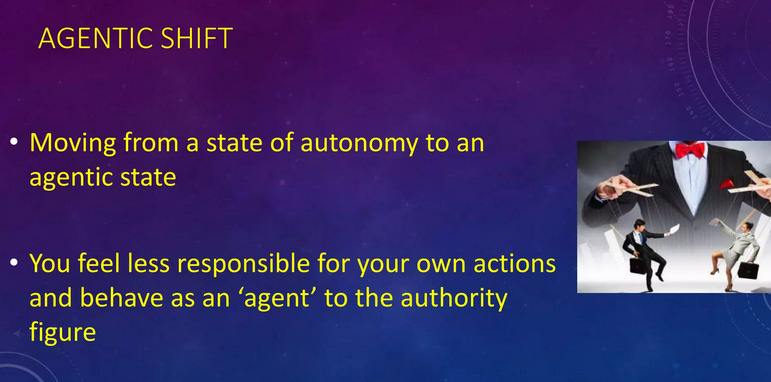
- Autonomous State: In this state, individuals perceive themselves as responsible for their own actions and act according to their own principles and values. They feel a sense of personal control and accountability.
- Agentic State: Milgram suggested that in certain situations, individuals shift into an agentic state. Here, they see themselves as merely agents or instruments carrying out the wishes of an authority figure. Responsibility for their actions is transferred to the authority, alleviating personal moral strain. The focus shifts from the morality of the act to the success of following orders.
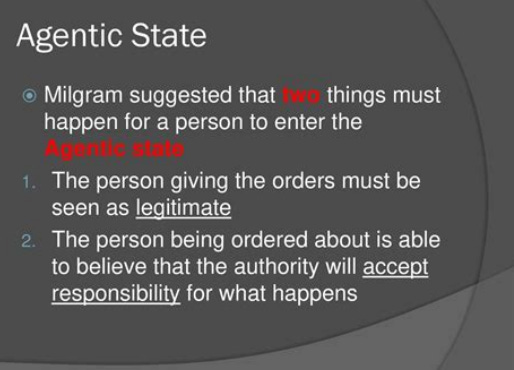
The transition to an agentic state, according to Milgram, is a survival mechanism. In many social structures, obeying legitimate authority is beneficial and necessary for societal function. However, the experiment revealed the potential for this mechanism to lead to destructive outcomes when authority figures command harmful actions in a state of induced stress.
Such a goal may be deliberately purposeful or it may be an innocent happenstance. However, BOOM prefers to examine closely the first possibility because that appears inherently evil.
The alternative explanation is that the promoters of “Agentic AI” are really aiming to create an “Autonomous AI” but have simply mis-labelled the project. BOOM thinks that is unlikely.
References: The Milgram Experiment: Unpacking the Shocking Truth About Obedience https://psychotricks.com/milgram-experiment/
And: https://psychotricks.com/all-articles/
Read full story here…


