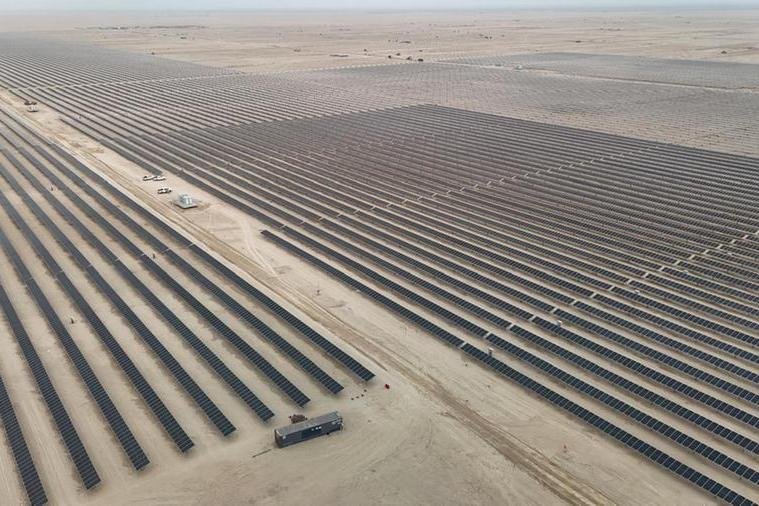
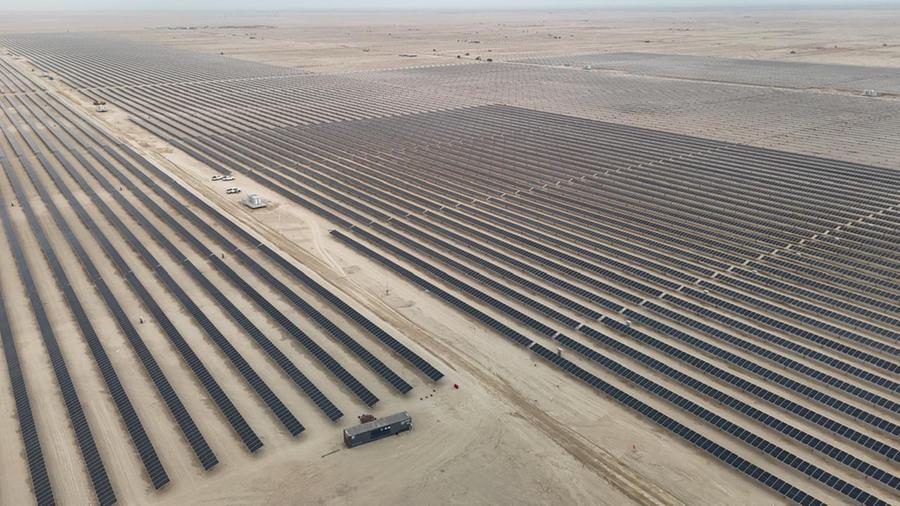
Unit 1 of the Al-Ratawi photovoltaic project in southern Iraq has achieved full-capacity grid connection and power generation as work progresses on the 1.25-gigawatt (GW) solar scheme being developed under the country’s Gas Growth Integrated Project (GGIP).
China Energy Engineering Corporation (Energy China), which leads the Engineering, Procurement and Construction (EPC) consortium, said last week the first of the project’s four units has achieved grid connection and power generation.
In a separate statement, Iraq’s Ministry of Electricity confirmed that output is being increased gradually. The first unit began generation at about 61 megawatts (MW) and will be ramped up sequentially until reaching its full capacity of 250 MW, after which it will be connected to the national grid through the New Rumaila and Suq al-Shuyukh transmission lines, the ministry said.
Construction of the solar PV power plant, located near the Ratawi field in Basra, began in the first quarter of 2025.
Part of mult-billion-dollar GGIP
The solar power project is being developed by France’s TotalEnergies and Qatar’s QatarEnergy in partnership with Iraq’s Ministry of Oil as part of the $10 billion Gas Growth Integrated Project (GGIP).
QatarEnergy holds a 50 percent stake in the solar project, with TotalEnergies owning the remaining 50 percent.
The EPC consortium includes Tianjin Electric Power Construction Co. and Southwest Electric Power Design Institute Co., with the engineering, procurement and construction contract signed in October 2024.
The project has been divided into four units to match the capacity of the local transmission network, according to TotalEnergies.
Two million panels planned
The solar facility will include about two million bifacial photovoltaic panels mounted on single-axis trackers over an area of roughly 9 square kilometres.
Once completed, the plant is expected to generate enough electricity to supply about 350,000 homes and reduce carbon dioxide emissions by around 2 million tonnes per year.
Testing, inspection and certification firm Bureau Veritas is the owner’s engineer for the project.
The project forms support’s Iraq’s plan to increase renewable energy capacity and meet about 12 percent of its electricity demand from renewables by 2027, while reducing reliance on imported fuel for power generation.
(Writing by N Saeed; Editing by Anoop Menon)
(anoop.menon@lseg.com)
Subscribe to our Projects’ PULSE newsletter that brings you trustworthy news, updates and insights on project activities, developments, and partnerships across sectors in the Middle East and Africa