

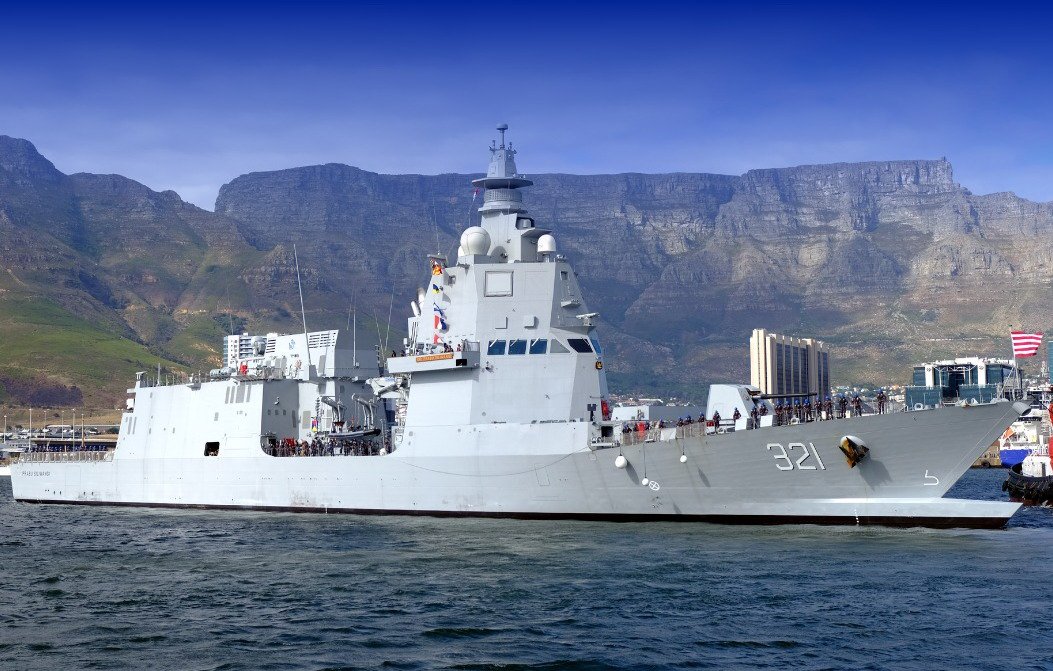
On 4 March, the Indonesian Navy’s newest frigate, KRI Prabu Siliwangi (321), docked in Cape Town harbour in the first visit by Indonesian warship in three decades, marking a key stop on its voyage home from Italy to Surabaya Naval Base after commissioning in December 2025.
The vessel arrived in Cape Town from Lagos in Nigeria. Warships don’t normally get to wait off port limits for a berth, and she immediately entered Cape Town harbour, proceeding into the Duncan Dock, and was berthed on the Eastern Mole, away from easy public gaze. For a maiden visit, in more senses than one, the welcome mat laid out by the South African Navy was not very much in evidence.
Ordered back in 2014, her keel was laid down in April 2021, and she was launched in October 2023. She was ordered by the Italian Navy, originally named ‘Ruggiero di Lauria (P435)’, and was the sixth of a class of seven, up to now, what are described as light patrol frigates or offshore patrol vessels (OPV), known as the ‘Thaon di Revel’ class. However, in March 2024 it was agreed that the Indonesian Navy would take over two of the newbuilds, as part of a wider purchase agreement, to ensure that they would get delivery sooner, and the Italian Navy would order two more to replace them.
She was renamed KRI Prabu Siliwangi in January 2025 by the Tentara Nasional Indonesia Angkatan Laut, better known in English as the Indonesian National Military Sea Force, or simply as the Indonesian Navy, and commissioned in December 2025. For the nomenclature aficionado, KRI is an acronym for Kapal Perang Republik Indonesia, which translates as Naval Vessel of Indonesia, and is the equivalent of the naval acronyms of SAS, HMS, or USS. Her pennant number 321 is based on the Indonesian Navy numbering protocol that all frigates or corvettes have ‘3’ assigned to the start of their pennant number.

Photo: Fincantieri
Also, for the nomenclature aficionado, all Indonesian Navy frigates and corvettes receive names that represent Indonesian National Heroes, Naval Heroes, or National Historical Figures. In this case, KRI Pradu Siliwangi is named after King Siliwangi, who was a dynastic and legendary King of the Sunda Kingdom, lying in the west of the Island of Java in Indonesia, and who ruled before the Islamification of Indonesia. The motto of KRI Pradu Siliwangi is “Palastra Sangkan Kadigjayaan”, which is Javanese Sanskrit for “The Way to Achieve Greatness”.
Built by the Fincantieri SpA shipyard at Muggiano in Italy, KRI Prabu Siliwangi was purchased by the Indonesian Government, along with a sistership named KRI Brawijaya (320), for a combined total of €1.18 billion (R22.33 billion), with both vessels now known as belonging to the ‘Brawijaya’ class, and both assigned to the Second Fleet Command of the Indonesian Navy, and to be based at the Surabaya Naval Base in Eastern Java. Her versatile design, together with a high level of modularity, and a high degree of automation, allows for multiple deployment functions, such as coastal patrol, air sea rescue, civil protection and her primary design function of frontline naval assault.

Photo: Fincantier
Finally, she was ready to depart from the Italian Naval Base at La Spezia, and on 11 February 2026 she departed for her long voyage home to Indonesia, sailing under the command of Colonel Kurniawan Koes Atmadja. Making her first courtesy call at Casablanca in Morocco, arriving on 13 February, and departing on 17 February for her next courtesy call en-route home. She duly arrived at Lagos in Nigeria on 24 February, and departed there on 27 February, now for her courtesy call at Cape Town, which would not only be a maiden call for KRI Prabu Siliwangi, but a maiden call for a warship of the Indonesian Navy.
She is 143 metres in length, with a beam of 16.5 metres, and a displacement tonnage of 6 270 tons. Her propulsion drivetrain system is Combined Diesel and Gas (CODAG), with KRI Prabu Siliwangi being fitted with a single General Electric (GE)-Avio LM2500+G4 gas turbine engine producing 43,000 bhp (32,000 kW), and her diesel propulsion being provided by two MTU 20V8000-M91L twenty cylinder, four stroke, main engines producing 13,000 bhp (10,000 kW) each.
She has two controllable pitch propellers, and as a CODAG warship, KRI Prabu Siliwangi has many options for propulsion when out at sea. She is able to achieve a service speed of 27 knots when operating solely with her gas turbine engine. When operating with both of her diesel engines she can maintain a sea speed of 25 knots, and when operating by using just one of her two diesel engines she is able to maintain a sea speed of 18 knots.
She also has two, reversible, electric motors, each producing 1,350 kW, which can be utilised for propulsion, which is a novel aspect of her design, and allows her to maintain a sea speed of 10 knots when operating solely on her electric motors. Her auxiliary machinery includes four MAN 12V175D-MEM generators, which provide 1,640 kW each, and two emergency generators. For added manoeuvrability she is fitted with a bow transverse thruster.
As a small frigate, KRI Prabu Siliwangi has the potential to be well armed. She was purchased in light armament configuration, with the expectation that she will be upgraded to full configuration once she arrives at her home base in Indonesia. In her light armed condition, her traditional weaponry includes her main armament, which is a single Oto-Melara 127mm rapid fire gun, mounted forward. She also has a single Oto-Melara 76mm anti-aircraft gun, mounted aft, and is fitted with two Oto-Melara 25 mm autocannons, one mounted on the port side, and one mounted on the starboard side.

Photo: Fincantieri
She is fitted with two, eight-cell, DCNS Sylver surface to air, vertically launched, missile systems, located forward, directly behind the main gun. On her return to Indonesia it is expected that she will be retrofitted with surface to surface missile launchers, placed amidships, as well as torpedo launchers. She is fitted with two Oto-Melara ODLS-20 decoy launchers, and a stern launched Leonardo-Finmeccanica active towed sonar array, and is fitted with a hull mounted diver detection sonar.
With a helideck measuring 25.5 metres by 16.5 metres, KRI Prabu Siliwangi is capable of operating with either a single Agusta-Westland AW101 Merlin helicopter, or two Airbus AS565 Panther helicopters, which can be accommodated in a double hangar. Her sonar stern ramp can also hold a single 11 metre rigid hulled inflatable boat (RHIB), used for boarding purposes, as well as being fitted with two amidships davits holding a further two 11 metre RHIBS.
As expected, with her comprehensive fit of both weapons, KRI Prabu Siliwangi is fitted with a full suite of sensors, radar systems, tracking systems, fire control systems, electronic countermeasure systems, and both passive and active warning systems. For deck support, and loading of mission specific containers, she is also fitted with an amidships Pellegrini knuckleboom deck crane, with a lifting capacity of 20 tons.
She has an operating range of 5,000 nautical miles, and her normal operating crew is 90 officers, petty officers and ratings, although she has sufficient accommodation for a maximum of 173 persons. The additional crewing requirements are based on her carrying a full aviation detachment of pilots, observers, and maintenance engineers, and any operational needs to carry a naval force of marines.
Shortly after coming alongside in Cape Town, an unusual operation took place when four divers from the South African Navy arrived, and entered the water to conduct an underwater hull inspection, around the stern of KRI Prabu Siliwangi.
The Commander of the KRI Prabu Siliwangi, Colonel Kurniawan Koes Atmadja, along with the ship’s officers, accompanied by the Indonesian Defence Attaché in Pretoria, Marine Colonel Guntur Alamsyih, paid a courtesy call to the SA Navy’s Flag Officer Fleet in Simon’s Town Naval Base, where they were received by Rear Admiral Handsome Thamsanqa Matsane.
Her crew were all taken on the mandatory coach tours of the Cape Peninsula, and after a three day rest and recuperation (R&R) period alongside, and with all logistic requirements completed, she was ready to continue homeward on her maiden voyage.
At 09:00 on the morning of 7 March, KRI Prabu Siliwangi sailed from Cape Town, and as with most warships, she gave no indication of where she was bound next. However, she rounded the Cape at a steady speed of 20 knots, and coasted out in the direction of Reunion and Mauritius, one of which is likely to be her next courtesy call whilst heading home, which is in line with her schedule that showed her arrival in Indonesia is expected to be early April.
As it turned out, Port Louis in Mauritius was to be her next courtesy call with the ship arriving there at 08:00 on the morning of Thursday 12 March.
Sadly, her sistership KRI Brawijaya did not pay a visit to South Africa. She had departed from the Italian Naval Base at La Spezia back in late July 2025, and arrived back at her operating base in Surabaya in Indonesia in early September. Interestingly, despite regional tensions, her voyage home was made via the Suez Canal and the Red Sea, with courtesy port calls made in Turkey, Egypt, Saudi Arabia, United Aran Emirates and Sri Lanka, prior to her first home calls made at both Lampung on the island of Sumatra, and the Indonesian Capital city of Djakarta, on the island of Java.
Written by Jay Gates for Africa Ports & Ships, with additions by DefenceWeb. Republished with permission – the original article can be found here.


