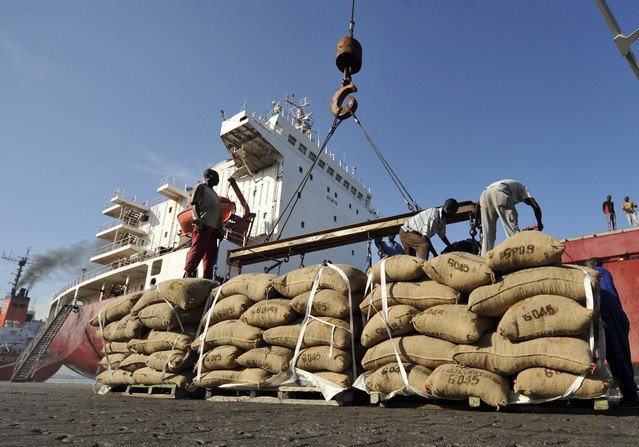
This week, Ghanaian President John Dramani Mahama convened an emergency Cabinet meeting to tackle growing challenges in the cocoa sector, including delayed payments to farmers, liquidity issues at the Ghana Cocoa Board (COCOBOD), and sharply declining harvests.
For decades, Ghana has ranked just behind Côte d’Ivoire, Africa’s top producer, and has held the position of the world’s second-largest cocoa supplier.
The crop supports more than 800,000 farming households and remains a vital source of foreign exchange for the country.


Falling production deepens crisis
Output has dropped sharply in recent seasons. In June 2025, the Ghana Cocoa Board (COCOBOD), the government agency responsible for regulating the country’s cocoa sector and supporting farmers, signalled that Ghana would likely miss its production target for the 2024/2025 season.
After lowering its forecast from 650,000 tonnes to 617,500 tonnes in December 2024, the regulator said harvests would likely not exceed 600,000 tonnes.
“I don’t think that much will change, looking at the time we have to end the crop season,” COCOBOD Managing Director Randy Abbey said on June 10, 2025, noting that 590,000 tonnes had already been collected with three months remaining.
More recently, addressing a press conference at Cocoa House in Accra on Friday, February 6, 2026, Abbey revealed that although COCOBOD has sold more than 530,000 tonnes of cocoa for the current season, about 50,000 tonnes remain unsold and still with farmers.
He attributed the situation to Ghana’s non-competitive farmgate price, which has made it difficult for buyers to absorb the excess cocoa.
“The situation is where we have beans, but they are not buying; the beans are too expensive,” Abbey said. He assured that efforts are underway to address delayed payments.
Consequently, the projected harvest is well below Ghana’s historical average of 800,000 tonnes and far from the more than 1 million tonnes recorded during the 2020/2021 bumper season.
COCOBOD cited aging plantations, the spread of Cocoa Swollen Shoot Virus Disease, illegal gold mining known locally as galamsey, smuggling, and climate-related weather disruptions as the main factors behind the decline.
Competitors are on the rise
Meanwhile, rival producers are steadily expanding, positioning themselves to challenge Ghana’s long-held global ranking.
Ecuador is leading the charge in South America, projected to produce more than 650,000 tonnes in the 2025/2026 season, with expectations of reaching 800,000 tonnes by the end of the decade.
Ecuadorian yields average about 800 kilograms per hectare, compared with less than 500 kilograms per hectare in West Africa, and farmers receive roughly 90% of the world market price, well above the 60–70% earned by farmers in Ghana and Côte d’Ivoire.
Across Southeast Asia, Indonesia, the world’s third-largest cocoa producer, is also on the rise. The country, which primarily cultivates Forastero beans with some Trinitario varieties, recorded 641,741 tonnes in 2023 and dominates the region’s cocoa market.
Exports reached $47 million that year, and global supply forecasts suggest Indonesian output could grow by roughly 30% to around 836,000 tonnes by 2026.
This growth is supported by government programs and private initiatives such as Cocoa Life, which aim to improve fermentation consistency and overall farm yields.
In West Africa, Nigeria, currently ranked fourth globally, has likewise signalled ambitions to increase production.
The country aims to raise output from about 340,000 tonnes to 500,000 tonnes, targeting roughly 6.5% of global supply.
While year-round irrigation and state support could boost production, structural challenges remain. Even so, Nigeria could still emerge as a credible contender to challenge Ghana’s position as the world’s second-largest cocoa producer.
Global market pressures
As of February 12, 2026, cocoa futures have corrected from the historic peaks of 2024 but remain elevated, trading around the mid‑$3,700s per tonne, according to global ICE cocoa futures prices.
In response to ongoing volatility, a United Nations Cocoa Conference on February 13, 2026, will inaugurate the new International Cocoa Agreement, aiming to promote sustainability and ensure price stability across the sector.
Ghana’s ability to maintain its second-place ranking will hinge on domestic reforms and how quickly it responds to rising competition from Ecuador, Indonesia, and Nigeria.