By Gabriela Inchauste and Mariel Siravegna
Nowadays, many aspects of daily life have gradually returned to pre-pandemic conditions. As the world adapted to a “new normal”, teleworking has emerged as a critical trend in the labor market, offering workers greater flexibility in managing their hours, remote work has become a valuable tool. The ability to work from home saves both time and money, bypassing fixed expenses like public transportation and avoiding time-consuming commutes. Moreover, telework allows employees the benefit of a better balance of work and family responsibilities, potentially increasing labor force participation, especially for women who often perform a larger share of unpaid household work.
In Mexico, the landscape of telecommuting changed significantly in December 2020 with the approval of new regulations that formalized remote work conditions and rights for the first time in the country. Our recent study – that examines how working from home affected men’s and women’s decision to work in Mexico during the COVID-19 pandemic – shows that while the increased flexibility of teleworking during the pandemic positively impacted the participation of skilled women in the workforce, family responsibilities continue to be a key factor in their decisions to join or remain in the labor force market. Without appropriate support, flexible work arrangements alone are insufficient to incentivize highly skilled women to participate in the workforce, particularly if they lack caregiving assistance. Our research findings challenge the belief that telecommuting can effectively reduce gender disparities in caregiving responsibilities and labor force participation.
Telework and labor supply decisions
Drawing on data from a national survey (ENDUTIH, 2020), we examine the association between telework and labor supply decisions. We look at whether people choose to stay outside the workforce, work in an office, or work from home, whether as employees or self-employed.
Our research underscores the significant potential of telework. The flexibility provided by telework can encourage educated women, especially those with a college degree, to remain in the workforce. While women with college degrees are significantly less likely to be out of the labor force than women without college degrees, one out of every five college-educated women was out of the labor force in Mexico in 2019. This is a significant loss not only for their households but also for the country as a whole, since it is falling short of its productive potential.
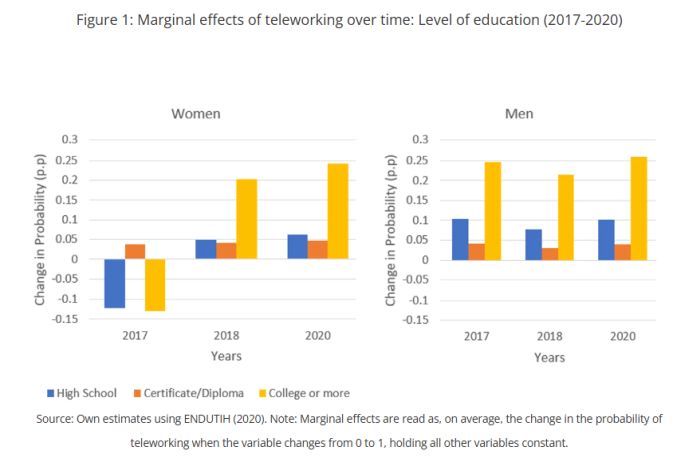

In 2020, the likelihood of telecommuting in Mexico was nearly 24 percentage points higher for women with a college degree than for those without the same level of education. Figures 1 and 2 show that the observed increase in salaried telework was more substantial for women with education and those without young children.
Supporting women’s participation in the workforce
Addressing women’s caregiving responsibilities is crucial to improving access to job opportunities. While telecommuting can lower the barriers to entering the workforce, it does not reduce the burden of caregiving that many women carry. Our research indicates that family circumstances significantly influence women’s decision to work. Well-crafted policies are essential to support women’s participation in the workforce. These policies should promote part-time and hybrid work options and, most importantly, provide comprehensive childcare and eldercare programs. Expanding access to affordable and quality care highlights the critical role of supportive policies in achieving gender equality.
Boosting women’s participation in the labor force is vital for economic progress. No country can achieve its full potential by excluding nearly 50 percent of its population from the workforce. The economic benefits of increasing women’s labor force participation are significant and should not be overlooked.