– Advertisement –
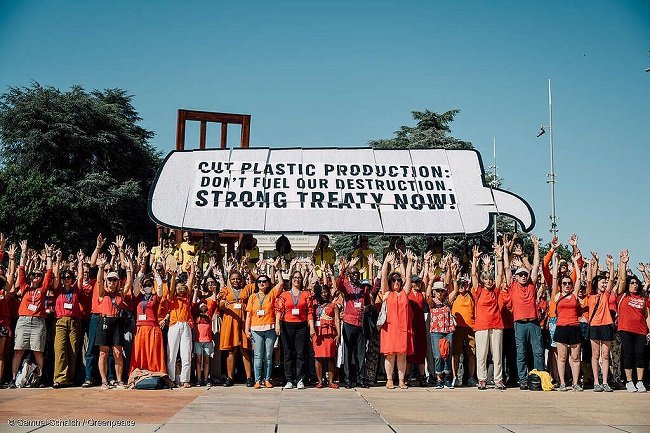
Four days into the final Global Plastics Treaty negotiations in Geneva, civil society organisations (CSOs) are bothered that the world is not on track to deliver a treaty that will protect people and nature.
They are therefore demanding a change, even as they join the voices of waste pickers, frontline communities, scientists, healthcare professionals, children and youth, women, businesses, and non-governmental organisations around the world to call on governments to step up.
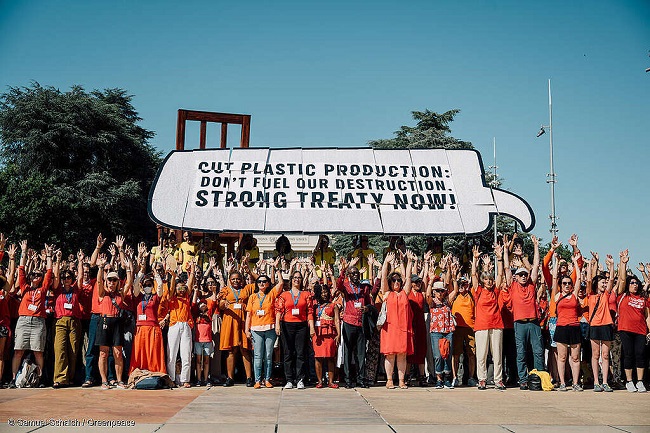
“Fix the process, keep your promise, and finalise a meaningful treaty to end plastic pollution,” they insist.
In a reaction to the current state of the Plastics Treaty negotiations, Break Free From Plastic Movement submitted: “People worldwide have made it clear: they support decisive action to cut plastic production, consumption, and pollution. A majority of governments have endorsed these demands, yet negotiations are stalling with a small group of petro- and plastic-producing states deploying delay tactics, with no sign that they intend to raise ambition.
“With just days remaining, the dynamic must change. Countries must keep their commitment to end plastic pollution. They must use every tool available to deliver a strong treaty – one that includes legally binding rules on production and chemicals, uplifts real solutions, safeguards human rights and protects frontline communities. There is no room left for compromise that weakens ambition. The world is watching.”
The Business Coalition for Global Plastics Treaty is bothered that, at the midpoint of INC-5.2, negotiations are running out of time, with no clear path to an agreement. It adds that the current approach is not delivering the progress needed to reach a meaningful outcome by the end of next week.
The group stated: “Governments committed to leaving Geneva with a strong treaty must act decisively. They must leverage all means available and support the INC Chair to establish an effective process. The time for incremental steps has passed.
”Governments must be bold, guided by the clear ask from the majority of countries, businesses, and civil society to deliver a robust agreement with harmonised regulations across the full lifecycle to address plastic pollution. The Business Coalition stands ready to support negotiators in achieving this outcome.”
“Plastic pollution is a global challenge, and global regulation is needed to effectively alleviate the situation. Harmonised regulations drive consistency across borders while supporting national ambitions and provide the lowest cost option to effectively address plastic pollution,” said Tove Andersen, CEO at TOMRA and Spokesperson for a Business Coalition for Global Plastics Treaty.
“At Borealis, we’ve long championed circularity. Through innovation and partnerships, we’ve shown that sustainable plastics solutions are possible. However, to scale these solutions globally, we need a level playing field,” said Stefan Doboczky, CEO at Borealis.
“We’re at a unique moment in time where business, civil society, and a majority of countries are calling for harmonised regulation on plastic pollution. The time to act is now,” stated Jodie Roussell, Global Public Affairs Lead, Packaging and Sustainability at Nestlé and Spokesperson for a Business Coalition for Global Plastics Treaty.
“Our economic analysis suggests that harmonised regulations could more than double global extended producer responsibility revenues to $576 billion, driving a scale up of collection and recycling,” noted Sabine Strnad, Global Lead Circular Economy and Packaging at Henkel and Spokesperson for a Business Coalition for Global Plastics Treaty.
“We want to scale solutions that tackle plastic pollution, and a treaty with harmonised regulations will make this easier for businesses to do,” said Ed Shepherd, Senior Global Sustainability Manager – Circular Economy at Unilever and Spokesperson for a Business Coalition for Global Plastics Treaty.
“Our economic analysis shows that harmonised regulations can drive stable job creation, with 2.3 million more jobs being created, particularly in waste management,” stressed Ali Golden, Director of Strategic Relationships at TerraCycle and Spokesperson for a Business Coalition for Global Plastics Treaty
“Our economic analysis shows that harmonised regulations on product design alone can create $50 billion per year in additional economic value for materials in the plastics recycling value chain,” said Rob Opsomer, Executive Lead Plastics & Finance, The Ellen MacArthur Foundation.
“Business supports a treaty with harmonised regulations because it drives regulatory consistency across borders while supporting national ambitions,” said Conrick Gallagher III, VP of Partnerships at Okeanos.
The Centre for International Environmental Law stated: “After three years of trying to work by consensus, the negotiations are now at a breaking point.
“What was meant to be a global effort to solve the plastics crisis has stalled. As in the climate space, it’s the countries least responsible for the problem that are fighting hardest for an ambitious treaty, we see some of the countries least responsible for the plastics crisis holding the line for ambition while producers are in a race to the bottom, with some even questioning whether the treaty is about plastic.
“This cannot continue. Member States must use every tool of multilateralism at their disposal and move forward with solutions that aren’t hostage to those defending the status quo.
“Anything less will fall short of the ambition promised in UNEA resolution 5/14 – and fail the people and planet this treaty was meant to protect.”
“The Global Plastics Treaty must enable a process for effective decision-making,” states Merrisa Naidoo, GAIA Africa Plastics Programme Manager. “To avoid earnest negotiations amounting to nothing, negotiators must demonstrate courage, not compromise by calling for a majority vote when consensus cannot be reached. If we continue to stall in consensus, we trade progress for paralysis.”
Rafael Eudes of Aliança Resíduo Zero Brasil states, “It is time to use decision-making tools that allow willing counties to move forward instead of letting a few run negotiations around in circles. A strong treaty with majority support beats a weak treaty that caters only to the few. Governments need to hear civil society’s urgent demand for ambition – the credibility of multilateralism and the planet’s future is on the line.”
Youth Plastic Action Network (YPAN) stated: “We are deeply concerned by the deadlock, the unwillingness to compromise, and the deliberate and malicious delays we are witnessing.
“Failing to reach an agreement at INC-5.2, failing to report back to UNEA, and failing to deliver on Resolution 5/14 is not just a procedural catastrophe. It is an acceptance that the deliberate actions to block a treaty today will have an intergenerational multiplier effect, undermining the health of present generations, degrading our shared ecosystems, and putting at risk the well-being of all future generations.
“Additionally, a failure at INC-5.2 would be yet another devastating blow to an already faltering multilateral order.
“We call upon all Member States to rise above individual interests, to demonstrate ambition, and to engage constructively in negotiations aimed at securing an outcome that advances the collective interest of all. For the sake of our futures, we need meaningful action now.”
Graham Forbes, Head of the Global Plastics Campaign for Greenpeace USA as well as the Greenpeace delegation for the treaty negotiations, commented: “In Busan and Nice, governments have shown ambition, which means reducing plastic production. A weak and effective treaty would be a betrayal that would further increase the burden on the countries of the Global South and encourage the world’s biggest polluters. All countries that have shown ambition must step up and adopt a treaty that reduces plastic production. They must have confidence because the public supports them and relies on their leadership and action.
“Multilateralism must work for those who need it most. The consensus failed because of the tyranny of a minority. Ambitious countries must deliver on their promises, or they will be remembered as those who let the world choke on plastic. Governments have promised to be ambitious. They must now deliver on their promises, without compromise.”
Erin Simon, Vice President, Plastic Waste & Business, World Wildlife Fund, said: “We’re nearly halfway through INC-5.2 and the same, tired tactics are still causing gridlock at the negotiating table. We’ve been here before, and we know the same old playbook doesn’t work.
“With so much at stake, the cost of inaction will have devastating consequences for generations to come. If we can’t turn this around, we risk leaving Geneva either empty-handed or with an empty treaty. It’s time for the majority to find their voice, choose a path and leave a legacy of progress not pollution.”
Margaret Spring, Chair, International Science Council Expert Group on Plastic Pollution, said: “Scientific evidence remains unchanged by negotiations, and provides an objective basis for sound decision-making now and in the future. This science is clear: impacts to human health and the environment from plastic pollution occur across the full life cycle of plastics.
“The International Science Council and our colleagues in the scientific community are ready to support the critical opportunity before delegates to demonstrate that multilateral cooperation informed by science can address the challenges of our time and protect human health and the environment from plastic pollution.”