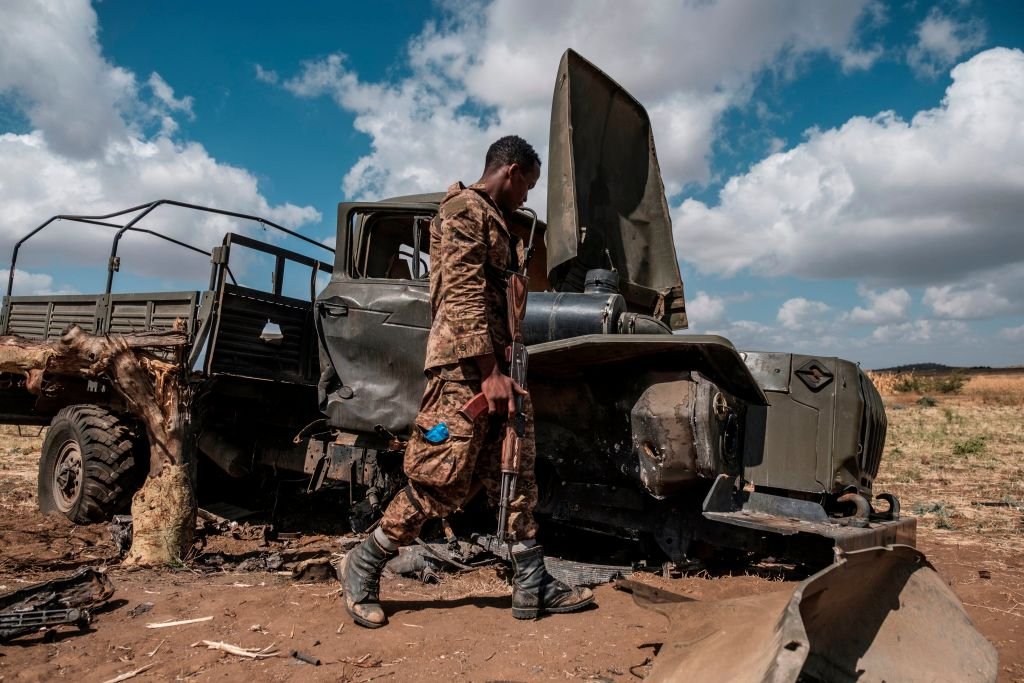
The Tigray Defence Forces (TDF) on January 26 entered the disputed Ethiopian territory of Tselemt in the northwestern Tigray region, clashing with federal troops and militias from the neighboring Amhara region. Three days later, the TDF moved into Korem and Alamata in southern Tigray’s contested Raya district, without apparent federal resistance, the International Crisis Group reported.
The federal government then canceled all flights to the region and on January 31 conducted two drone strikes in central Tigray. This prompted analysts to warn that continued fighting in Tigray could ignite another war.
Tigray, the northernmost region of Ethiopia, has been in a power struggle since 2018, when Tigrayan leaders lost their dominant influence in Ethiopia’s government.
Following the drone strikes, Tadesse Werede, the TDF leader, said the federal government had started “something resembling an all-out war,” The Economist magazine reported. Werede also said the TDF would withdraw from Tselemt to de-escalate the situation and that “disagreements … can be resolved through dialogue.”
Tigrayan forces face a combined offensive from the Ethiopian National Defence Force (ENDF) and Amhara militias, which seized Tselemt during the previous Tigray war and refused to withdraw. While flights to Tigray resumed February 3, tensions remained. That day, Ethiopian Prime Minister Abiy Ahmed suggested during a speech to Parliament that the Tigray People’s Liberation Front (TPLF), the region’s ruling party, consisted of “traitors” working to “dismantle Ethiopia.”
A TPLF official responded by saying the ENDF was “mobilizing in full force.”
“I can’t tell you how scary this war is going to be if Abiy doesn’t stop what he is doing,” the official said in a report by The Economist.
On February 10, Volker Türk, the United Nations’ human rights chief, called on all parties to take urgent steps to de-escalate the dispute.
“The situation remains highly volatile, and we fear it will further deteriorate, worsening the region’s already precarious human rights and humanitarian situation,” Türk said. “Civilians are once again caught in between escalating tensions, with both TSF (Tigray Security Forces) and ENDF reportedly carrying out arrests for perceived affiliation with the opposing side. This must stop.”
Leftover animosity from the civil war drives the crisis. When the war broke out in 2020, Amhara militias seized western Tigray, where hundreds of thousands of people were forced to flee. Most have since lived in squalid displacement camps in other parts of the region.
A few thousand people returned to their Tigray homes in 2024, but many faced intimidation and abuse from Amhara militias. Abiy also has stonewalled the TPLF’s demands to give control of disputed territories from Amhara back to Tigray.
Abiy has feared the TPLF wants to take western Tigray back by force. The Ethiopian Army reportedly has moved large amounts of troops and weaponry toward Tigray’s borders.
Analysts at The Economist wrote that both sides may move cautiously. The TPLF is weakened by constant infighting and Abiy is navigating tensions with neighboring Eritrea. On February 3, he accused Eritrean troops of committing mass killings while fighting alongside Ethiopian troops in the previous war that ended in 2022, during which more than 400,000 people were killed. Eritrea has grown diplomatically closer to the TPLF amid a feud between Asmara and Addis Ababa over Red Sea access.
“Yet Ethiopia’s crisis is also intertwined with the civil war in Sudan and the rivalries between the external powers that have been fueling it,” analysts at The Economist wrote. “A new war in Tigray would probably spiral into a regional disaster. Those who can must push for peace while they still have time.”
Time may be running out. In a February 7 letter to his Eritrean counterpart, Ethiopian Foreign Minister Gedion Timothewos claimed Eritrean forces had been inside his country for a “considerable period,” and accused Asmara of providing direct material support to militant groups operating in Ethiopia.
“Developments over the last few days indicate that the Government of Eritrea has chosen the path of further escalation,” Timothewos said in a report by the bne IntelliNews news wire agency. Timothewos demanded that Asmara “withdraw its troops from Ethiopian territory and cease all forms of collaboration with rebel groups,” calling the alleged actions “not just provocations but acts of outright aggression.”