As a housing crisis pummels the West, from Sun Valley, Idaho, to Tucson, Arizona, there’s a dull irony in the number of abandoned houses and old hotels. Some of them cluster around former mining boomtowns; Bannack, Montana, for instance, was briefly the state’s capital before the veins of gold ran dry and the 10,000 residents moved on. Today, some 60 buildings still stand, including the handsome red-brick Hotel Meade. Two Guns, Arizona, once served Dust Bowl migrants and other travelers along Route 66, but when the interstate highway passed it by, the town collapsed. Today, its ruins include homes and motels as well as campgrounds for travelers and the remnants of a zoo that once housed mountain lions and Gila monsters.
These “ghost houses” aren’t just found in old mining camps in the desert or mountains; they’re also in busy Western cities. Even places with housing shortages can be home to thousands of vacant buildings. The city of Denver knocks down dozens of derelict homes every year. Other places, like Albuquerque, New Mexico, have taken a different approach: They’re trying to rehabilitate the abandoned houses and turn them into new housing. Like many mid-size cities, Albuquerque has a shortage of affordable places to live. Housing costs have risen almost 50% since 2019, and the city needs as many as 30,000 new units to keep up with the demand. Meanwhile, plywood covers the windows of unused buildings, many of them one-story faux-adobe Pueblo Revival structures. In 2018, a municipal task force estimated that 1,200 to 1,300 homes were either vacant, abandoned or generally substandard.
The city is also home to a collection of crumbling hotels. Some of these are former motels, which, like the city of Two Guns, went out of business when Route 66 was officially removed from the highway system in 1985. Others fell into a state of decay as the city’s economy and reputation changed.
But Albuquerque has recently ramped up an effort to rescue these old houses and hotels and turn them into new and more affordable homes. Last year, the city created a program that offered developers $4 million to turn hotels and other existing buildings into apartments. It’s not a new idea: In the 2010s, for example, developers reclaimed a string of old Route 66 motels, using federal tax incentives to turn them into new housing.


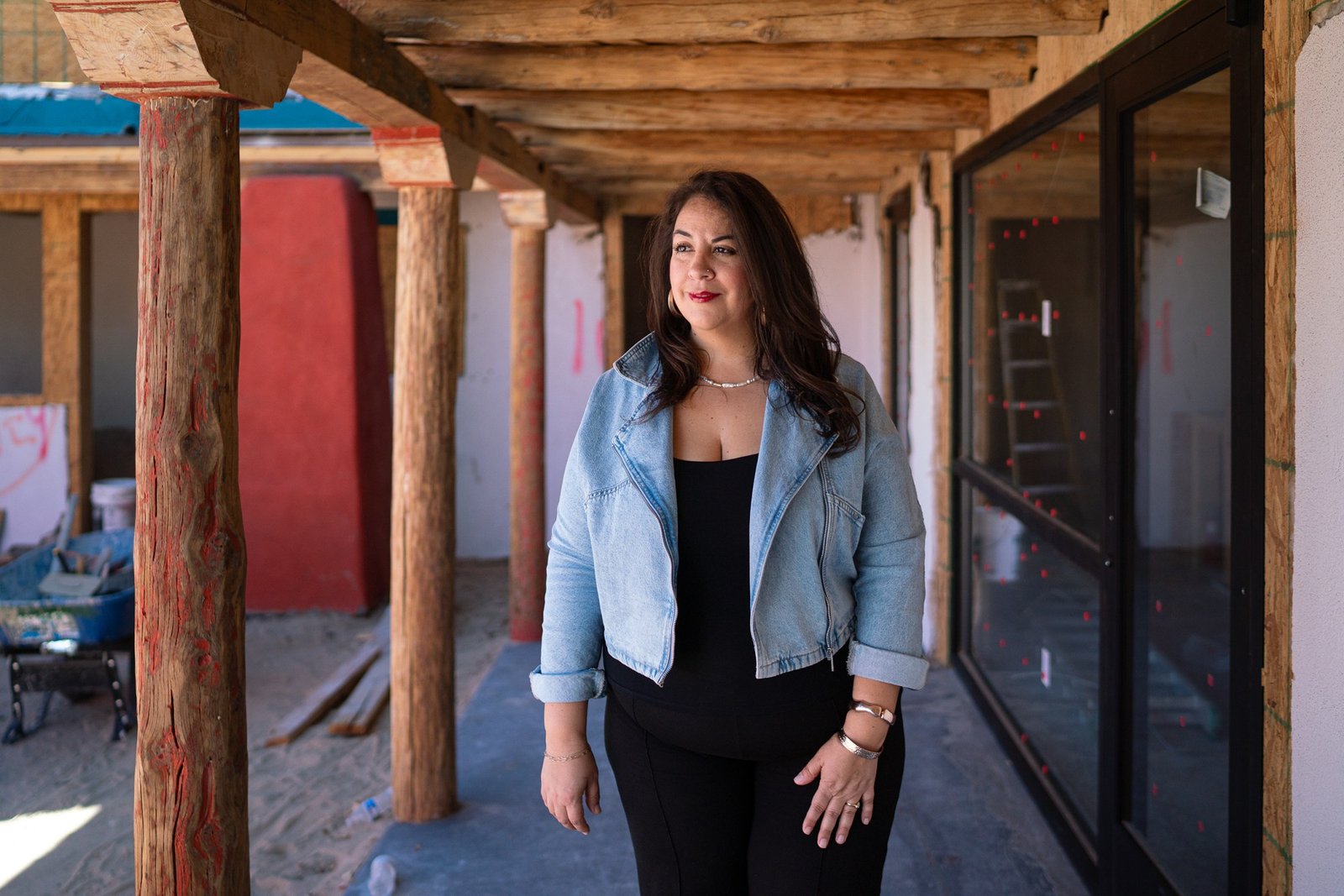
The city’s increasing involvement has attracted developers with new projects in mind. Like many Albuquerque residents, real estate agent Karina Chavez had noticed the derelict midcentury modern motels scattered around town but paid them little mind. Chavez, a Mexican immigrant, specialized in working with Spanish-speaking clients.

In 2022, a real estate agent friend came to her with an idea: The Adobe Manor, an old motel in West Central Albuquerque, was for sale. “He was like, ‘Why don’t you just buy this motel and convert it into affordable housing?’” Chavez said.
She was passionate about creating new housing for her community and believed that, with the mix of federal and local incentives, she would be able to make some money in the process. “I loved the idea,” she said.
Chavez is familiar with how economic forces can alter entire cities. She was born in Guadalajara, the daughter of a prosperous real estate agent and architect, but her family lost almost everything in the Mexican peso crisis of 1994. When they relocated to Albuquerque, she was still in middle school, sleeping on the floor of a condo with her sisters as her father worked to rebuild his real estate business. In those days, housing in Albuquerque was cheap, and Chavez’s father geared his new agency toward helping other new immigrants and their U.S. citizen children buy their first homes. Chavez, who joined the family business, takes pride in the fact that she built her career by helping many families buy their first homes in the States.
“Having your own place changes everything,” Chavez said.
She’s seen how having a stable home can change a family’s trajectory: Neighbors get to know each other, kids make friends and stay in the same schools. But Albuquerque was hit particularly hard by the nationwide housing crisis. While rents in cities like Denver have fallen significantly from their pandemic-era peak, in Albuquerque they’ve remained high, although they appear to have stabilized. Chavez has seen residents priced out and forced to move to exurbs and rural counties. Chavez hoped that by developing Adobe Manor, she could help the families who wanted to stay in the city.


Adobe Manor wasn’t completely abandoned when Chavez acquired it. It still had a few residents, but the living conditions were bad, and motel rooms, by their nature, tend to make subpar housing. Chavez added kitchenettes, installed mini-split air conditioning units, and put in new cabinets and fixtures. One resident, who decided to stay during the renovations, became a sort of informal super for Chavez.
Today, Adobe Manor has 16 renovated units for families and individual renters. Adobe Manor offers Section 8 affordable housing, and Chavez rents some of the units to Catholic Charities, a nonprofit that provides housing and direct aid to immigrants and the housing insecure in the city.
And now, Chavez is expanding: In the last two years, she’s bought three more Route 66 motels. Two will become new housing, and the third will be converted into a food hall. Since the pandemic, multiple restaurants in the area have shut down, and Chavez worried that the people who moved into her renovated hotels would end up living in a food desert. Opening the food hall seemed like another instance where the well-being of her businesses and the neighborhood could align.

In the mid-1800s, once the gold rush ended and the economy stalled, Californians blamed the Chinese. When the stock market crashed and the Great Depression took hold in 1929, President Herbert Hoover blamed Mexican immigrants for the job shortages. In 2024, Donald Trump and J.D. Vance cannily followed the same playbook. Sensing the anger and frustration about housing shortages, the two spent their campaign blaming immigrants for the crisis.
Repackaging their mass deportation regime as housing policy, Trump and his allies argued that getting rid of immigrants would free up homes for U.S. citizens. “You have got housing that is totally unaffordable because we brought in millions of illegal immigrants to compete with Americans for scarce homes,” said Vance during an October vice-presidential debate. The message resonated; in Albuquerque, in the months before the election, I heard residents grumble about Venezuelan immigrants living in affordable housing
That’s why there’s hope in renovating existing housing. When a malevolent ghost in the macroeconomic machine creates a crisis, it is human instinct is to find a scapegoat. Rehabilitating older housing solves two problems: It revitalizes an economy that boomed in some neighborhoods and left others blighted. And it’s a rallying cry against scarcity, where the remnants of a past collapse become symbols of new life: boarded-up buildings transformed into new homes for those on the margins.