

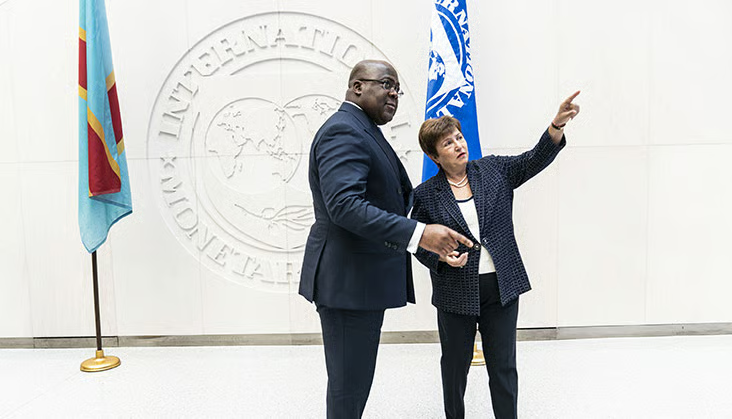
The International Monetary Fund and World Bank have deployed $85 billion in new lending facilities specifically targeting African sovereign debt distress, as the continent faces a $180 billion refinancing wall through 2027. The IMF’s Enhanced Debt Treatment Initiative (EDTI), launched in February 2026, represents the most significant overhaul of multilateral lending architecture since the 2020 Debt Service Suspension Initiative.
New Lending Framework Architecture
Under the EDTI, the IMF has streamlined debt restructuring timelines from an average of 36 months to 18 months for qualifying sovereigns. Twenty-three African countries currently meet distress criteria, with debt-to-GDP ratios exceeding 70% and external debt service consuming over 25% of government revenues. Ghana, Kenya, and Zambia serve as pilot cases under the new framework, with restructuring negotiations involving Chinese creditors now following standardized protocols.
The World Bank’s parallel Crisis Response Facility provides bridge financing of up to $3 billion per country while negotiations proceed. This facility requires maintaining expenditure floors for health and education at 4.5% and 6% of GDP respectively conditions that have sparked debate among finance ministers across the continent.
Chinese Creditor Participation Breakthrough
The most significant development involves China’s formal participation in the Common Framework for Debt Treatments. Chinese institutions hold approximately $160 billion in African sovereign debt, representing 35% of the continent’s external obligations. The Export-Import Bank of China and China Development Bank have agreed to comparable treatment terms with Paris Club creditors, ending years of coordination failures.
However, Chinese participation comes with infrastructure asset evaluation requirements. Projects financed under the Belt and Road Initiative must undergo independent technical assessments, with asset values potentially applied against outstanding debt balances. This mechanism has already reduced Kenya’s obligations by $2.8 billion following evaluation of the Standard Gauge Railway.
Conditionality Matrix and Governance Requirements
The new lending architecture introduces a three-tier conditionality system. Tier 1 requirements include standard fiscal targets: primary budget surpluses of 2-3% of GDP and debt-to-GDP stabilization within 60 months. Tier 2 conditions mandate governance reforms including public procurement transparency, beneficial ownership registries for state contracts, and quarterly debt reporting.
Tier 3 represents the most controversial element: resource revenue management requirements for commodity exporters. Countries with extractive revenues exceeding 25% of fiscal income must establish sovereign wealth funds with ring-fenced allocations. Nigeria’s recent establishment of the Nigeria Sovereign Investment Authority 2.0 with $12 billion in initial capitalization serves as the template.
Market Response and Spreads
African Eurobond spreads have compressed significantly since the announcement. Ghana’s 2030 bonds, trading at 45 cents on the dollar in January, recovered to 72 cents following EDTI enrollment. Similarly, Kenya’s sovereign risk premium decreased by 340 basis points, with the country successfully pricing a $2 billion Eurobond at 8.2% in March down from projected rates of 12-13%.
However, frontier market analysts note selectivity in investor appetite. Countries outside the EDTI framework, including Chad and Mali, continue facing spreads exceeding 1,500 basis points over US Treasuries.
Implementation Challenges and Timeline
The IMF projects full implementation across participating countries by December 2027, though several obstacles remain. Legal challenges from holdout private creditors have already emerged in New York courts, with Elliott Management contesting Ghana’s restructuring terms. Additionally, domestic political resistance to governance conditionalities has surfaced in several countries, with Ethiopia’s Parliament rejecting beneficial ownership requirements for state enterprises.
Currency volatility presents another implementation risk. The framework assumes exchange rate stability, but recent devaluations in the Nigerian naira and Egyptian pound have increased debt burdens despite nominal restructuring progress.
Forward-Looking Implications
The success of the new debt architecture will largely depend on Chinese creditor compliance and the ability of African sovereigns to meet governance benchmarks. Early indicators suggest mixed results: while debt service relief has provided immediate fiscal space, structural reform implementation remains uneven.
For international investors, the framework creates clearer distressed debt investment opportunities with standardized recovery timelines. However, the governance conditionalities may limit investment in countries struggling with transparency requirements. Policymakers should monitor quarterly compliance reports beginning in Q3 2026, as these will determine continued program eligibility and influence broader market confidence in African sovereign credits.


