

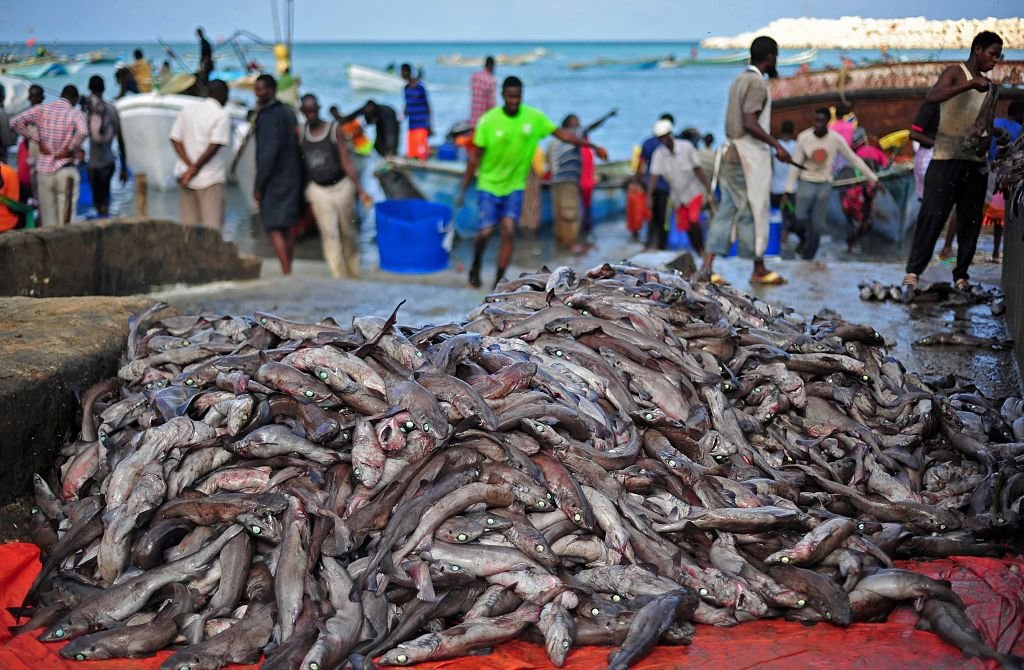
Somali fisherman Sadiq Mohammed Abdulle returned to shore with empty nets in a village near Mogadishu. The waters there once teemed with yellowfin tuna, shark, mackerel, snapper and grouper, but increasing instances of illegal fishing by foreign industrial trawlers has decimated the area’s fish stocks.
“There’s a lot of big fishermen with big vessels that take all the fish,” Abdulle told Al Jazeera. “They are well-equipped. We have nothing. We don’t have proper equipment to catch the fish.”
Illegal, unreported and unregulated (IUU) fishing costs Somalia $300 million annually. Much of the scourge is driven by Chinese vessels. China commands the world’s largest distant-water fishing fleet and is by far the world’s worst illegal fishing offender, according to the IUU Fishing Risk Index. Vessels from other countries in Europe, the Middle East, and Asia have also been recorded operating illegally in Somali waters in recent years.
Ahmed Hassan Aden, Somalia’s minister of fisheries and blue economy, said the government is addressing the issue.
“We are fighting with the poachers,” Aden told Al Jazeera. “We have a new fishing law. We have also sent messages to the governments that are involved. Most of them are willing to help. We are tracing the culprits. We are strengthening the Navy. We have made several arrests of illegal fishermen and some are in court.”
Somalia also has turned to international partners for assistance. In 2024, Somalia and Turkey signed a memorandum of understanding that established the Turkish Armed Forces as a maritime security and law enforcement partner with Somalia for 10 years. Turkey agreed to rebuild, equip and train the Somali Navy while receiving 30% of the revenue generated from Somalia’s exclusive economic zone.
In December 2025, Somalia signed another agreement with Turkey that aims to combat illegal fishing in the Indian Ocean, particularly off the Somali coast. Through the jointly established SOMTURK company, the agreement is expected to strengthen Somalia’s maritime surveillance and enforcement capacity and enhance the country’s ability to safeguard its maritime jurisdiction, ownership rights and economic opportunities in the Indian Ocean.
“This cooperation will contribute to Somalia’s maritime security while ensuring the sustainable protection of marine resources,” Aden told Anadolu Agency.
Aden said the partnership also will contribute to the development of Somali ports, cold chain and storage infrastructure, and processing and industrial facilities.
“These developments will generate new job opportunities for young people, provide vocational training and support the expansion of foreign trade,” Aden told Anadolu Agency.
Curbing IUU fishing also might stem a surge in Somali pirate attacks on foreign fishing vessels. In late November 2024, a band of armed and angry Somali fishermen seized a Chinese fishing trawler with the Liao Dong Yu fleet. Hijackers released the vessel and its 18-man crew in mid-January 2025 for a reported $2 million ransom.
One of the hijackers told Al Jazeera that he and the other fishermen were not pirates but members of “a community under siege,” accusing Chinese vessels of overfishing and threatening the livelihoods of Somalia’s 90,000 artisanal fishermen. Subsequent Somali attacks on foreign fishing vessels have occurred intermittently.
There were seven reported incidents of piracy that took place off the coast of Somalia last year, according to the International Maritime Bureau, including three hijackings. These numbers are small compared to the peak of Somali piracy 15 years ago, when it experienced more than 200 such attacks a year. However, some maritime security experts cite a resurgence of profit-driven piracy in the Gulf of Aden and western Indian Ocean, where international navies have diverted their attention to sea attacks by Yemen’s Houthi rebels.
Abdiwahid Hersi, a fisheries expert and former director general of the Ministry of Fisheries and Marine Resources in Puntland, said the situation easily could spiral out of control.
“These attacks should be treated as serious but not necessarily a full return to 2010-scale piracy,” Hersi told the Canadian Broadcasting Corp. “They may be episodic clusters that can escalate if unchecked.”


