
• Business
  • Markets
  • Politics
  • Crypto
  • Finance
  • Intelligence
    • Policy Intelligence
    • Security Intelligence
    • Economic Intelligence
    • Fashion Intelligence
  • Energy
  • Technology
  • Taxes
  • Creator Economy
  • Wealth Management
  • LBNN Blueprints
  • Business
  • Markets
  • Politics
  • Crypto
  • Finance
  • Intelligence
    • Policy Intelligence
    • Security Intelligence
    • Economic Intelligence
    • Fashion Intelligence
  • Energy
  • Technology
  • Taxes
  • Creator Economy
  • Wealth Management
  • LBNN Blueprints

HVAC algorithm can provide thermal comfort for building occupants, with a smaller carbon footprint

Simon Osuji by Simon Osuji
October 5, 2023
in Artificial Intelligence
0
HVAC algorithm can provide thermal comfort for building occupants, with a smaller carbon footprint
0
SHARES
3
VIEWS
Share on FacebookShare on Twitter


Comfort with a smaller carbon footprint
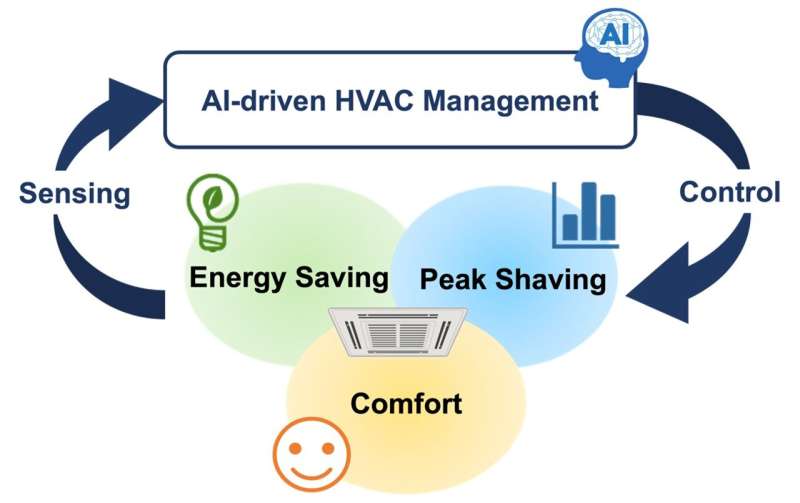
Overview of Data-driven Online Energy Management Framework. Credit: Ittetsu Taniguchi

As organizations work to reduce their energy consumption and associated carbon emissions, one area that remains to be optimized is indoor heating and cooling. In fact, HVAC—which stands for heating, ventilation, and air conditioning—represents, on average, about 40% of a building’s total energy use. Methods that conserve electricity while still providing a comfortable indoor environment for workers could make a significant difference in the fight against climate change.

Related posts

Vantrue E1 4K Pro Review (2026): Tiny and High-Definition

February 26, 2026
Kalshi Suspended a California Politician and a YouTuber for Insider Trading

Kalshi Suspended a California Politician and a YouTuber for Insider Trading

February 26, 2026

Now, researchers from Osaka University have demonstrated significant energy savings through the application of a new, AI-driven algorithm for controlling HVAC systems. This method does not require complex physics modeling, or even detailed previous knowledge about the building itself. The work is published in the journal Applied Energy.

During cold weather, it is sometimes challenging for conventional sensor-based systems to determine when the heating should be shut off. This is due to thermal interference from lighting, equipment, or even the heat produced by the workers themselves. This can lead to the HVAC being activated when it should not be, wasting energy.

To overcome these obstacles, the researchers employed a control algorithm that worked to predict the thermodynamic response of the building based on data collected.

This approach can be more effective than attempting to explicitly calculate the impact of the multitude of complex factors that might affect the temperature, such as insulation and heat generation. Thus, with enough information, ‘data driven’ approaches can often outperform even sophisticated models. Here, the HVAC control system was designed to ‘learn’ the symbolic relationships between the variables, including power consumption, based on a large dataset.

The algorithm was able to save energy while still allowing the building occupants to work in comfort. “Our autonomous system showed significant energy savings, of 30% or more for office buildings, by leveraging the predictive power of machine learning to optimize the times the HVAC should operate,” says lead author Dafang Zhao. “Importantly, the rooms were comfortably warm despite it being winter.”

The algorithm worked to minimize the total energy consumed, the difference between the actual and desired room temperature, and change in the rate of power output at peak demand. “Our system can be easily customized to prioritize energy conservation or temperature accuracy, depending on the needs of the situation,” adds senior author Ittetsu Taniguchi.

To collectively achieve the goal of a carbon-neutral economy, it is highly likely that corporations will need to be at the vanguard of innovation. The researchers note that their approach may enjoy rapid adoption during times of rising energy costs, which makes their findings good for both the environment as well as company viability.

More information:
Dafang Zhao et al, Data-driven online energy management framework for HVAC systems: An experimental study, Applied Energy (2023). DOI: 10.1016/j.apenergy.2023.121921

Provided by
Osaka University

Citation:
HVAC algorithm can provide thermal comfort for building occupants, with a smaller carbon footprint (2023, October 5)
retrieved 5 October 2023
from https://techxplore.com/news/2023-10-hvac-algorithm-thermal-comfort-occupants.html

This document is subject to copyright. Apart from any fair dealing for the purpose of private study or research, no
part may be reproduced without the written permission. The content is provided for information purposes only.




Source link

Previous Post

Tecnotree Switch MVNO Platform Powers Briclinks Africa ‘BTEL’

Next Post

Getting Ahead in Business Development and Sales

Next Post
Getting Ahead in Business Development and Sales

Getting Ahead in Business Development and Sales

Leave a Reply Cancel reply

Your email address will not be published. Required fields are marked *

RECOMMENDED NEWS

Kenya’s economic gains at risk as inflation continues to creep back up

Kenya’s economic gains at risk as inflation continues to creep back up

7 months ago
Appraisal Well Confirms Bourdon’s Potential for New Development Cluster off Gabon

Appraisal Well Confirms Bourdon’s Potential for New Development Cluster off Gabon

10 months ago
Betika Launches Nationwide Giveaway Worth Over Sh100 Million

Betika Launches Nationwide Giveaway Worth Over Sh100 Million

5 months ago
LAWMA reiterates economic value of waste – EnviroNews

LAWMA reiterates economic value of waste – EnviroNews

10 months ago

POPULAR NEWS

  • Ghana to build three oil refineries, five petrochemical plants in energy sector overhaul

    Ghana to build three oil refineries, five petrochemical plants in energy sector overhaul

    0 shares
    Share 0 Tweet 0
  • The world’s top 10 most valuable car brands in 2025

    0 shares
    Share 0 Tweet 0
  • Top 10 African countries with the highest GDP per capita in 2025

    0 shares
    Share 0 Tweet 0
  • Global ranking of Top 5 smartphone brands in Q3, 2024

    0 shares
    Share 0 Tweet 0
  • When Will SHIB Reach $1? Here’s What ChatGPT Says

    0 shares
    Share 0 Tweet 0

Get strategic intelligence you won’t find anywhere else. Subscribe to the Limitless Beliefs Newsletter for monthly insights on overlooked business opportunities across Africa.

Subscription Form

© 2026 LBNN – All rights reserved.

Privacy Policy | About Us | Contact

Tiktok Youtube Telegram Instagram Linkedin X-twitter
No Result
View All Result
  • Home
  • Business
  • Politics
  • Markets
  • Crypto
  • Economics
    • Manufacturing
    • Real Estate
    • Infrastructure
  • Finance
  • Energy
  • Creator Economy
  • Wealth Management
  • Taxes
  • Telecoms
  • Military & Defense
  • Careers
  • Technology
  • Artificial Intelligence
  • Investigative journalism
  • Art & Culture
  • LBNN Blueprints
  • Quizzes
    • Enneagram quiz
  • Fashion Intelligence

© 2023 LBNN - All rights reserved.