

Partner Article
The solution provides data centre operators a more holistic approach to their entire portfolio, providing unified security and network optimisation
The global data centre (DC) industry is experiencing a surge in investment and expansion, driven by escalating demand for cloud services, AI workloads, and edge computing. Once dominated by vast, centralised hyperscale facilities, the market is now shifting toward a more distributed model that places smaller, strategically located DCs closer to the end user. This strategic shift provides numerous benefits to the customer, providing enabling lower latency, improved resilience, and greater flexibility, but it is not without its challenges.
Running numerous DCs across different regions, each built using equipment from different vendors, is operationally complex. From network optimisation across sites to cybersecurity, managing distributed DCs is costly, and difficult to deploy and maintain.
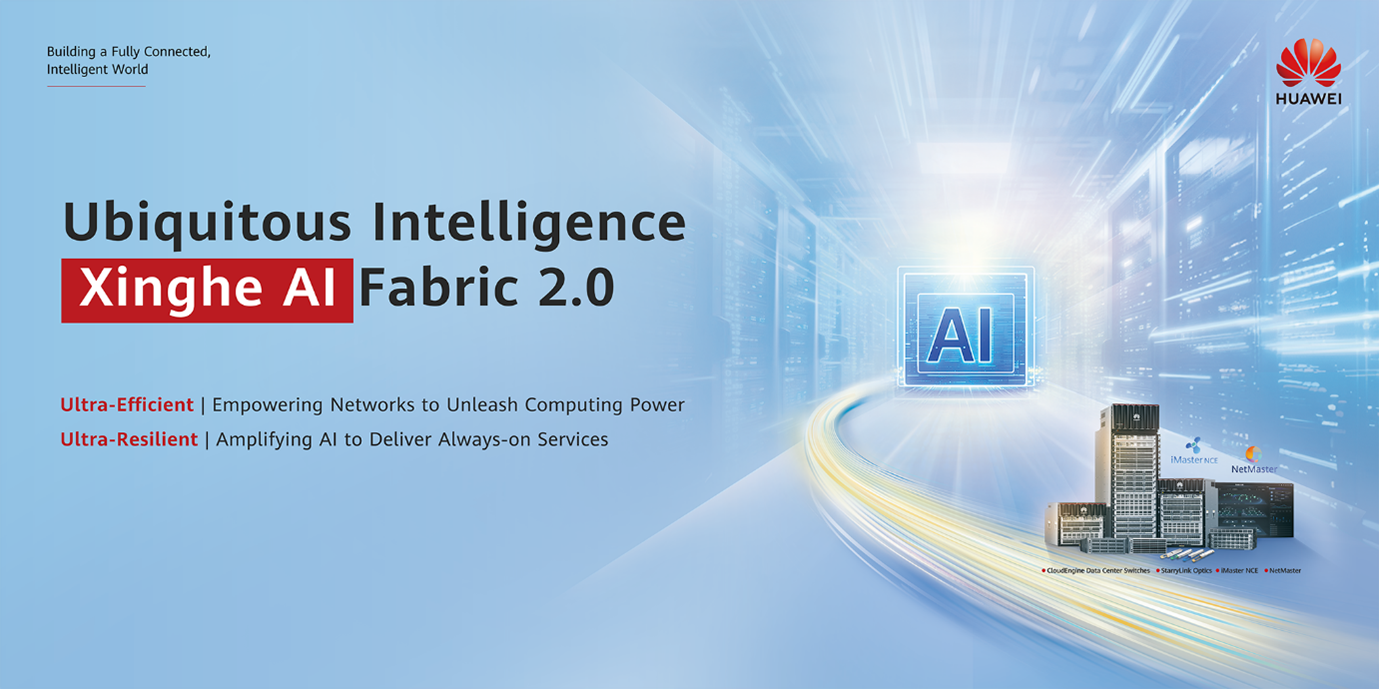
At the Ultra-Broadband Forum (UBBF), jointly organised by Huawei and the United Nations Broadband Commission, Huawei showcased its answer to these challenges: Xinghe AI Fabric 2.0.
Building for the AI era
Huawei launched its first iteration of AI Fabric back in 2018 – a time when few could have imagined the speed with which the ‘AI era’ was to arrive. Nonetheless, this first release anticipated much of the pressure that AI’s widespread development and deployment would place on the DC industry, focussing on delivering zero packet loss, lower latency, and higher throughput. This provided a strong foundation for AI training, distributed storage, and high-performance computing (HPC).
In 2025, however, simply improving the traditional network is no longer enough. Date centre operators today are looking to AI to help alleviate their biggest pain points: slow deployment, manual operations, and network unreliability.
Solving these problems has been the primary focus of Huawei’s Xinghe AI Fabric 2.0, which combines a variety of AI-powered solutions to improve network security, reliability, and operations and maintenance (O&M).

From fault detection to network optimisation
First among these solutions is Huawei’s StarryWing Digital Map, which is coupled with AI to automate the notoriously complex process of cross-DC network and security provisioning. By integrating security data, this platform dynamically generates a security access matrix, which then automatically recommends policy solutions with 100% accuracy within two minutes. This replaces a previously manual scripting process that would take a typical team two days to complete.
The second element is the introduction of its AI agent, NetMaster. This platform combines four systems – unified detection, network automation, O&M management platform, and traffic visualisation – using over 45 APIs. This allows for natural language orchestration, enabling the automated resolution of 80% of fault tickets and reducing average resolution time by over 90%. This is supported by the AI Eagle Eye Engine, which uses Huawei’s proprietary IFIT (In-situ Flow Information Telemetry) technology to detect and localise faults in seconds, compared to the hours that has long been the norm.
Finally, the Xinghe AI Fabric 2.0 is aiming to dramatically reduce the impact of network outages for DC network operators. It’s Data Plane Crossing Faults (DPCF) technology uses intelligent identification and automatic switching to reduce network fault recovery time from hours to minutes, while its Dynamic Path Fast Recovery (DPFR) technology resolves local failures in just 1ms. Finally, its M-LAG technology focuses on the link itself, using optical module channel protection to improve its reliability ten-fold. Combined, this three-layer approach to outages adds significant resilience, ensuring maximum uptime across deployments.
An automation philosophy: Using AI to support AI
By incorporating AI throughout the platform’s design, DC operators’ networks are increasingly optimised, but also flexible, able to respond quickly and accurately to network faults or cybersecurity incidents without manual oversight. With service demands from enterprise customers, latency-sensitive applications, and AI workloads increasing in prominence, the ability for networks to self-deploy, self-heal, and self-optimise will soon become a necessity.
Ultimately, Xinghe AI Fabric 2.0 is the natural evolution of DC network architecture, representing the latest example of Huawei’s prevailing design philosophy of leveraging AI to support AI, here called ‘AI for Fabric and Fabric for AI’. Huawei is rapidly embracing AI throughout its portfolio, building systems that can self-evolve to meet the changing needs of a rapidly changing AI world.
Keep up to date with all of the latest telecoms news from around the world with the Total Telecom newsletter
Also in the news
Connected Britain Award winners 2025 announced!
Netomnia announces ‘powerful and ambitious’ rebrand ahead of Connected Britain
VodafoneThree drops Samsung, relies on Nokia and Ericsson for £2bn network upgrade


