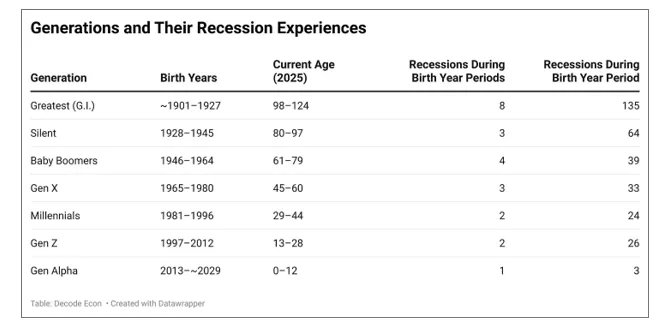
Economic downturns aren’t just temporary blips in GDP figures—they leave profound, lasting impacts on individuals who experience them during critical life stages. This analysis from Decode Econ examines how recessions during childhood and early career years create “economic scarring” that affects health, education, earnings and life choices for decades. By analyzing generational experiences from the Silent Generation to Gen Alpha, the research reveals that the timing of economic hardship fundamentally shapes not just financial outcomes, but entire worldviews about work, money and stability.
Dr. Abdullah Al Bahrani, author of the September 2025 study “The Hidden Scars of Recessions: How Recessions Shape Our World View,” investigated the long-term consequences of experiencing recessions during formative life stages, specifically focusing on two critical periods:
Childhood exposure to recessions: How economic downturns affect children’s development, health and future outcomes when household income falls during their early years.
Early career exposure to recessions: How entering the workforce during economic downturns impacts lifetime earnings, employment stability and major life decisions like homeownership and family formation.
His analysis spanned multiple generations—from the Silent Generation (born 1928-1945) through Gen Alpha (born 2013-present)—examining both the frequency of recessions each generation experienced during their birth years and how these economic shocks correlate with widely-held generational stereotypes.
The Childhood Impact
Drawing on a comprehensive review of 54 studies across OECD countries from 1988-2017, the research found that household income has a direct causal impact on children’s outcomes:
Cognitive development: Higher income leads to better test scores and increased graduation rates.
Social outcomes: Children in financially stable households face fewer behavioral problems and develop stronger social connections.
Health benefits: Economic stability during childhood correlates with higher birth weights, better mental health, and long-term health improvements.
Magnified effects for vulnerable populations: These impacts are especially pronounced for children from low-income families, where recession-driven income losses create disadvantages that can persist throughout life.
The Early Career Penalty
For young adults entering the workforce during recessions, the consequences are equally severe:
Permanently reduced earnings: Research by UC Berkeley’s Jesse Rothstein found that graduates starting careers during recessions face lower earnings and employment rates that persist throughout their careers.
The Great Recession impact: Young workers who graduated during the 2007-2009 downturn earned approximately 2% less for years afterward—a seemingly small figure that compounds into substantial lifetime losses.
The pandemic generation: Students who graduated during the COVID-19 recession are estimated to lose between $62,500 and $115,900 in lifetime earnings, according to Opportunity Insights.
Life milestone delays: Recession-scarred workers tend to delay homeownership, marriage and family formation, fundamentally reshaping life trajectories.
The Generational Lens
The analysis reveals how recession timing shapes generational characteristics:
-
Silent Generation grew up with Depression-era scarcity, fostering frugality and loyalty;
-
Baby Boomers benefited from postwar prosperity but are accused of resource hoarding;
-
Generation X developed independence and skepticism amid 1970s-80s economic turbulence;
-
Millennials became “financially unlucky,” graduating into the Great Recession;
-
Gen Z entered adulthood during pandemic uncertainty, developing side-hustle mentality; and
-
Gen Alpha is forming amid inflation, climate anxiety and rapid technological change.
The Bottom Line
Recessions are never equally shared. The timing of economic downturns relative to an individual’s life stage creates lasting impacts on health, education, earnings and fundamental worldviews about money and work.
Behind every “lazy Millennial” or “quiet quitting Gen Z” headline is a generation shaped by economic trauma at critical developmental stages. Smart investors will look beyond stereotypes to understand how recession scarring influences long-term consumer behavior, labor market dynamics, and wealth accumulation patterns.
The question isn’t whether the next recession will occur—it’s which generation will bear the scars, and how those scars will reshape the economy for decades to come.