

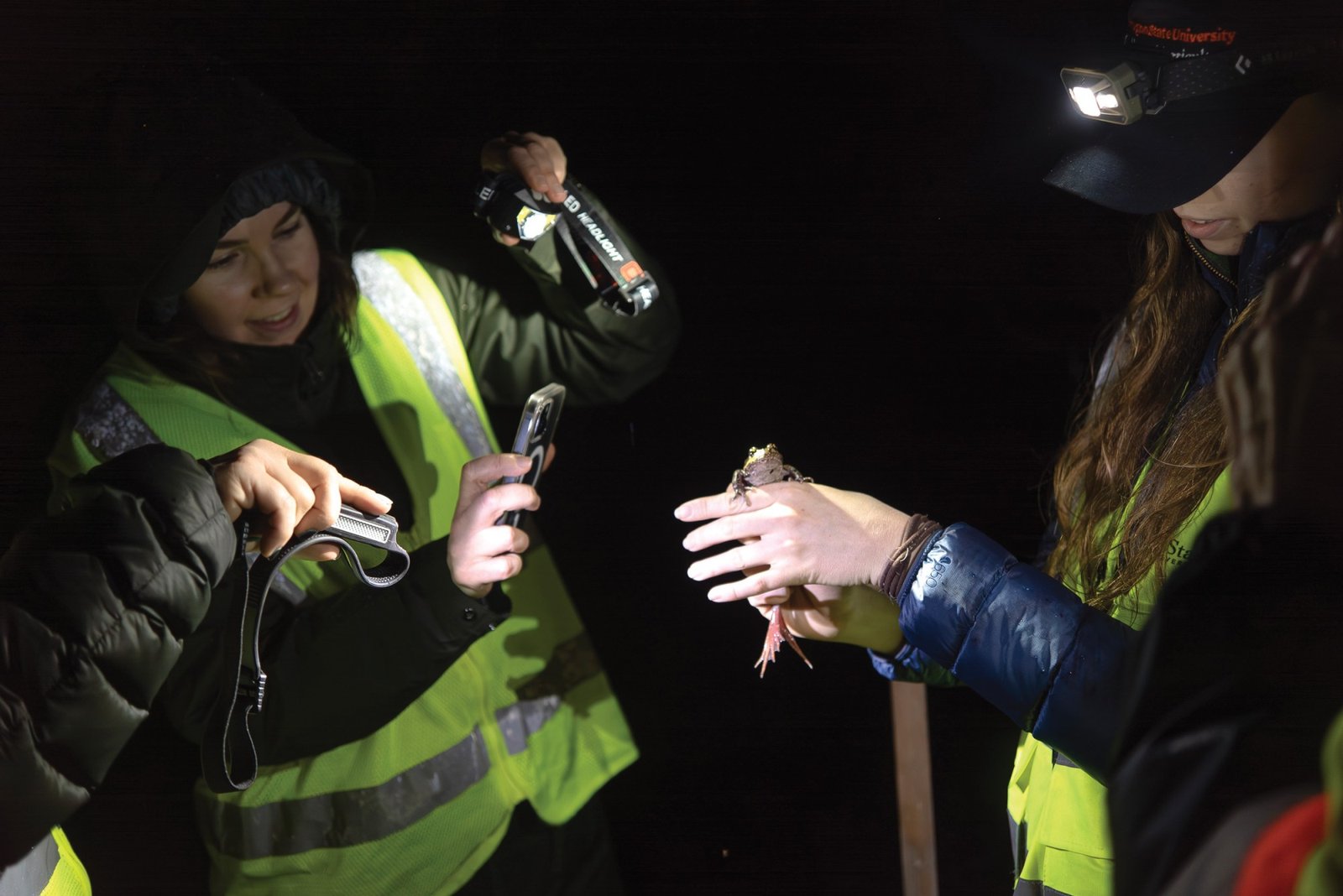
The late-afternoon sky was surprisingly clear for December, the kind of evening Portlanders revel in after days of rain. But for the half-dozen volunteers gathered on Harborton Drive — a steep frontage road carved into a bluff beside Highway 30, along the city’s northwestern riverfront — it wasn’t ideal. Frogs, especially the ones they sought, prefer rain. But the crew’s leaders remained hopeful: The road was still wet, and the warm temperature, over 50 degrees, might lure the frogs out anyway.
All week, volunteers had met here at dusk, holding buckets and wearing reflective vests with “FROGS” printed across the back. For the 13th winter in a row, they aimed to prevent one of Oregon’s largest remaining populations of northern red-legged frogs from crossing the four lanes of high-speed traffic on Highway 30, just below them. Past the roadway, city lights reflected on the Willamette River.
Every winter, this species — a reclusive, palm-sized amphibian that’s considered “sensitive,” and thereby protected, under Oregon law — must cross this highway to breed. Traversing up to three miles of the city each way, they hop and slide from their forested upland habitat, under sword ferns in undeveloped parkland, to their winter breeding grounds in the few surviving seasonal wetlands along the river. Migrating just after dark in each direction — they return upslope after laying eggs — they brave an urban rush hour twice between December and March.

It was January 2013 when Harborton resident Rob Lee, 74, first realized what a gantlet the animals were running. Lee was carpooling to a local environmental group meeting one evening when he found himself helping the driver navigate a sudden frenzy of frogs crossing Harborton. The next morning, Lee counted 60 carcasses on his barely trafficked road. He suspected that on Highway 30 below, “they were getting obliterated.”
Lee contacted Oregon’s Department of Fish and Wildlife (ODFW) and the following winter met a state biologist on Harborton to scoop up frogs and taxi them down to the wetlands. “Then,” he said, “it dawned on us that we’re going to have to take them back as well.”
For the 13th winter in a row, they aimed to prevent one of Oregon’s largest remaining populations of northern red-legged frogs from crossing the four lanes of high-speed traffic on Highway 30.
Friends soon joined them, and the group has since grown into the Harborton Frog Shuttle, a winter tradition that attracts so many volunteers, there’s sometimes a waitlist. In 2024, about 100 students, biologists, retirees and enthusiasts shuttled some 1,700 frogs downhill and nearly 2,000 back up again.
It’s hard to quantify how much this helps; adult red-legged frogs stay so hidden that biologists don’t know how many still live in Portland. Egg counts in the wetlands below Harborton show an upward trend since 2019, but this could also be due to restoration work. (Like many intact local wetlands, this one is owned by a utility, Portland General Electric (PGE), which maintains it as part of the company’s environmental mitigation efforts.) But numbers aren’t everything, said ODFW biologist Susan Barnes. “Anything we can do,” she said, to help frogs survive and hatch young, is beneficial.
Given the lack of rain, Heather Perkins, the night’s co-leader — a 68-year-old composer who loves amphibians so much, she named her record label Land-O-Newts — initially had the crew hold off on erecting the landscape-fabric fence they usually clip to Harborton’s guardrail to stop frogs from continuing downhill. Then a volunteer spotted the glinting eyes and speckled back of a scrawny male frog in roadside vegetation.

He escaped their grasp — flailing on rust-colored legs back up the steep bluff — but soon they saw another frog, frozen in a headlamp beam, and then a female, round with eggs, hiding under a leaf. Patricia Wolf, a professional musician and DJ, scooped up the slick, squirming creatures, then set them in buckets lined with wet leaves. “This time of year can be so gloomy,” she said, “but when you’re out here, you’re battling it with goodness.”
As dedicated as the volunteers are, they can’t catch every frog. Many also suspect that veteran females — which can live 15 years — have learned to evade assistance, including by crossing the highway elsewhere.
That’s why about a dozen partners, including the Oregon Wildlife Foundation, ODFW, the state transportation agency (ODOT) and PGE, are working toward a permanent fix: a wildlife crossing designed specifically for frogs. Their plan would install a box culvert under the highway and a concrete barrier along Harborton to funnel frogs toward it. The foundation is raising $550,000 for project engineering, but construction — estimated at $4 million — will require additional support.


The biggest barrier, foundation director Tim Greseth said, is ODOT’s capacity to help. The agency, which has no mandate to protect wildlife, is currently tackling a $242 million budget shortfall. Because state dollars are all but required for such a costly project, Greseth said advocacy groups are lobbying lawmakers to prioritize conservation here anyway.
The project has a promising precedent: In 2024, a council of regional governments, working with ODOT, ODFW and the federal Bonneville Power Administration, installed Oregon’s first amphibian crossing just a few miles west of here, where smaller numbers of red-legged frogs cross the same highway to reach BPA-owned wetlands. Last winter, cameras showed 300 red-legged frogs using the tunnel, along with myriad small wildlife, including weasels, skunks and reptiles. “It’s worked as well as we dreamed, and better,” said Rachel Wheat, ODFW’s wildlife connectivity coordinator.
“It would be a shame to lose this species because we don’t do something we’re capable of.”
Wildlife crossings are on the rise across the West, mostly designed for large animals like deer; tens of thousands of Americans are injured in wildlife collisions every year. At least 17 new crossings, from New Mexico to Alaska, were enabled by Biden-era infrastructure funds.
Amphibian collisions usually go unnoticed, since they rarely injure humans. But in Portland, they’re a top threat to red-legged frogs. And unlike other hazards — toxic storm runoff and invasive predatory bullfrogs among them — the car problem is solvable. “It would be a shame to lose this species because we don’t do something we’re capable of,” Greseth said.
If fully funded, the crossing could be built as early as 2028. Until then, volunteers will come every warm, wet night through the winter.

We welcome reader letters. Email High Country News at editor@hcn.org or submit a letter to the editor. See our letters to the editor policy.
This article appeared in the March 2026 print edition of the magazine with the headline “One frog at a time.”



