
• Business
  • Markets
  • Politics
  • Crypto
  • Finance
  • Intelligence
    • Policy Intelligence
    • Security Intelligence
    • Economic Intelligence
    • Fashion Intelligence
  • Energy
  • Technology
  • Taxes
  • Creator Economy
  • Wealth Management
  • LBNN Blueprints
  • Business
  • Markets
  • Politics
  • Crypto
  • Finance
  • Intelligence
    • Policy Intelligence
    • Security Intelligence
    • Economic Intelligence
    • Fashion Intelligence
  • Energy
  • Technology
  • Taxes
  • Creator Economy
  • Wealth Management
  • LBNN Blueprints
Home Technology

How origami might inform disease diagnoses

Simon Osuji by Simon Osuji
August 25, 2023
in Technology
0
How origami might inform disease diagnoses
0
SHARES
2
VIEWS
Share on FacebookShare on Twitter

How origami might inform disease diagnoses
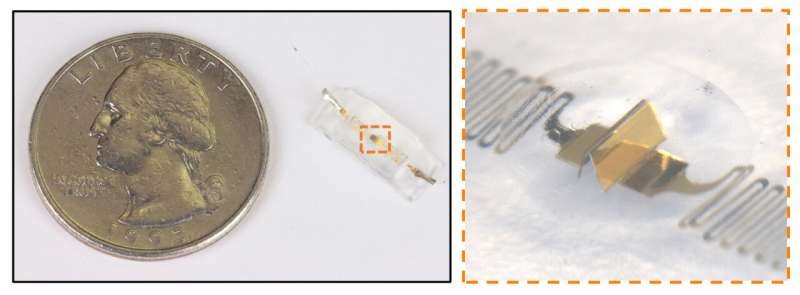
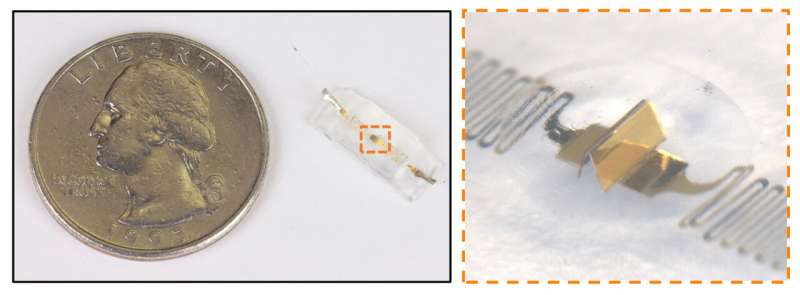
Researchers at the USC Viterbi School of Engineering looked to origami to create new sensors that could someday be employed to detect deformations in organs and also for use in wearables and soft robotics. Credit: The Zhao Research Group, USC Viterbi School of Engineering

Researchers at the USC Viterbi School of Engineering looked to origami to create new sensors that could someday be employed to detect deformations in organs and also for use in wearables and soft robotics.

Their paper, “High-Stretchability and Low-Hysteresis Strain Sensors Using Origami-Inspired 3D Mesostructures,” featured in Science Advances explains how USC researchers Hangbo Zhao, Xinghao Huang, Liangshu Liu, Yung Hsin Lin, Rui Feng, Yiyang Shen, and Yuanning Chang developed “stretchable strain sensors,” that can measure how much an object strains or deforms.

“The challenge,” says the paper’s corresponding author, USC Assistant Professor of Aerospace and Mechanical Engineering and Biomedical Engineering, Hangbo Zhao, “is to create sensors that can stretch significantly, respond quickly, and give precise readings even when measuring large and dynamic deformations.”

Current stretchable strain sensors mostly use soft materials like rubber—but this type of material can have irreversible changes in the material properties through repeated use, thus producing unreliable metrics related to deformation detection.

Researchers thus devised a new type of structure for the sensors. Inspired by origami, more rigid materials are folded with electrodes on each side of the panel (imagine the sensor as an upside down, opened book with two electrodes on the front and back covers). As the electrodes unfold the strength of the electrical field between the electrodes is captured. A model developed by the team then converts this reading into a measurement that captures the amplitude of the deformation.


USC researchers created new sensors that could someday be employed to detect deformations in organs and also for use in wearables and soft robotics. Credit: Zhao Research Group at USC Viterbi School of Engineering

The newly created sensors can stretch up to three times their original size with high sensing accuracy even with repeated use. In addition, the sensors respond very quickly, detecting deformations in less than 22 milliseconds in very tiny areas (approximately 5 square millimeters). In addition, they are capable of detecting strain from different directions.

Such sensors can measure large and complex deformations accurately, which can have applications in sensing motions of soft robots, tracking movements of human joints, or even monitoring organs such as the bladder to determine abnormalities that might indicate disease.

More information:
Xinghao Huang et al, High-Stretchability and Low-Hysteresis Strain Sensors Using Origami-Inspired 3D Mesostructures, Science Advances (2023). DOI: 10.1126/sciadv.adh9799. www.science.org/doi/10.1126/sciadv.adh9799

Provided by
University of Southern California

Citation:
How origami might inform disease diagnoses (2023, August 25)
retrieved 25 August 2023
from https://phys.org/news/2023-08-origami-disease.html

This document is subject to copyright. Apart from any fair dealing for the purpose of private study or research, no
part may be reproduced without the written permission. The content is provided for information purposes only.


Source link

Previous Post

ChatGPT Can Get Good Grades. What Should Educators Do about It?

Next Post

Shibarium Gas Token BONE Continues Bullish Stride

Next Post
Shibarium Gas Token BONE Continues Bullish Stride

Shibarium Gas Token BONE Continues Bullish Stride

Leave a Reply Cancel reply

Your email address will not be published. Required fields are marked *

POPULAR NEWS

  • Mahama attends Liberia’s 178th independence anniversary

    Mahama attends Liberia’s 178th independence anniversary

    0 shares
    Share 0 Tweet 0
  • Ghana to build three oil refineries, five petrochemical plants in energy sector overhaul

    0 shares
    Share 0 Tweet 0
  • The world’s top 10 most valuable car brands in 2025

    0 shares
    Share 0 Tweet 0
  • Top 10 African countries with the highest GDP per capita in 2025

    0 shares
    Share 0 Tweet 0
  • Global ranking of Top 5 smartphone brands in Q3, 2024

    0 shares
    Share 0 Tweet 0

Get strategic intelligence you won’t find anywhere else. Subscribe to the Limitless Beliefs Newsletter for monthly insights on overlooked business opportunities across Africa.

Subscription Form

© 2026 LBNN – All rights reserved.

Privacy Policy | About Us | Contact

Tiktok Youtube Telegram Instagram Linkedin X-twitter
No Result
View All Result
  • Home
  • Business
  • Politics
  • Markets
  • Crypto
  • Economics
    • Manufacturing
    • Real Estate
    • Infrastructure
  • Finance
  • Energy
  • Creator Economy
  • Wealth Management
  • Taxes
  • Telecoms
  • Military & Defense
  • Careers
  • Technology
  • Artificial Intelligence
  • Investigative journalism
  • Art & Culture
  • LBNN Blueprints
  • Quizzes
    • Enneagram quiz
  • Fashion Intelligence

© 2026 JNews - Premium WordPress news & magazine theme by Jegtheme.