


- Increasing revenues, establishing an effective budget framework, and scaling up the cash transfer system can all support Nigeria’s progress
By Axel Schimmelpfennig and Christian Ebeke
Over the past two years, Nigeria—Africa’s most populous country—has implemented difficult reforms to tackle long-standing obstacles weighing on the economy. While the reforms are starting to show results, poverty and food insecurity remain high, and the uncertain global environment presents additional challenges. As discussed in our latest annual economic health check of the West African nation, the right policies can help Nigeria realize its potential as an African and global economic powerhouse.
A difficult starting point
Upon taking office in 2023, the new government faced low growth and rising poverty. Between 2014 and 2023, real per capita GDP declined on average by 0.7 percent annually. In 2023, the poverty rate stood at 42 percent. This difficult situation was compounded by limited access to dollars, which meant that people had to turn to the parallel currency market and thereby pay a much higher price than the official rate. In the meantime, public finances were strained by an opaque fuel subsidy system, which also caused recurrent petrol scarcity. And central bank financing of the fiscal deficit pushed up inflation.
In response to these challenges, Nigerian policymakers have embarked on a series of bold reforms over the last two years. In 2023, the new government and the Central Bank of Nigeria liberalized the foreign exchange market, stopped central bank financing of the fiscal deficit, and reformed fuel subsidies. The government also strengthened revenue collection, which is still one of the world’s weakest.
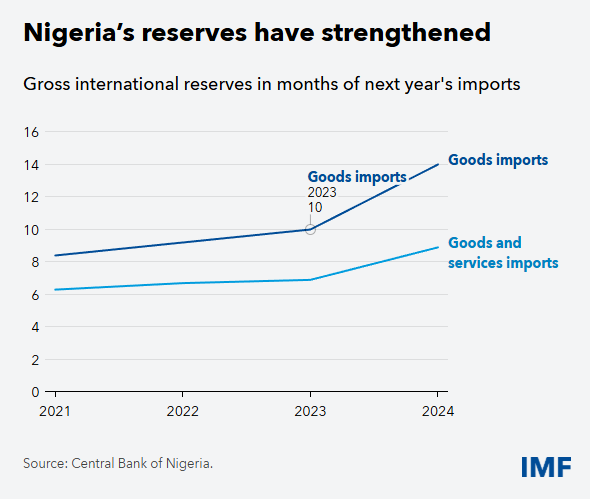
Since these reforms were implemented, international reserves have increased, and anyone can now access foreign exchange in the official market. Nigeria successfully returned to international capital markets last December and was recently upgraded by rating agencies. A new domestic, private refinery is positioning Nigeria up the value chain in a fully deregulated market.
The work continues
While progress has been encouraging, significant challenges remain. Inflation still exceeds 20 percent. Poor infrastructure, especially for electricity, inhibits economic activity. Poverty and food insecurity remain high. Nigeria lacks an effective social safety net to cushion the impact of shocks on the most vulnerable.
In addition, the global environment is posing new challenges with elevated uncertainty and high borrowing costs. Nigeria is especially affected by volatile international oil prices since oil revenues account for a large proportion of government revenues—a figure that stood at 30 percent in 2024.
Policy priorities
To address these challenges, Nigeria should focus on three key priorities:
First, the country needs stronger and more sustained growth to lift millions of people out of poverty and food insecurity, which is what the authorities are focusing on. This does not happen overnight. In the meantime, making growth more inclusive also requires scaling up the existing cash transfer system.
Second, as an essential ingredient for economic development, Nigeria needs an effective budget framework. Delivering effective investments in people and infrastructure requires realistic budget assumptions, strong expenditure management, and transparent implementation and reporting—which, in turn, can strengthen accountability. For its part, monetary policy should contianue to decisively tackle inflation and reduce economic uncertainty.
Third, the government should continue to increase domestic revenues. This is essential given Nigeria’s substantial funding needs in growth-enabling areas such as agriculture, infrastructure, including access to electricity, and climate adaptation. The government’s tax reforms will make it easier to pay taxes and ensure that everyone who owes taxes pays them. Over time, once the ongoing cost-of-living crisis abates and the cash transfer system is fully operational, there will be room to align tax rates with those in neighboring countries. For now, the share of revenue that goes to interest spending leaves too little for investment in people and infrastructure. It is therefore critical that the substantial financial savings from the removal of fuel subsidies flow to the government to fund priority spending.
Nigeria’s potential is beyond doubt but achieving it will require continued reforms and an effective social safety net to carry the most vulnerable along.
****
Axel Schimmelpfennig is the IMF’s mission chief to Nigeria and an assistant director in the IMF’s African Department. Christian Ebeke is the IMF’s resident representative in Nigeria.
This article is based on the Staff Report for the 2025 Article IV Consultation with Nigeria.


