Over the past few decades, extreme weather events have not only become more severe, but are also occurring more frequently. Neara is focused on enabling utility companies and energy providers to create models of their power networks and anything that might affect them, like wildfires or flooding. The Redfern, New South Wales, Australia-based startup recently launched AI and machine learning products that creates large-scale models of networks and assess risks without having to perform manual surveys.
Since launching commercially in 2019, Neara has raised a total of $45 million AUD (about $29.3 million USD) from investors like Square Peg Capital, Skip Capital and Press Ventures. Its customers include Essential Energy, Endeavour Energy, SA Power Networks. It is also partnered with Southern California Edison Co and EMPACT Engineering.
Neara’s AI and machine learning-based features are already part of its tech stack and have been used by utilities around the world, including Southern California Edison, SA Power Networks and Endeavor Energy in Australia, ESB in Ireland and Scottish Power.
Co-founder Jack Curtis tells TechCrunch that billions are spent on utilities infrastructure, including maintenance, upgrades and the cost of labor. When something goes wrong, consumers are affected immediately. When Neara started integrating AI and machine learning capabilities into its platform, it was to analyze existing infrastructure without manual inspections, which he says can often be inefficient, inaccurate and expensive.
Then Neara grew its AI and machine learning features so it can create a large-scale model of a utility’s network and surroundings. Models can be used in many ways, including simulating the impact of extreme weather on electricity supplies before, after and during an event. This can increase the speed of power restoration, keep utilities teams safe and mitigate the impact of weather events.
“The increasing frequency and severity of severe weather motivates our product development more so than any one event,” says Curtis. “Recently there has been an uptick of severe weather events across the world and the grid is being impacted by this phenomenon.” Some examples are Storm Isha, which left tens of thousands without power in the United Kingdom, winter storms that caused massive blackouts across the United States and tropical cyclone storms in Australia that leave Queensland’s electricity grid vulnerable.
By using AI and machine learning, Neara’s digital models of utility networks can prepare energy providers and utility for them. Some situations Neara can predict include where high winds might cause outages and wildfires, flood water levels that mean networks need to turn off their energy and ice and snow buildups that can make networks less reliable and resilient.
In terms of training the model, Curtis says AI and machine learning was “baked into the digital network from inception,” with LiDAR being critical to Neara’s ability to simulate weather events accurately. He adds that its AI and machine learning model was trained “on over one million miles of diverse network territory, which helps us capture seemingly small but high consequential nuances with hyper-accuracy.”
That’s important because in scenarios like a flood, a single degree difference in elevation geometry can result in modeling inaccurate water levels, which means utilities might need to energize electricity lines before they need to or, on the other hand, keep power on longer than is safe.
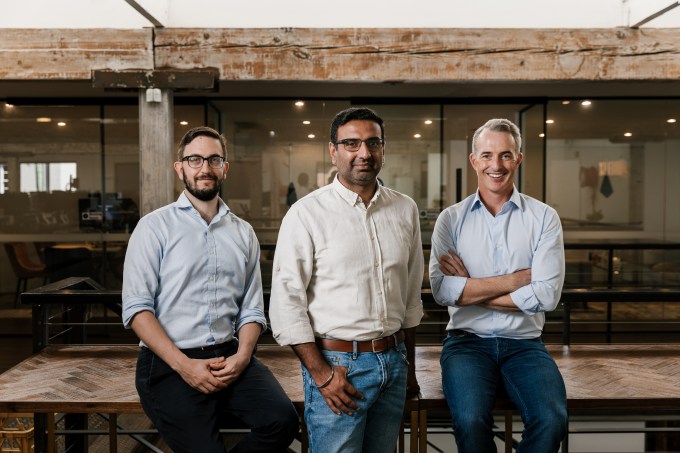
Neara co-founders Daniel Danilatos, Karamvir Singh and Jack Curtis
LiDAR imagery is captured by utility companies or third-party capture companies, instead of LiDAR. Some customers scan their networks to continuously feed new data into Neara, while others use it to get new insights from historic data.


“A key outcome from ingesting this LiDAR data is the creation of the digital twin model,” says Curtis. “That’s where the power lies as opposed to the raw LiDAR data.”
A couple examples of Neara’s work include Southern California Edison, where its goal is ”auto-prescription,” or automatically identifying where vegetation is likely catch fire more accurately than manual surveys. It also helps inspectors tell survey teams where to go, without putting them at risk. Since utility networks are often massive, different inspectors are sent to different areas, which means multiple set of subjective data. Curtis says using Neara’s platform keeps data more consistent.
In this Southern California Edison’s case, Neara uses LiDAR and satellite imagery and simulates things that contribute to the spread of wildfire through vegetation, including windspeed and ambient temperature. But some things that make predicting vegetation risk more complex is that Southern California Edison needs to answer more than 100 questions for each of its electric poles due to regulations and it’s also required to inspect its transmission system annually.
In the second example, Neara started working with SA Power Networks in Australia after the 2022-2023 River Murray flooding crisis, which impacted thousands of homes and businesses and is considered one of the worst natural disasters to hit southern Australia. SA Power Networks captured LiDAR data from the Murray River region and used Neara to perform digital flood impact modeling and see how much of its network was damaged and how much risk remained.
This enabled SA Power Networks to complete a report in 15 minutes that analyzed 21,000 power line spans within the flood area, a process that would have otherwise taken months. Because of this, SA Power Networks was able to re-energize power lines within five days, compared to the three-weeks it originally anticipated.
The 3D modeling also allowed SA Power Networks to model the potential impact of various flood levels on parts of its electricity distribution networks and predict where and when power lines might breach clearances or be at risk for electricity disconnection. After river levels returned to normal, SA Power Networks continued to use Neara’s modeling to help it plan the reconnection of its electrical supply along the river.
Neara is currently doing more machine learning R&D. One goal is to help utilities get more value out of their existing live and historical data. It also plans to increase the number of data sources that can be used for modeling, with a focus on image recognition and photogrammetry.
The startup is also developing new features with Essential Energy that will help utilities assess each asset, including poles, in a network. Individual assets are currently assessed on two factors: the likelihood of an event like extreme weather and how well it might hold up under those conditions. Curtis says this type of risk/value analysis has usually been performed manually and sometimes don’t prevent failures, as in the case of blackouts during California wildfires. Essential Energy plans to use Neara to develop a digital network model that will be able to perform more precise analysis of assets and reduce risks during wildfires.
“Essentially, we’re allowing utilities to stay a step ahead of extreme weather by understanding exactly how it will affect their network, allowing them to keep the lights on and their communities safe,” says Curtis.