

For most observers, the emergence of the Dangote refinery represents a glimmer of hope for Nigeria’s downstream petroleum sector.
For decades, the sector, despite its potentials, has been crippled by incessant petroleum imports, racketeering, alleged subsidy fraud, and smuggling.

The refinery has come to change that narrative.
Described as the true “game changer,” it is projected to slash Nigeria’s import bill by at least 40% and attract not less than $30 billion in foreign exchange inflows once it reaches full capacity.
More importantly, Nigeria, a country dependent on petrol imports since the 1970s, will now become a net exporter of the same product.
That shift, if realized, would be nothing short of an economic miracle.
Dangote himself has pledged to list the refinery on the Nigerian Stock Exchange, giving ordinary citizens a chance to own a part of the venture.
“Every Nigerian can now hold a part of the company,” he said while confirming the listing plan.
In a country where capital flight is common and investment risks are daunting, his commitment stands out.
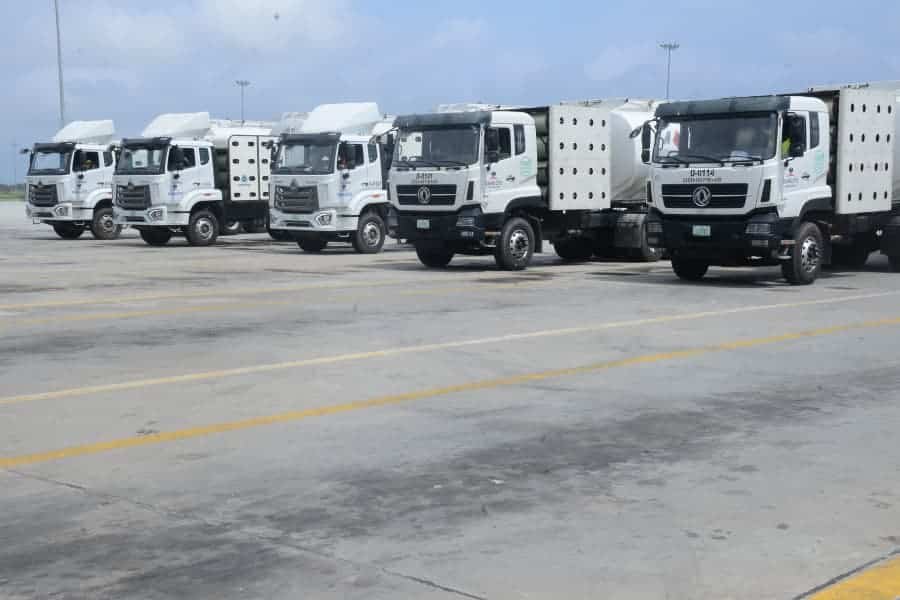
The company also announced plans to import about $470 million worth of trucks, around 4,000 in number, to distribute its products nationwide.
This, according to management, will ease logistics and bypass conventional middlemen who usually sit between refineries and retail outlets.
On the surface, this looks like a welcome development. But the realities on the ground raise questions that may soon prove daunting.
Some of the trucks have already arrived in Nigeria, with more expected.
The issue, however, is that Nigeria’s road infrastructure may not be able to absorb 4,000 heavy wheelers moving out from one location.
Lagos, a congested city
The mega refinery is located in Ibeju-Lekki, Lagos, close to the Atlantic Ocean.
Trucks leaving the site would have to pass through the Lekki–Ajah corridor, Ikoyi, and the Lekki Tollgate before connecting Lagos Island and the Third Mainland Bridge into the mainland.
This is a single linear route with limited alternatives.
For trucks heading to the northern part of the country, the Epe–Ijebu Ode–Owo axis remains the primary option, again a linear road with no significant bypass.
The challenge is obvious. Lagos is already one of the most congested cities in Africa, home to over 20 million people and more than 1.6 million registered vehicles.
Traffic jams in the city can stretch for hours, rivaling what you would see in Mumbai or New York.
But unlike those cities, Lagos lacks a network of alternate routes for heavy-duty trucks, leaving all road users competing for the same narrow corridors.
An observer for instance noted:
“When thousands of trucks are moving in and out of Apapa or the Lekki Free Zone daily, the ripple effects are felt not just in traffic jams as evidenced by the gridlock experienced in Victoria Island/Lekki axis 2 weeks ago but in productivity losses and rising urban maintenance costs.”
Lessons from Apapa’s corridor
Apapa provides a cautionary tale. Once a tranquil residential neighborhood, it has since become synonymous with traffic nightmares.
The Apapa-Oshodi Expressway and Wharf Road, home to Tin Can Island Port, are perennially gridlocked.
Trucks carrying containers in and out of the port have left motorists stranded for days, caused accidents, and worsened road degradation.
Government interventions ranging from checkpoints to road repairs and even truck impoundments have done little to stem the chaos.
Reports suggest that about 2,000 trucks pass through Apapa daily, half the number Dangote plans to put on the Lekki–Epe axis.
But Lekki presents an even sharper contradiction. Unlike Apapa, it is a high-end residential district, home to some of Lagos’ most elite enclaves.
The presence of 4,000 trucks daily would not only worsen congestion but also disrupt the urban character of the area.
The coastal highway option
Another potential outlet for Dangote trucks could come from the newly proposed Lagos-Calabar coastal highway.
The planned 700 km road is expected to link Lagos through coastal states like Ogun, Ondo, Delta, Bayelsa, Rivers, and Akwa Ibom before ending in Calabar, Cross River State.
This could connect Dangote trucks and others going through Lagos Island as an alternate route to other parts of the country.
The road is to cost the government about $11.88 billion, most of which would be borrowed.
Given various estimates, completion of the road will take up to eight years if all things go as planned and there is no abandonment due to changes in government, as has happened with many federal projects.
Given its current pace, only about 30 percent of the road has been completed despite the government already spending two years in office.
There are doubts that the road will be ready in eight years. Dangote cannot wait that long to begin distribution of his products.
The refinery needs to sell every refined litre in order to remain profitable, and this means doing everything possible to ensure supply.
An alternate route for export
Initially, the refinery was designed to transport products through the Atlantic Ocean for export to other countries.
The proximity to the sea was a key factor in siting it in Ibeju-Lekki.
However, the refinery also needs to capture Nigeria’s domestic market, which is easier to penetrate than disrupting established supply chains overseas.
It has already exported to countries such as Cameroon, Ghana, Asia, and the United States through the sea route, but that is not enough when a significant portion of buyers are inland.
Dangote has repeatedly claimed that he can meet Nigeria’s entire petrol consumption and still have enough left for export.
This would mean transporting inland from Lagos to Delta, to Kogi, to Abuja, to Kaduna, and every corner of the country where petrol is consumed.
The keyword here is that everything begins in Lagos.
The starting and ending point for the distribution would be Lagos, and it would only be through the limited routes mentioned earlier, at least for the next six years.
The question therefore is whether the possible congestion, road fragility, and prolonged traffic jams will be considered a necessary inconvenience for the energy security of the country.
A broken pipeline system
This is in no way Dangote’s fault. Any other refinery that comes on stream will most likely experience the exact same challenge of limited navigable roads across Nigeria.
Despite government efforts to expand road infrastructure and create multiple outlets for goods and services, the reality remains that routes are few and overstretched.
When it comes to petroleum, however, the deeper problem lies with pipelines.
Nigeria’s fuel distribution system was never designed to depend on trucks.
Oil and gas expert, Oliseyum Wakwe, put it quite succintly:
“This isn’t just a Dangote issue, it’s a national design flaw. Nigeria has over 5,000 kilometers of petroleum product pipelines, but much of it is either underutilized, vandalized, or in disrepair.
“If these networks were functional, they could move product from refinery to depot with far less environmental, economic, and urban disruption. A single pipeline corridor can displace hundreds of trucks per day. The contrast is stark.”
For much of its history, refined products moved through pipelines spread across the country.
The network also tied into Lagos import jetties at Atlas Cove and Apapa, creating a grid that delivered petrol, kerosene, and diesel efficiently, cheaply, and with less environmental risk.
That network has collapsed due to neglect, spills, and sabotage by non-state actors.
The failure to revamp the pipelines forced petroleum distributors to depend on trucks.
If Nigeria had a functioning pipeline system like most countries, Dangote would not need to spend $470 million importing trucks to move products nationwide.


