
• Business
  • Markets
  • Politics
  • Crypto
  • Finance
  • Intelligence
    • Policy Intelligence
    • Security Intelligence
    • Economic Intelligence
    • Fashion Intelligence
  • Energy
  • Technology
  • Taxes
  • Creator Economy
  • Wealth Management
  • LBNN Blueprints
  • Business
  • Markets
  • Politics
  • Crypto
  • Finance
  • Intelligence
    • Policy Intelligence
    • Security Intelligence
    • Economic Intelligence
    • Fashion Intelligence
  • Energy
  • Technology
  • Taxes
  • Creator Economy
  • Wealth Management
  • LBNN Blueprints

How Can a Locomotive Pull a Long Train That’s Much Heavier?

Simon Osuji by Simon Osuji
March 10, 2026
in Artificial Intelligence
0
How Can a Locomotive Pull a Long Train That’s Much Heavier?
0
SHARES
0
VIEWS
Share on FacebookShare on Twitter


The second difference is the equal sign instead of less-than-or-equal. This means the frictional force is constant as long as the object is sliding—it doesn’t equal the applied force anymore. That means the net force isn’t zero. Push harder on the chair by running and the chair will speed up.

Let’s go back to that tug-of-war. The driver on the right now has an idea: Instead of gunning his engine, he throttles down to maintain a static friction interaction with the rails. Slow and steady. The guy on the left floors it—and what happens? His wheels spin and he gets a kinetic frictional force. Well, static friction beats kinetic friction, so the right train wins!

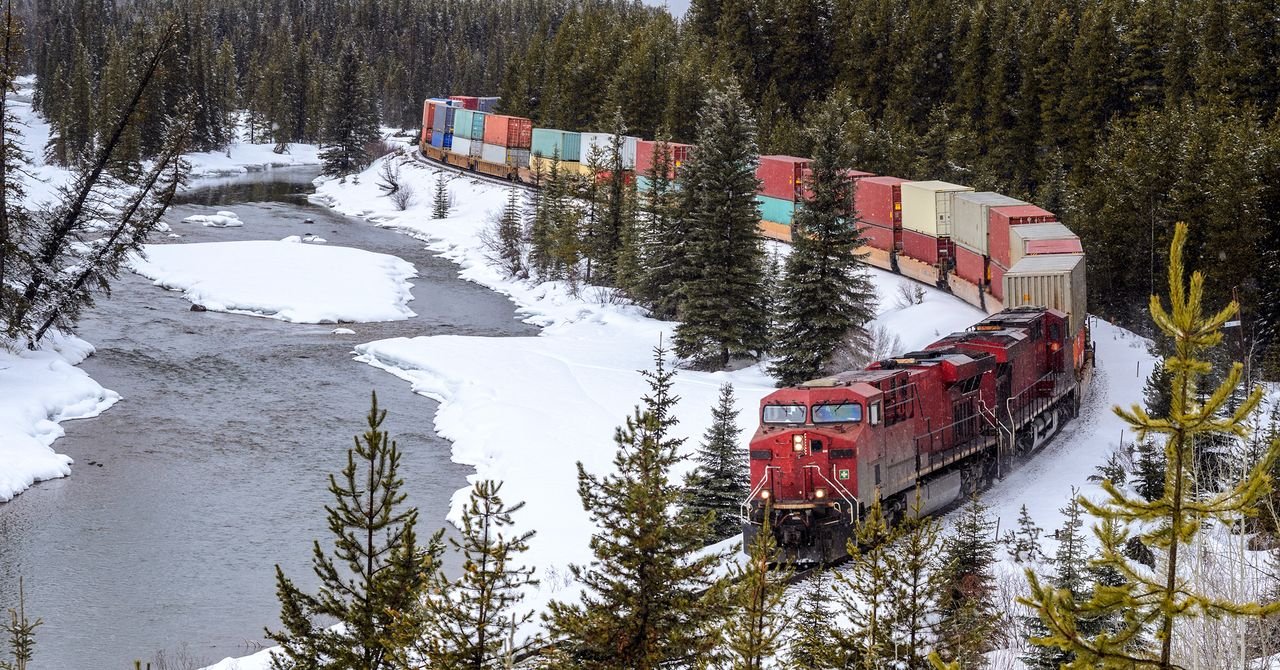
This would work even if the train on the left is somewhat heavier. So, it is possible for a train engine to pull cars that are more massive. But wait! There’s an even more important factor: A moving train car is rolling, not sliding. The wheel just touches the rail at one point and then rolls on to another point on the wheel. This is the magic of wheels: For the cars being towed, there is no longer any friction with the rails.

But there has to be kinetic friction somewhere, and indeed there is—it’s between the wheel axles and the car itself. To rotate, the axle has to slide along some surface in the housing that holds it in place. But with roller bearings and lubrication, μk can be massively reduced, from 0.56 for dry steel on steel to something like 0.002.

Now we’re talking! This is how a locomotive can pull a long train of cars with a much greater mass. The engine is pulling forward using steel-on-steel static friction, which is pretty high (0.74), giving it good traction. And the cars have a resistive kinetic friction force with a coefficient that is orders of magnitude smaller.

Some Extra Tricks

Still, that huge weight of 10,000 metric tons makes for a very high normal force—like roughly 100 million newtons. And remember, static friction is higher than kinetic friction. So even if you can keep a train moving, you might not be able to get it started.

That’s why trains have a trick called slack action. If you’ve ever been near a train as it starts moving, you probably heard a bunch of cracking that moves down the line of cars. The reason is that the connection from one car to the next is loose. So when the locomotive pulls the first car, the second car remains stationary until the slack is gone. With this trick, the locomotive can get one car moving at a time and add it to the group of moving cars. Pretty smart!

One last cool thing. There’s yet another type of friction called rolling friction. You see this on a truck with rubber tires: Under the weight of the vehicle, the tires flatten out on the bottom. So when the truck is moving, the tires are continually being deformed and returning to their proper shape. This flexing heats up the tires, and where there’s heat there’s energy loss. Since energy is conserved, this means the wheels slow down, and the truck has to burn more fuel to maintain its speed. Trains, on the other hand, have very little rolling friction, because their steel wheels barely deform at all. This makes trains a more energy-efficient mode of transportation.

So, you see—it is indeed possible for a locomotive to pull a bunch of cars that have more mass. You just need to use a little physics.



Source link

Related posts

Are Smart Beds Worth It? A Certified Sleep Science Coach Weighs In (2026)

Are Smart Beds Worth It? A Certified Sleep Science Coach Weighs In (2026)

March 10, 2026
The Agentic Payments Race Heats Up as Mastercard Goes Live in Singapore

The Agentic Payments Race Heats Up as Mastercard Goes Live in Singapore

March 10, 2026
Previous Post

Whoop launches a new blood test focused on women’s health

Next Post

Successful Erasmus Castle bidders have six months to complete refurbishment

Next Post
Successful Erasmus Castle bidders have six months to complete refurbishment

Successful Erasmus Castle bidders have six months to complete refurbishment

Leave a Reply Cancel reply

Your email address will not be published. Required fields are marked *

RECOMMENDED NEWS

FTX Co-Founder Sam Bankman-Fried Denied Release By Judge

FTX Co-Founder Sam Bankman-Fried Denied Release By Judge

2 years ago
House authorizers: cut F-35 purchases to fix problems

House authorizers: cut F-35 purchases to fix problems

2 years ago
New tool detects AI-generated videos with 93.7% accuracy

New tool detects AI-generated videos with 93.7% accuracy

2 years ago
Trade tariffs and geopolitics set to bolster gold’s appeal

Trade tariffs and geopolitics set to bolster gold’s appeal

1 year ago

POPULAR NEWS

  • Mahama attends Liberia’s 178th independence anniversary

    Mahama attends Liberia’s 178th independence anniversary

    0 shares
    Share 0 Tweet 0
  • Ghana to build three oil refineries, five petrochemical plants in energy sector overhaul

    0 shares
    Share 0 Tweet 0
  • The world’s top 10 most valuable car brands in 2025

    0 shares
    Share 0 Tweet 0
  • Top 10 African countries with the highest GDP per capita in 2025

    0 shares
    Share 0 Tweet 0
  • Global ranking of Top 5 smartphone brands in Q3, 2024

    0 shares
    Share 0 Tweet 0

Get strategic intelligence you won’t find anywhere else. Subscribe to the Limitless Beliefs Newsletter for monthly insights on overlooked business opportunities across Africa.

Subscription Form

© 2026 LBNN – All rights reserved.

Privacy Policy | About Us | Contact

Tiktok Youtube Telegram Instagram Linkedin X-twitter
No Result
View All Result
  • Home
  • Business
  • Politics
  • Markets
  • Crypto
  • Economics
    • Manufacturing
    • Real Estate
    • Infrastructure
  • Finance
  • Energy
  • Creator Economy
  • Wealth Management
  • Taxes
  • Telecoms
  • Military & Defense
  • Careers
  • Technology
  • Artificial Intelligence
  • Investigative journalism
  • Art & Culture
  • LBNN Blueprints
  • Quizzes
    • Enneagram quiz
  • Fashion Intelligence

© 2023 LBNN - All rights reserved.
