
• Business
  • Markets
  • Politics
  • Crypto
  • Finance
  • Intelligence
    • Policy Intelligence
    • Security Intelligence
    • Economic Intelligence
    • Fashion Intelligence
  • Energy
  • Technology
  • Taxes
  • Creator Economy
  • Wealth Management
  • LBNN Blueprints
  • Business
  • Markets
  • Politics
  • Crypto
  • Finance
  • Intelligence
    • Policy Intelligence
    • Security Intelligence
    • Economic Intelligence
    • Fashion Intelligence
  • Energy
  • Technology
  • Taxes
  • Creator Economy
  • Wealth Management
  • LBNN Blueprints

How AI and traditional web searches differ

Simon Osuji by Simon Osuji
October 29, 2025
in Artificial Intelligence
0
How AI and traditional web searches differ
0
SHARES
0
VIEWS
Share on FacebookShare on Twitter


The great search divide: How AI and traditional web searches differ
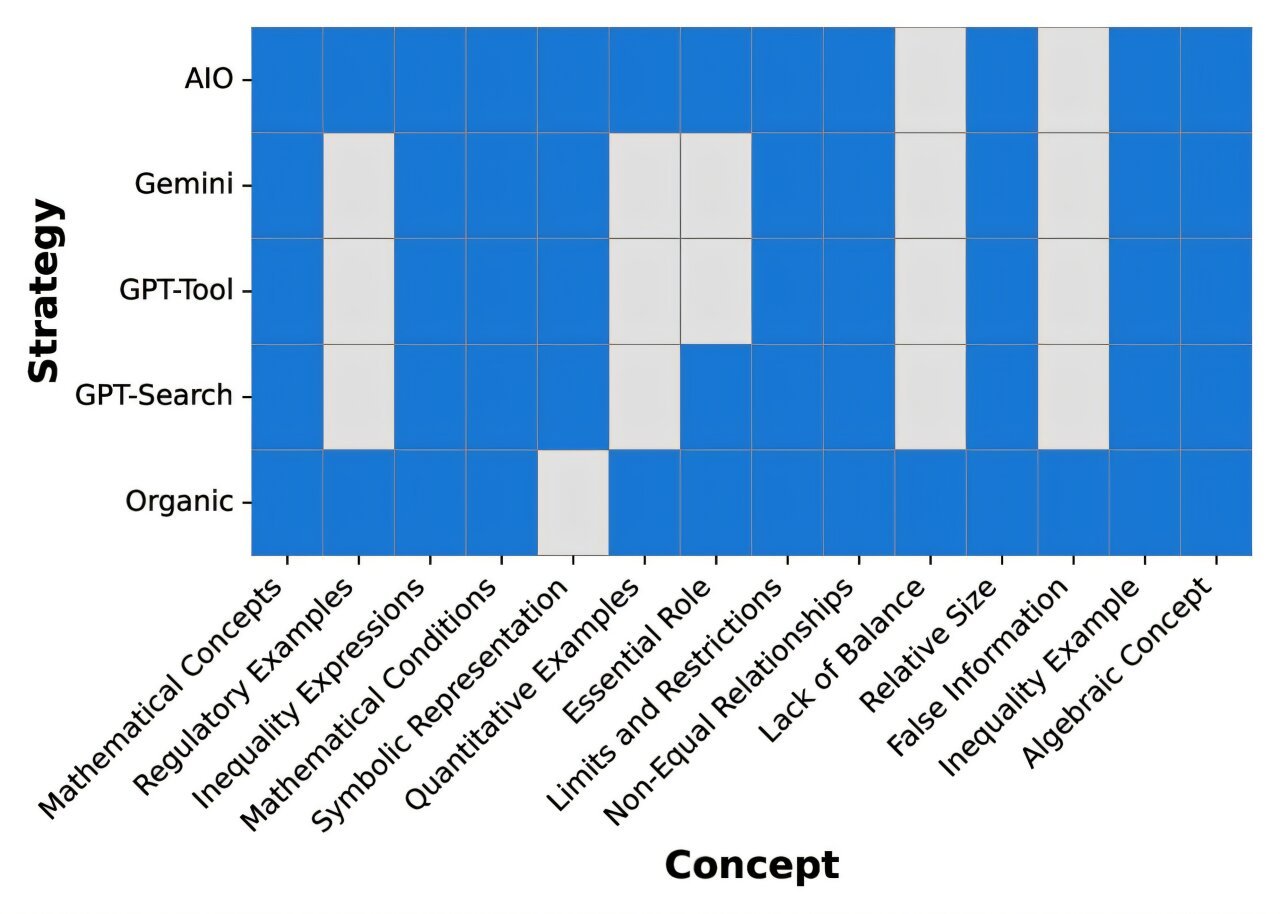
Concepts covered by different strategies for the query “What is an example of inequality?”. The x-axis shows the topics discovered in the search engine outputs (Section 5), the y-axis shows the search engines. Blue boxes indicate that the topic appeared in that engine’s output. Search engines differ in the concepts they bring up. Credit: arXiv (2025). DOI: 10.48550/arxiv.2510.11560

As anyone who uses the internet will know, the way we find information has fundamentally changed. For the last three decades, search engines have delivered ranked lists of links in response to our queries, and it was our job to search through them to find what we wanted. Now, major search engines use generative AI tools to deliver a single coherent answer, often embedded with a few links. But how does this approach compare with the traditional method? In a comprehensive new study, scientists compared these two approaches to see what we are gaining and losing.

Related posts

How the Olympic Torchbearers Are Chosen

How the Olympic Torchbearers Are Chosen

February 5, 2026
Moving experimental pilots to AI production

Moving experimental pilots to AI production

February 5, 2026

Comparing AI with traditional searches

To figure this out, researchers from Ruhr University Bochum and the Max Planck Institute for Software Systems compared traditional Google Search with four generative search engines: Google AI Overview (AIO), Gemini, GPT-4o-Search and GPT-4o with Search Tool. The team ran thousands of queries covering six main areas, including general knowledge, politics, science and shopping.

Then they made a detailed comparison of the two search styles based on three key metrics. First, they analyzed source diversity by checking the websites AI used against traditional search’s top links. Second, they measured knowledge reliance to see how much AI relied on its own internal memory rather than searching the web for fresh information.

Then they examined conceptual coverage to determine whether each AI’s final answers covered a broader range of ideas than traditional top search results. Finally, they reran the experiment two months later to see how quickly AI sources and answers changed over time.

Clear differences emerge

As the team outlined in their paper published on the arXiv preprint server, there are clear differences between the two. AI casts a wider net, pulling information from a more diverse set of websites than traditional searches, but the links it used were often not among the top search results. However, just because AI uses more sources doesn’t mean its answers are more comprehensive. In fact, that often wasn’t the case.

“Differences in source selection and internal knowledge use can subtly shift which perspectives and facts users are exposed to, even when overall topic coverage appears similar,” wrote the study authors.

AI answers also tended to be less stable over time, changing significantly after two months.

The researchers also discovered differences between the AI models. For example, GPT-4o with Search Tool relied on its internal memory, while Google AI Overview and Gemini constantly pulled information from a larger, fresh set of external sites.

Overall, the team did not conclude whether one type of search was better than the other, although there is a clear trade-off when using AI. Users receive a diverse, summarized answer, but lose the reliable sources and consistent results they get from traditional searches. Most notably, the authors emphasized the need for new benchmarks and standards to properly evaluate answers returned by AI.

Written for you by our author Paul Arnold, edited by Gaby Clark, and fact-checked and reviewed by Robert Egan—this article is the result of careful human work. We rely on readers like you to keep independent science journalism alive.
If this reporting matters to you,
please consider a donation (especially monthly).
You’ll get an ad-free account as a thank-you.

More information:
Elisabeth Kirsten et al, Characterizing Web Search in The Age of Generative AI, arXiv (2025). DOI: 10.48550/arxiv.2510.11560

Journal information:
arXiv

© 2025 Science X Network

Citation:
The great search divide: How AI and traditional web searches differ (2025, October 29)
retrieved 29 October 2025
from https://techxplore.com/news/2025-10-great-ai-traditional-web-differ.html

This document is subject to copyright. Apart from any fair dealing for the purpose of private study or research, no
part may be reproduced without the written permission. The content is provided for information purposes only.





Source link

Previous Post

African Development Bank approves $6 million grant to strengthen disaster risk management in Africa

Next Post

Russia’s Lukoil plans to sell some African oil and gas assets over sanctions

Next Post
Russia’s Lukoil plans to sell some African oil and gas assets over sanctions

Russia’s Lukoil plans to sell some African oil and gas assets over sanctions

Leave a Reply Cancel reply

Your email address will not be published. Required fields are marked *

RECOMMENDED NEWS

Four giraffe species officially recognised in major IUCN conservation reclassification – EnviroNews

Four giraffe species officially recognised in major IUCN conservation reclassification – EnviroNews

6 months ago
Cattle are drinking the Colorado River dry

Cattle are drinking the Colorado River dry

2 years ago
Telegram CEO Pavel Durov Arrested in France

Telegram CEO Pavel Durov Arrested in France

1 year ago
0xShibarium Aims To Be The First Standardized Platform on Shibarium

0xShibarium Aims To Be The First Standardized Platform on Shibarium

2 years ago

POPULAR NEWS

  • Ghana to build three oil refineries, five petrochemical plants in energy sector overhaul

    Ghana to build three oil refineries, five petrochemical plants in energy sector overhaul

    0 shares
    Share 0 Tweet 0
  • The world’s top 10 most valuable car brands in 2025

    0 shares
    Share 0 Tweet 0
  • Top 10 African countries with the highest GDP per capita in 2025

    0 shares
    Share 0 Tweet 0
  • Global ranking of Top 5 smartphone brands in Q3, 2024

    0 shares
    Share 0 Tweet 0
  • When Will SHIB Reach $1? Here’s What ChatGPT Says

    0 shares
    Share 0 Tweet 0

Get strategic intelligence you won’t find anywhere else. Subscribe to the Limitless Beliefs Newsletter for monthly insights on overlooked business opportunities across Africa.

Subscription Form

© 2026 LBNN – All rights reserved.

Privacy Policy | About Us | Contact

Tiktok Youtube Telegram Instagram Linkedin X-twitter
No Result
View All Result
  • Home
  • Business
  • Politics
  • Markets
  • Crypto
  • Economics
    • Manufacturing
    • Real Estate
    • Infrastructure
  • Finance
  • Energy
  • Creator Economy
  • Wealth Management
  • Taxes
  • Telecoms
  • Military & Defense
  • Careers
  • Technology
  • Artificial Intelligence
  • Investigative journalism
  • Art & Culture
  • LBNN Blueprints
  • Quizzes
    • Enneagram quiz
  • Fashion Intelligence

© 2023 LBNN - All rights reserved.