
Yemen’s Ansar Allah – commonly known as the Houthis – and Somalia’s two proscribed terrorist organisations, al-Shabaab and Islamic State in Somalia (IS Somalia), are reportedly deepening ties.
How could this impact the tools of war, especially lethal drone technology, which is increasingly a hallmark of Ansar Allah’s operations backed by its powerful ally, Iran? Will the relationship with the United Nations (UN)-sanctioned group influence how Somalia’s violent extremist groups fight or are perceived regionally?
Technology transfer between armed groups is better understood since the proliferation of improvised explosive devices following conflicts in Iraq (2002) and Afghanistan (2001-2021). Migration of foreign fighters and access to 3D printing have ramped up these groups’ ability to exploit arms trafficking channels, share knowledge, access components or inspire others. The proliferation of military-grade drones in Africa makes this an even more crowded space.
Al-Shabaab has to date used drones largely for propaganda, intelligence and surveillance rather than attacks. UN monitors describe its relationship with Ansar Allah as ‘transactional or opportunistic’ – the pair having shared interests in smuggling routes and access to revenue streams.
However, there is evidence that al-Shabaab may seek a more lethal use of drones. The UN monitors note that in meetings between the two groups in 2024, al-Shabaab’s leadership requested ‘advanced weapons and training’ from Ansar Allah.
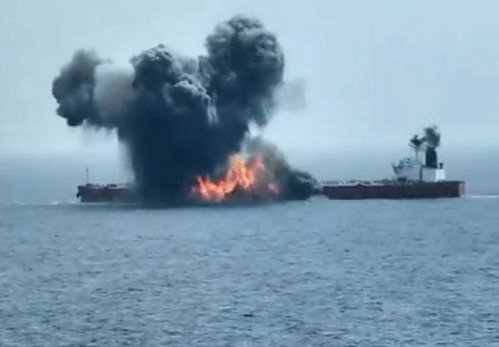
Ansar Allah has demonstrated a penchant for using drones, seen during attacks on commercial ships during the Red Sea crisis that began in 2023. Some of the group’s equipment and components were traced directly to Iran, ‘and were likely mostly domestically assembled Sammad-series [unmanned aerial vehicles],’ Conflict Armament Research’s Head of Gulf Operations Taimur Khan told ISS Today.
‘The Houthis procure the internal dual-use components themselves and make the airframes domestically.’ They also use commercial off-the-shelf drones.
Al-Shabaab, IS Somalia and Ansar Allah mutually benefit from working together. A Carnegie Endowment for International Peace report, which includes interviews with coastguards, claims that, ‘Somalia’s porous coastlines have become critical to ensuring that the group has access to Iranian supplies of Chinese equipment necessary for the growth of its Iranian-supported drone and missile programme.’ And Somalia’s armed groups allegedly benefit from training and more sophisticated drones.
IS Somalia is also experimenting with drones. In Puntland, where it has a foothold, the group’s first recorded drone strikes – on the Puntland Security Force – were in January 2025. In the six months before, security officials seized five suicide drones ‘dispatched by Ansar Allah … and arrested seven individuals’ linked to Somalia’s two main extremist groups.
Furthermore, the UN monitors said that in May 2024 ‘[IS Somalia] employed unmanned aerial vehicles for reconnaissance and limited explosive deployment … It is assessed that the programme was aimed at building suicide unmanned aerial vehicles.’ This either suggests cooperation between Yemen and Somalia’s armed groups or that they draw inspiration from each other.
Owning drones is important for armed groups’ power projection. Media focus on suicide or first-person view drones used for short-range missions. These enable operators to receive real-time information, and are ‘one of the deadliest threats to civilians in frontline areas,’ say UN human rights monitors in Ukraine. They are regarded as a game-changer in asymmetric warfare and seem highly coveted by armed groups, including Ansar Allah.
But how likely are these weapons to be routinely used in Somalia? ‘There have been … seizures of FPV [drone] components being smuggled into Yemen, but Conflict Armament Research has not seen FPV drones being used by [al-Shabaab], although it does not mean it has never happened,’ says Khan.
Assault rifles are still the main weapon smuggled into the region, but experts say greater drone proliferation seems almost inevitable. ‘Once this technology is adopted [by] a particular terrorist group, the ideas will proliferate in the region and be picked up by other armed groups, even if there are no direct links between those groups,’ says Khan.
Pre-existing supply routes for other forms of contraband can easily be repurposed. The relationship between Ansar Allah and al-Shabaab provides greater access for al-Shabaab to more sophisticated arms, and smuggling routes and financial opportunities for Ansar Allah.
Closer ties with extremist groups in Somalia also mean that Ansar Allah – and more so Iran, which provides it with military, financial and logistical support – gains ‘strategic depth,’ says the Carnegie Endowment. Via its Yemeni proxy, Iran can help ‘shape the maritime security architecture of the Gulf of Aden and Bab-al-Mandab Strait,’ the site of many commercial shipping attacks.
It also potentially increases threat perceptions in the region, especially in Ethiopia, Somalia, Djibouti and Kenya. This will force militaries to allocate more resources to air defences, says Institute for Security Studies (ISS) Maritime Senior Researcher Timothy Walker.
There is also a psychological and diplomatic effect of more lethal technology transfer, says ISS Senior Researcher Moses Okello. He suggests the mere threat of owning lethal drones or having access to components and supply routes, may impact diplomacy such that ‘insurgents may be less willing to take part in political discussions.’
For the African Union Support and Stabilization Mission in Somalia, the prospect of lethal drones in the hands of al-Shabaab is alarming, Okello adds. ‘Offensive drones have not yet taken root, but al-Shabaab is said to be adapting commercial drones, adding payloads to them.’ Insurgents need only one successful drone strike to impact the conflict’s direction.
Peacekeepers know that for now, assault rifles are still the weapon of choice in Somalia. But sharing technology and expertise with a key player in Yemen’s complex proxy war could recast the conflict in the Horn of Africa and beyond.
Written by Karen Allen, Consultant, ISS Pretoria.
Republished with permission from ISS Africa. The original article can be found here.