


On Nooitgedacht farm near Kenhardt in the Northern Cape, drought isn’t a crisis – it’s a way of life. But by improving soil health, Charl Saunderson has managed to make his land more resilient and productive in one of South Africa’s toughest farming regions.
– ADVERTISEMENT –
There isn’t much you can tell Charl Saunderson and his wife, Isabel, about drought.
Their farm, Nooitgedacht, near Kenhardt in the Northern Cape, receives an average of just 130mm of rain a year – with some years being far drier – and others, occasionally, a lot or a little wetter.
“Drought isn’t an eventuality here, it’s a way of life. You have to plan for it,” says Saunderson. “There’s not much you can do about the weather, but on a sheep farm like ours, improving soil health can go a long way in buffering you against long dry spells.”
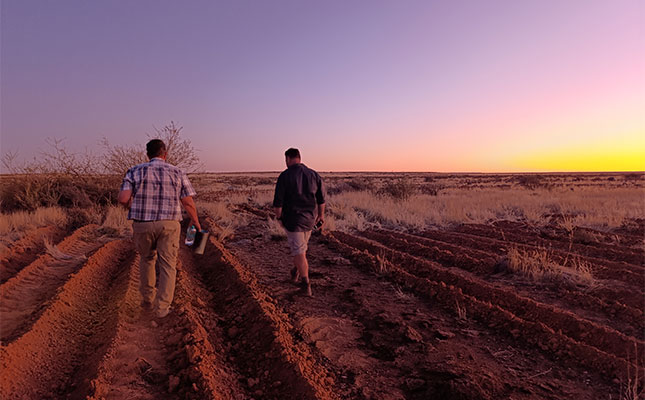
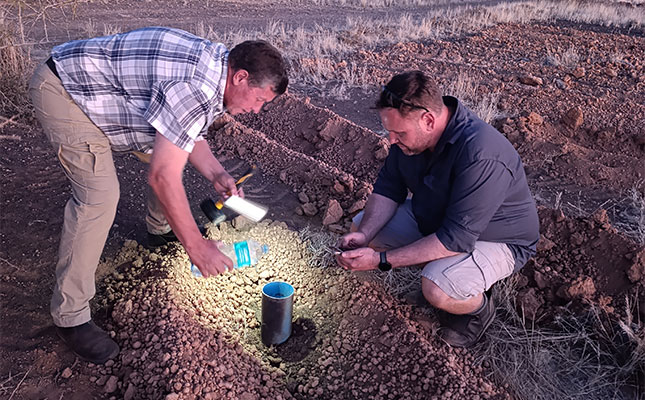
But how? As the sun sets over the Boesmanland, Saunderson picks up a 30cm-long pipe, about 10cm in diameter, to demonstrate the difference between compacted and healthy soil.
Near the farmhouse lies a patch of land where, in his great-grandfather’s time, farmers from the region used to bring their sheep to drink. When Saunderson pours 500ml of water through the pipe onto this soil, it takes more than 15 minutes for the water to seep in.
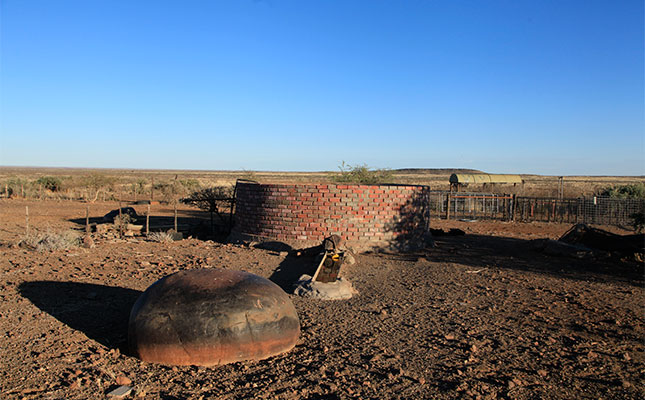
“The test shows what happens when you get heavy rains,” he explains. “The soil is so compacted that the water simply runs off, leaving it dry and barren. It will take years to rehabilitate this land from the damage done in the 1920s and 1930s.”
Water infiltration tests from other parts of the farm tell a different story.
Where the soil has been ripped to break compaction, the water takes less than half the time to sink in, sometimes even shorter. In areas that have been ripped and enriched with organic matter, the water disappears within seconds.
“This is what you want when you receive rain,” he says with a smile.
Removing invasive species
Saunderson was named the Climate Smart Ambassador of 2024 for his efforts to restore and bring life back to the soil on his farm.
He is quick to point out, however, that the rehabilitation journey began long before his time.
“My dad, Charl, had the most astonishing insight into the veld, while my granddad, also Charl, was one of the best stockmen I’ve ever known. I was truly blessed to work with and learn from them,” he says.
The first steps toward restoring the land started around 1976, when his father began removing the invasive Prosopis trees that had spread across the farm.
Farmers in the region had originally planted these trees under guidance of the then government to provide fodder, shade and firewood, but they soon became a problem due to their aggressive growth and deep-rooted nature, leading to the degradation of grasslands.
“Prosopis is a pest because it drains all the moisture from the soil, leaving nothing for the natural vegetation and negatively influence the ground water table. Removing those trees laid the foundation for everything that followed,” he explains.
Today there are no Prosopis trees left on the farm, and Saunderson has since turned his attention to removing other alien species.
Dealing with compaction
To tackle soil compaction, Saunderson and his father decided to rip the soil. “At the time, ripping the veld was completely unheard of in our region, and even today many of my peers think I’m crazy for doing it,” he says.
To start with, Saunderson’s father visited several farms where ripping was practised with varying success. In the end, he was most impressed by what he saw at Francis Visagie’s farm, also in the Boesmanland, and decided to adopt a similar approach.
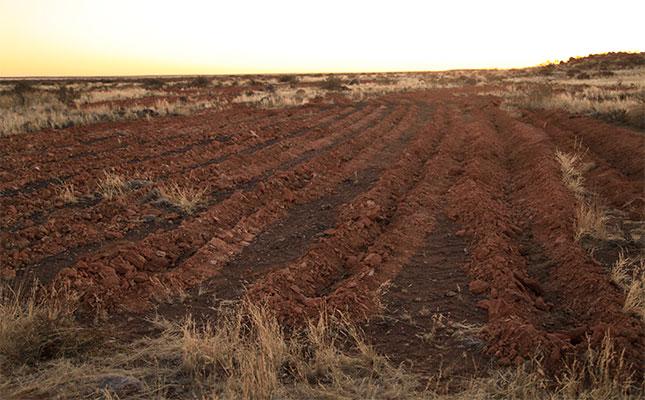
With this method, the soil is ripped about 30cm deep for 4m, leaving 2m of undisturbed soil between each ripped strip. The spacing between the ripped rows is also 4m.
“The goal is not only to break up compacted layers, but to slow the movement of water across the surface and reduce run-off. It is like pruning a crop to improve yields,” says Saunderson.
He adds that each area is ripped only once in its lifetime. “If you do it right, you never need to do it again.”
Building on this approach, Saunderson has started experimenting by almost doubling the length of the ripped sections and reducing the space between the rows to 50cm. He also incorporates organic material into the ripped areas to accelerate soil recovery.
The organic mix consists mainly of sheep dung collected from beneath shade structures and the handling area, combined with ash from dead animals. The carcasses are collected in a cement zinc dam, then burned at high temperatures until only a fine ash remains – similar to how biochar is produced.
Alongside this, Saunderson no longer waits for natural vegetation to return on its own. Instead, he harvests seed from desirable plants growing in the veld, such as ganna bush, which he affectionately calls ‘Kalahari gold’ for its high protein content. These seeds are mixed with the organic material before being sown into the ripped soil.
“You need a long-term vision for this type of work,” he says. “It took about 20 years for the veld to recover after my dad began rehabilitation efforts in the 1980s, and another 20 years to lift the farm’s potential above average. Today, Nooitgedacht has a carrying capacity of 30ha per large stock unit, compared to the regional average of around 39ha.”
Sheep production
To make the most of what the veld offers, Saunderson runs both a commercial Dorper flock and a Dorper stud, while Isabel manages a White Dorper stud.
“I grew up with Merinos, but my dad switched to Dorpers in the 1980s when we realised how much better suited they were to our harsh veld and erratic climate,” he says. “They’re not fussy eaters, they cope well in dry conditions, and their carbon footprint is relatively low.”
Saunderson keeps meticulous performance records and works closely with a genetic specialist, Daan Bosman, to guide his mating decisions.
“The goal is to breed hardy, fertile sheep that can thrive on natural veld and produce at least 1,5 lambs per ewe per year, with a lambing interval of 270 days to 300 days,” he says.
He has experimented with shortening the lambing cycle to 240 days, but found that it led to fewer multiple births and a greater risk of running into feed shortages.
“In our environment, balance is everything,” he says.
Sheep are managed on a four-camp rotational system. Each flock is rotated between three of the camps roughly every two months, depending on grazing quality, while the fourth camp is rested and rehabilitated.
“This gives the veld time to recover and ensures we don’t undo the soil work we’ve done over the years,” he explains.
He adds that high-density grazing wouldn’t work on his farm, because of the region’s low rainfall.
“The idea with high-density grazing is to simulate the movement of large herds of game, but remember that game movements followed the path of the rain.”
Selection pressure is high; even stud ewes are culled if they fail to lamb or raise a lamb successfully.
“Drought is often when you really see which animals belong here. It’s a tough time, but it’s also an opportunity to reset the flock and strengthen its genetics for the future.”
Where most livestock farms employ only a couple of workers, Saunderson has six, without whom he admits he could not have thrived.
“My workers are exceptionally skilled, hard-working, and passionate about what they do. The worker in charge of the flock is a real flockman, with an uncanny ability to pair lambs with their mothers, and he knows almost each sheep by sight as they age.”
One worker is dedicated to continuously inspecting the farm and repairing fences.
“Besides drought, our biggest risk is predation, particularly from jackals and caracal. We have jackal-proof fencing with electricity, but it’s useless if the electricity is not permanently on,” he says.
Planning and continuous learning
While soil, veld and flock management form the backbone of Nooitgedacht, Saunderson stresses that long-term success also depends on planning, continuous learning and the willingness to take small but consistent actions every year.
He understands the power of sharing knowledge and doesn’t hesitate to draw on the experience of fellow farmers, experts, consultants and specialists to help make informed decisions.
“Even exceptional sportsmen like [Roger]Federer and [Novak] Djokovic employ trainers to reach the top of their sport. Why should it be any different for farmers?” he asks.
Each year, he sits down to review his plans and sets out short-term, medium-term and long-term goals.
“You need to differentiate between the time frames and identify practical steps to achieve them,” he advises.
He acknowledges that finances sometimes limit what a farmer can do in a given year.In those cases, he says, it’s better to do what you can, than to do nothing.
For more information email Charl Saunderson at [email protected].
Get trusted farming news from Farmers Weekly in Google Top Stories.
➕ Add Farmers Weekly to Google
✔ Takes 10 seconds · ✔ Remove anytime


