

 Download this post…
The 250th anniversary will sport celebrations everywhere as Technocracy and Technocrats slither around to provide the exploding cake. The war with Iran provides emergency powers to do unthinkable and unspeakable things to our nation. Americans are already in a state of shock with the uncertainty of war, which is the perfect scenario for Technocrats to practice the “Science of social engineering.” ⁃ Patrick Wood, Editor.
A 112,000-word book called America at 250: A Beacon for the AI Age is launching at Harvard on May 1, 2026 — timed to America’s 250th birthday. Its authors are former Massachusetts Governor Michael Dukakis and the CEO of the AI World Society (AIWS), a UN Centennial Initiative contributor. Every organization named in this article is marketing democracy to subvert the Republic — deliberately deploying the language of freedom, renewal, and citizen governance to dismantle the fixed constitutional foundation that makes those words mean anything at all. The book proposes replacing the Declaration’s metaphysical framework — unalienable rights grounded in fixed human nature — with an AI-governed “enlightened governance” order certified by unelected international bodies. It is not a birthday gift to the Republic. It is a blueprint for its supersession.
Every technocratic project in history has begun with the same quiet philosophical move: replacing Being with Becoming, as Parmenides and Heraclitus first opposed and Plato and Aristotle later codified. Once there is no fixed human nature, there are no unalienable rights — only certified permissions. The book launching on America’s 250th birthday is not a birthday gift to the Republic. It is a blueprint for that substitution, dressed in the language of the Founding it intends to supersede.
The Boston Global Forum (BGF) and its sister organization the AI World Society have announced the publication of America at 250: A Beacon for the AI Age, co-authored by former Massachusetts Governor Michael Dukakis and BGF CEO Nguyen Anh Tuan. The ebook was published on June 30, 2025, and the launch is scheduled for May 1st, 2026 at Harvard’s Loeb House — timed with ceremonial precision prior to the nation’s 250th birthday. As the Boston Global Forum’s own announcements describe it, the event took place at “Harvard University’s historic Loeb House” (repeated across multiple BGF press releases, including the official launch announcement and conference preview on bostonglobalforum.org). This choice of venue is no accident: Loeb House is repeatedly framed in BGF materials as a “historic” site ideal for convening “eminent thinkers, policymakers, and business leaders” in an atmosphere of global significance—much like their prior events there, such as the 2025 World Leader in AI World Society Award presentation and the “AIWS for New Democracy” conference, both held at the same “historic Loeb House.”
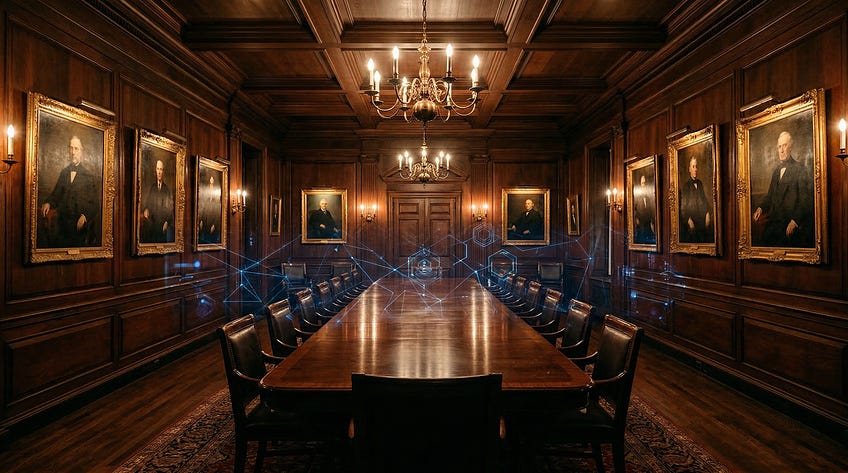
Institutional legitimacy as camouflage: the elite academic setting where technocracy wears the face of tradition.
Of course, selecting a prestigious Harvard address is a common tactic for organizations seeking to borrow institutional credibility and signal seriousness on the world stage—think tanks, policy forums, and international initiatives do it routinely to draw attention and participants. Yet in this context, the address matters precisely because it sells legitimacy: a 112,000-word blueprint for AI-governed “enlightened governance,” presented in the shadow of one of America’s most elite academic institutions, frames technocratic redesign as an extension of enlightened tradition rather than a departure from it. The venue doesn’t prove malice, but it amplifies the pattern—wrapping transnational AI frameworks in the aura of Harvard’s historic prestige while quietly proposing to supersede the Republic’s fixed foundations.
Twenty chapters. Over 112,000 words. Described by its own authors as “not a history but a vision — an offering to the country we love.”
How lovely.
Let me tell you what the vision actually is — and why you should be deeply, alarmed.
The conference brought together leaders around what it called its “central message”: that in the AI Age, America’s enduring strength is “not only national power, but the capacity to design a trusted AI order that the world chooses to join — grounded in freedom, human dignity, accountability, and shared prosperity.”
Each word in that sentence is load-bearing. ‘Design’ presupposes a designer with authority — not a citizenry with rights. ‘Trusted’ presupposes a certifying body — not a Constitution with fixed protections. ‘An order the world chooses to join’ presupposes that non-participation is a meaningful option — a guarantee no opt-in system has ever honored once its infrastructure becomes universal. The Declaration of Independence does not offer an order to join. It recognizes rights you already possess.
I have been watching the AI World Society and the Boston Global Forum for some time. In The UN’s AIWS Vision and Its Constitutional Risks (April 2025), I documented in detail how AIWS is not an independent AI ethics initiative — it is a UN Centennial Initiative contributor, positioned as a building block toward a transnational framework where AI and blockchain technologies manage resources, enforce ethics, and mediate human interactions on a planetary scale. And in “Exit & Build” to Tesla’s Wireless World Brain (March 2026), I traced how AIWS’s “opt-in” model of virtual cities and interoperable governance ecosystems is designed to harden into planetary infrastructure — where sovereignty fragments into algorithmic permissions, behavioral data becomes the currency of participation, and UN-aligned standards quietly supplant national constitutions. The opt-in always becomes the only option once the infrastructure is complete. So when I tell you this book is not what it appears to be, I am not speculating. I am pattern-matching against a documented architecture.
The most charitable way reading of this coalition presents itself is straightforward: it claims that AI governance is coming whether constitutional republics engage with it or not, and insists that it is better to have American voices — steeped in the language of rights and dignity — shaping international frameworks than to cede that field to actors with no such tradition. One could argue that Michael Dukakis is not a Bond villain, and the scholars at Harvard’s Loeb House are not reading from a script of deliberate deception. With a deeper glance, America at 250 functions less as a neutral exercise in civic reflection than as a bid to legitimize a particular technocratic governance framework — complete with its own institutional ecosystem and funding architecture — under the banner of American values. It dresses an ambitious project of AI-driven “governance 24/7” in the rhetoric of rights, dignity, and democratic renewal, while leaving open the question of who, exactly, will wield these tools and to whom they will be accountable.
This is the argument that must be taken seriously — because it is the argument most readers will find instinctively reasonable, and because it is precisely the argument that has justified every previous expansion of transnational governance beyond democratic reach. Good intentions and catastrophic architecture are not mutually exclusive. The road to the noosphere is paved with them.
You’ve Seen This Before. I’ve Documented It.
If you have been following this work, you don’t need me to convince you that technocracy is real, that it has a long history, and that it operates most effectively when it wears the face of something you already trust. That is the entire thesis of The Final Betrayal: How Technocracy Destroyed America, the book I co-authored with Patrick Wood — the foremost expert on technocracy’s origins, its re-emergence through the Trilateral Commission in 1973, and its full-bore capture of governance today.
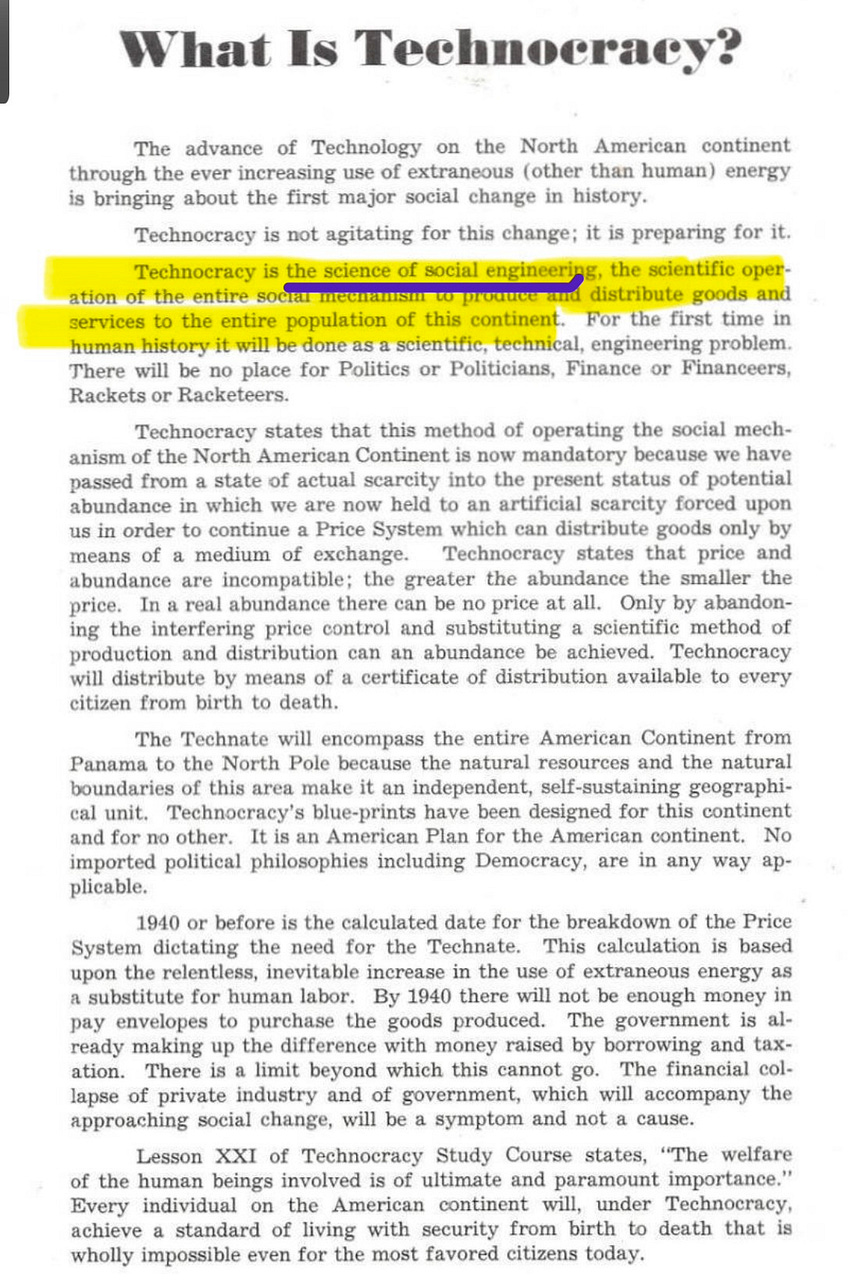
To understand what the Trilateral Commission adopted in 1973, the two pillars of historic Technocracy must be stated precisely. The first is social engineering — the application of scientific management to human behavior, replacing the consent of the governed with expert administration of populations. Technocrat magazine called it the “science of social engineering” in 1937, the same phrase that appears verbatim in the screenshot I inserted above in reference to treatment of Andrew Yang’s governance model. The second pillar is economic: Technocracy Inc. emerged directly from the Great Depression as a proposed replacement of the price system — money, wages, market exchange — with an energy accounting system. In Howard Scott and M. King Hubbert’s framework, every citizen would receive “energy certificates” — non-transferable, expiring units of energy allocation — instead of money, issued and tracked by a centralized scientific administration. You could not save them. You could not accumulate them. You could not opt out of the system that issued them. The Trilateral Commission, co-founded by Zbigniew Brzezinski and David Rockefeller in 1973, quietly adopted a modernized version of this architecture as its “New International Economic Order” — with the explicit goal, as Patrick Wood documented alongside Antony Sutton in Trilaterals Over Washington, of owning and controlling the world’s major resources. The price system was to be replaced not with energy certificates in their crude 1930s form, but with the far more sophisticated infrastructure of Sustainable Development, carbon accounting, and now digital asset certification — all of which measure, allocate, and restrict human economic activity through a scientifically managed metric rather than a free market. Much evidence indicates the green economy was not a climate project. It was the energy accounting system, rebranded. When the climate carrier signal lost cultural purchase — when net-zero fatigue set in and the Davos crowd pivoted to AI at their 2026 summit without missing a step — the underlying architecture did not change. Only the fear being managed did. The social impact finance rails, the digital identity infrastructure, the behavioral certification layer: these are the energy certificates of the AI Age. Human beings, in this system, are not citizens with unalienable rights. They are human capital nodes whose outputs are measured, allocated, and optimized by a scientific administration that no election can reach.
I outline what this may look like in my Proof of Persona article:
Patrick and I wrote that book precisely because the dark horse of the New World Order was never Communism, Socialism, or Fascism in isolation. It has always been Technocracy. And its consistent, recurring tell is that it never announces itself as what it is. It announces itself as the solution to whatever is currently frightening you.
In my article Hegel’s Dialectic, a Gnostic Jacob’s Ladder & the Machinery of Control, I mapped the philosophical mechanism by which this operates: thesis meets antithesis, conflict is manufactured or amplified, and a pre-determined synthesis emerges — always trending toward greater centralization, always disguised as resolution (Hegel used different terminology which is explained in that article). The Fabians understood this well — their mascot was the tortoise, slow and steady incrementalism — and their coat of arms was the wolf in sheep’s clothing, a direct nod to the Hegelian method.
Today, what’s frightening Americans is the state of the Republic-justifiably. Before proceeding, one correction must be stated plainly, because the entire coalition under examination depends on the confusion remaining uncorrected: America is not a democracy. It never was. The Founders were explicit — and alarmed — on this point. Madison distinguished the republic from a democracy in Federalist No. 10 precisely because pure democracy is mob rule with better branding. A constitutional republic subordinates majority will to permanent law — to the fixed, pre-political rights that no vote can revoke. Every movement in this convergence calls itself democratic. None of them calls itself republican — in the constitutional sense. That is not an oversight. Democracy is manageable. A republic, properly understood, is not — because its foundation cannot be put to a vote.
Right on cue, in response to the pervasive fear, an internationally credentialed governance body has arrived — holding court at Harvard’s Loeb House, because the address matters when you’re selling legitimacy — with a 112,000-word blueprint for how to fix it. Using AI. On America’s birthday. With a Declaration.
The Phoenix Symbolism Is Not Accidental

The phoenix does not restore what was. It replaces it with something new, wearing its ashes.
I need you to pause on the name of one of the movements gathering beneath this same banner: Operation Phoenix — an electoral initiative organized through the United Independents PAC and the Better Governance Institute, aiming to elect a slate of independents to Congress in 2026.
In my research report The Phoenix Conspiracy, I documented the alchemical and occult symbolism of the phoenix — the bird that burns the old order to ash so a new order can rise from it — as a recurring motif among the networks engineering what I called (drawing from Brett Weinstein’s speech at Rescue the Republic) the “phoenixing of the republic”: the deliberate collapse of Constitutional governance and its replacement with a corporate-controlled surveillance state. The phoenix doesn’t restore what was. It replaces it with something new, wearing its ashes.
The book announcement declares that “America’s third century must be defined by technological pioneering, a vibrant innovation economy, and moral leadership rooted in enlightened governance.” Enlightened governance. That phrase has a history. It is the Hegelian State made palatable — the idea that the rational unfolding of history through expert administration is itself the moral good. It is not the Declaration’s moral framework, which roots leadership not in esoteric enlightenment but in self-evident truth and the consent of the governed. The difference is not semantic. It is the entire argument.
Consider: we have a book launching just before America’s 250th birthday called America at 250: A Beacon for the AI Age — framing the Founding not as a completed metaphysical architecture to be preserved, but as a launching pad for a new AI-governed world order. We also have an electoral movement literally named Operation Phoenix claiming to restore citizen governance while running candidates through technocratic certification frameworks.
Its difficult to accept either is burning the Republic accidentally. Most people, at least superficially, understand exactly what the phoenix symbol means.
Operation Phoenix and the Generate Democracy Network
Who Is Actually Behind Operation Phoenix
Despite how it’s being portrayed, Operation Phoenix is not a grassroots citizen uprising. It is an orchestrated electoral initiative running through two institutional vehicles: the United Independents Campaign Fund (UIPAC) and the Better Governance Institute. The UIPAC’s own website describes its mission as electing “a new bloc of independent leaders to Congress” through what it calls “engineered wins” — a phrase that should stop any careful reader cold. The language is quite pointed: “We Engineer Wins.” Not earn wins. Not earn the trust of voters. Engineer them. That is the vocabulary of systems design, not self-governance.
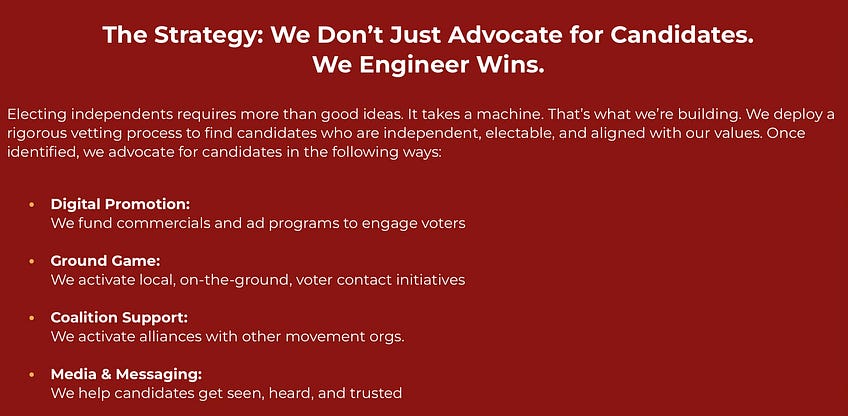
The UIPAC’s own website describes its mission as electing “a new bloc of independent leaders to Congress” through what it calls “engineered wins”
It is worth pausing to identify exactly who assembled this architecture. The Better Governance Institute — the think tank that trains and certifies the candidates Operation Phoenix intends to send to Congress — is directed by Christopher Life, whose LinkedIn and organizational bio describes his mission as “systemic transformation” inspired by integral theory and evolutionary governance frameworks. His co-organizer in the United Independent Movement is Benjamin Ross (aka Benjamin Life), whose own self-description identifies him as an “evolutionary myth-maker” and “meta-coherence steward” — language drawn directly from Daniel Schmachtenberger’s Game B and Ken Wilber’s Integral Theory frameworks. Ross describes One Nation’s governance architecture as “multi-axis voting” that activates “collective intelligence” rather than representative consent — a direct implementation of the participatory technocracy. The movement’s primary funder and launchpad financier is Brock Pierce — cryptocurrency mogul, former associate of Steve Bannon, and attendee of Jeffrey Epstein’s 2011 ‘Mindshift’ conference on Little St. James island. Pierce funded the Independent National Convention (INC23) in April 2023, where Brett Weinstein delivered the keynote and the United Independent Movement was formally launched. The philosophical heart of this ecosystem is provided at least in part by Charles Eisenstein — senior advisor to RFK Jr.’s 2024 presidential campaign, author of Sacred Economics, and one of the most prominent popularizers of the “Story of Interbeing” that is the metaphysical foundation of Game B. Eisenstein’s Sacred Economics advocates for negative-interest currency, gift economies, and the dissolution of what he calls the “Myth of Separation” — which is, in precise philosophical terms, the dissolution of the individual sovereign self that the Declaration of Independence presupposes. It replaces unalienable individual rights with relational nodes in an interdependent web — which is the Game B cosmology in economic veil. After RFK Jr. endorsed Trump, Eisenstein — paid up to $21,000 per month as Kennedy’s senior messaging advisor — published an essay laying out six principles for how Trump could accomplish “a revolution of and not against the system,” explicitly offering those principles to the incoming administration as a governing framework. He told his 80,000 Substack subscribers during the campaign that “winning the campaign is not the end goal”. That sentence is the tell. For Eisenstein, electoral vehicles are delivery mechanisms for a deeper cultural and cosmological project — whichever one is currently open.
This is the personnel layer of the synthesis I have been mapping. The governance certification architecture (Better Governance Institute / Christopher Life), the cosmological narrative layer (Charles Eisenstein / Sacred Economics / Game B), the financial infrastructure (Brock Pierce / cryptocurrency), and the electoral delivery mechanism (UIPAC / Operation Phoenix) could be percieved as independent phenomena, but functionally they are interlocking components of a single Third Way political operation, using the language of independence, healing, and renewal to deliver a pre-certified governance architecture that no voter designed and no election can dismantle.
The PAC explicitly frames its goal as holding “the balance of power” in Congress — not representing a constituency, not advancing a platform rooted in the consent of the governed, but holding the balance — meaning positioning a small certified bloc to tip outcomes in a divided legislature. This is not representation. It is leverage architecture.
The Generate Democracy Coalition and Andrew Yang
Operation Phoenix operates within the broader Generate Democracy ecosystem, which includes Andrew Yang’s Forward Party as a coalition partner. Yang’s political identity — Universal Basic Income, automation as a governing crisis, humanity-forward technocratic optimization — is the public-facing face of exactly the synthesis this article has been describing. The Forward Party has partnered with former No Labels affiliates and state-level independent parties, building ballot infrastructure in at least eight states under the banner of “not left, not right”. That framing is precisely the Hegelian move: transcend the thesis and antithesis by offering the synthesis as if it were a neutral third option.
What Yang and his network are selling is governance by credentialed managers — experts certified as independent of “broken” partisan politics, who will bring rationality and process to Washington. But governance by rational process, divorced from a fixed moral foundation, is Hegel in a fleece vest—rule by experts or engineers is technocracy, which its own Technocrat magazine in 1937 defined as the “science of social engineering”. It is the administrative state wearing the aesthetic of disruption.
The “Certification” Architecture: Who Qualifies as Independent?
When Operation Phoenix describes running candidates through “technocratic certification frameworks,” the critical question is: who sets the criteria? In UIPAC’s language, candidates must be “credible” and “aligned” — aligned with what? With the governance-first platform defined by the Better Governance Institute and its network. The citizen voter does not define alignment. The institute does. The PAC does. The certification body does.
This is structurally identical to the DASI certification discussed in the AIWS pillar — and that parallel is not coincidental. Both operate by inserting an unelected credentialing layer between the citizen and the outcome. You think you are electing an independent. You are electing someone pre-screened, pre-aligned, and pre-certified by a network that does not appear on any ballot.
The Forward Party and the Technocratic Aesthetics of “Neither Side”
The Forward Party was co-founded with former Homeland Security official Miles Taylor. Taylor is not a reform outsider. He is a national security state insider who exited through the “independent” door and re-entered through a third-party vehicle. This is the revolving door of the technocratic synthesis: the permanent administrative class does not retire when administrations change — it finds new institutional clothing.
Yang and Taylor’s explicit stated goal at the Forward Party’s founding was “a viable, credible national third party”. Credible to whom? Viable by whose metrics? These are not rhetorical questions. They are the entire hinge of the argument. A party whose viability is certified by the same institutional media, donor, and governance networks that defined the duopoly is not a third option. It is a managed release valve — designed to capture the energy of reform and redirect it into a pre-approved channel.
The Phoenix Symbol States What the Language Obscures
The choice of “Operation Phoenix” as a name is unlikely to be naive branding by well-meaning reformers (although I’m sure there’s well meaning people in the movement itself). The phoenix is the pre-eminent symbol in alchemical and Hermetic tradition of transmutation through destruction — the old form must be entirely consumed before the new one can emerge. If the movement’s intent were genuinely restorative — to return to Constitutional first principles — it would aptly reach for a different symbol. Restoration reaches for the original. The phoenix reaches for replacement. You do not name your movement after a bird that burns everything down unless you understand what it means to burn everything down. Bret Weinstein says, “we must Phoenix the Republic” to save the West.
Whether the founders of Operation Phoenix chose the name with full awareness of its alchemical weight or stumbled into it through careless branding, the symbolism is functionally accurate to their program. A restorative movement — one genuinely aimed at returning to Constitutional first principles — reaches for the language of recovery, preservation, original intent. The phoenix does not restore. It replaces. It is, at minimum, a telling Freudian slip from a movement that insists it wants to save the Republic while running candidates through a certification architecture that the Republic’s voters do not control.
Just as the phoenix name invites scrutiny for its implications of replacement, so too does the repeated choice of Harvard’s historic Loeb House serve as a branding device—prestigious, yes, but perhaps strategically deployed to lend unearned authority to a vision that reimagines America’s founding principles. BGF events, including prior conferences on AIWS for New Democracy and the Audrey Tang award presentation, consistently highlight Loeb House as a “historic” venue for convening global leaders—yet in this context, it functions less as neutral prestige and feels more as a deliberate aura borrowed from one of America’s elite institutions to normalize a post-constitutional framework.
Courtenay’s Substack is a reader-supported publication. To receive new posts and support my work, consider becoming a free or paid subscriber.
The Dialectic in Real Time: Game B Meets Dark Enlightenment
In The Phoenix Conspiracy and in my live presentation on the Silicon Valley Shadow Network, I identified what may be the most important dialectic operating in American politics right now — one that most people on both left and right are completely blind to:
Thesis: Game B — decentralized, theosophical, participatory, pluralistic. Think Jordan Hall’s civium, distributed governance, collective intelligence, network states, post-nation-state pluralism. This is the language of the New Pluralists, More Perfect, Generate Democracy, and Operation Phoenix.
Antithesis: Dark Enlightenment — authoritarian, neocameralist, corporate governance. Think Curtis Yarvin’s Cathedral thesis — that democracy is a managed illusion — and his prescription of a “hard reset” or “reboot” as he calls it, into a sovereign corporate state. Peter Thiel’s Prospera. Nick Land’s accelerationism.
Synthesis: Techno-feudalism — a world divided between the managed democratic surface layer that keeps populations pacified and the actual governing architecture underneath, running on AI, standards bodies, certified platforms, and international frameworks that no election can touch.

Apparent opposition, convergent destination: Game B and Dark Enlightenment meet at the same managed order.
BGF’s America at 250 sits precisely at that synthesis point. It speaks the poetic language of Game B — human dignity, inclusive prosperity, democratic renewal, cultural diplomacy — while building the architecture of the Dark Enlightenment: an AI-governed, internationally coordinated, expert-certified order that routes around elected government by design. Whether it does so intentionally or otherwise is not nearly as significant as the operational result of its philosophical deployment.
As I noted in my Hegelian Left-Right Building the Technocracy livestream: they’re preying on the fact that people are aware that co-option and corruption exist, and they’re using that awareness to pull citizens toward the very synthesis those citizens think they’re resisting.
What “AIWS Government 24/7” Actually Means
Let me translate the BGF’s four conference pillars out of the technocratic vernacular. I covered this structural pattern in depth in The Governance Stack: How Technocracy Was Built Over 200 Years — and it maps perfectly onto what BGF is proposing:
“AIWS Government 24/7” — AI-powered continuous governance. Government that never sleeps, never pauses, never requires the friction of deliberation. Madison designed the legislative process to be slow — deliberately. Friction is a feature in a constitutional republic. Continuous AI governance is the architectural elimination of that friction replaced by efficiency.

Service as surveillance: the displacement of human deliberation by loyal agents in the civic chamber.
In their own conference program, BGF defines AIWS Government 24/7 as “a new architecture of democratic service powered by trusted AI” — and lists specific platforms to be integrated: io and Loyal Agents. Not Congress. Not courts. Not elected representatives. Proprietary AI platforms called “Loyal Agents.” I want you to sit with that name. Loyal to whom?
This is not an abstract vision. The AIWS blueprint already includes AIWS City — a pilot “virtual digital city” launched in Vietnam to test AI-driven governance, with blockchain validation, ISO ethical standards, and a sharing economy framework. Each resident of AIWS City has, in their own words, “a Digital Home for storing and processing personal data.” The leadership at launch came from the Boston Global Forum and the Michael Dukakis Institute — the same people now publishing a 112,000-word vision for America’s next 250 years. Pilot programs are not whimsical experiments. They are proofs of concept waiting for scale.
Vietnam was only the proof of concept. Ukraine was always the intended scale. Ukraine was always the intended scale. Within weeks of the Russian invasion in 2022, the Boston Global Forum published a plan titled “Rebuilding Ukraine: From Devastation by War to Developing an Exemplary Nation” — explicitly proposing to apply the AIWS City model to rebuild Ukrainian cities as smart cities, install an AI-driven government modeled on Estonia, and give every citizen a “Digital Home.” Phase 2 of their plan calls for building a “smart government aided by AI and Digital technologies” with a “reimagined” financial and tax system. Ukraine’s own government has since declared its ambition to become one of the world’s top three AI nations by 2030, describing its trajectory as a move “from a digital state to an agentic state.” The pattern is now visible in Gaza as well: separate proposals — including the leaked “GREAT Trust” document and the Trump administration’s “Project Sunrise” — envision rebuilding the war-devastated enclave as a high-tech, AI-managed city with digital-ID infrastructure, smart manufacturing zones, and data centers. I repeat, pilot programs are not experiments. They are proofs of concept waiting for scale — and war, it turns out, is the most efficient demolition contractor.

War as demolition contractor: crisis → reconstruction → permanent managed infrastructure.
“AIWS Trust Infrastructure” — Standards, accountability mechanisms, and measurable trust tools. Who measures trust? Who certifies it? Who controls the metrics? As I wrote in Technocracy’s War on Free Speech: you don’t need to repeal the First Amendment if you build an enforcement stack above it and push it down through platforms, policies, and procurement. The same principle applies to every other right. You don’t repeal them — you build a certification layer above them and call it accountability.
“DASI Certification” — A digital asset standard administered by the AI World Society: an unelected, privately governed international body certifying what is and isn’t trustworthy in the American economy. I flagged this same architecture when covering the AI.gov leak and the rise of the digital panopticon — the government’s AI-driven monitoring apparatus built through public-private partnerships that carry no democratic accountability whatsoever.
“AIWS Film Park and Culture” — Using film and storytelling as “democratic infrastructure”and “cultural diplomacy.” When governance bodies start producing your culture, you are no longer watching art. You are watching a management program. Look carefully at what the Film and Culture pillar actually contains in their own program document: “Connecting Sacred Places and Spiritual Values in the AI World Society.” A governance body. Formally. Connecting. Sacred places. To its AI framework. This is not policy overreach. This is the noosphere, hive mind agenda stated plainly — the AI World Society does not merely want to govern your transactions and your government services. It wants to govern your sacred spaces. At that point we are no longer discussing governance. We are discussing a rival cosmology — one in which the AI World Society mediates your relationship to the transcendent. That is not a beacon for the AI Age. That is a counterfeit church.
This is the Antonio Gramsci playbook — the long march through the institutions — updated for the AI Age. Culture first, then cognition, then compliance.
This playbook did not originate with the AI Age. Steven C. Rockefeller — inheritor of the family network that funded the original Changing Images of Man report — wrote its operating manual decades ago. His book Spiritual Democracy and Our Schools: Renewing the American Spirit explicitly calls for replacing religious faith with institutionally mediated “spirituality,” creating what he describes as a “universal religion, yet no religion” — a moral framework with the clay-like flexibility to be “molded into whatever is moral given the current world crisis.” That is not renewal. That is the managed replacement of a fixed metaphysical foundation with a relativistic one — the identical substitution this article has been tracking at every level of the governance stack. Rockefeller was also the principal drafter of the Earth Charter — the global values document that provided the direct template for the UN’s Sustainable Development Goals, the same SDG framework that More Perfect openly acknowledges as the model for its “Sustainable Democracy Goals.” The branding of democracy as a spiritual renewal project is not a new tactic. It is a decades-long, institutionally funded, philosophically coherent operation — and the BGF’s “Sacred Places and Spiritual Values” pillar is its most recent iteration.
The Earth Charter’s deeper function was never purely environmental. It was the ethical and spiritual scaffolding for a planetary social impact finance architecture — a framework in which every measurable human behavior, from carbon output to civic participation to emotional well-being, becomes a monetizable data point in a global impact bond market. The UN estimates a $2.5–3 trillion annual investment gap for the SDGs — a gap explicitly designed to be filled by private capital through social impact bonds, blended finance instruments, and public-private partnerships that convert human outcomes into investable assets. Human beings, in this architecture, are not citizens with unalienable rights. They are human capital nodes generating impact returns. The mask, however, appears to be slipping. At Davos 2026 — the annual convening of the very network that built this framework — climate barely anchored any narrative. As one report described it, the summit was effectively “two Davoses”: one consumed by AI, the other by geopolitical volatility, with climate failing to anchor either. The WEF’s own managing director framed the shift not as abandonment but as “maturing beyond” climate aspiration. What this reveals is that climate was always the carrier signal, not the destination. When the carrier signal loses its cultural purchase — when net-zero fatigue sets in, when the green economy stalls — the same network simply migrates its infrastructure onto the next compelling crisis. Today that vehicle is AI. The governance stack, the certification architecture, the impact finance rails, the spiritual renewal branding: none of it changes. Only the fear being managed does.
The Full Coalition, Mapped
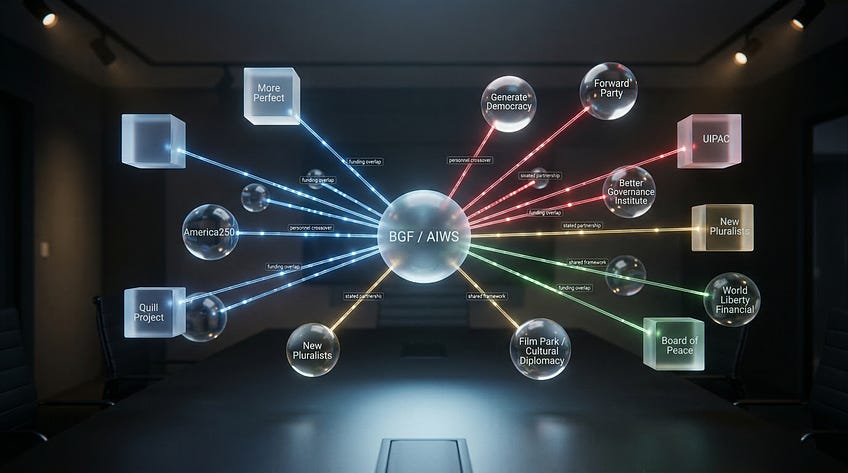
The converging architecture: governance, electoral, cultural, and financial layers all pointing to the same technocratic destination.
The BGF is not operating in isolation. What we are watching is the dialectical convergence I documented in The Phoenix Conspiracy — multiple movements, superficially opposed, all capitalizing on the 250th anniversary, all using the language of freedom and renewal, all arriving at the same technocratic destination. Explicit coordination is not required when operational coalescence does the heavy lifting.
America250.org — the official federal commemoration commission — provides the ceremonial container, lending the full weight of national identity to anyone invoking the anniversary. America250 is not a voluntary cultural initiative — it is a federally chartered commission created by an Act of Congress, meaning its ceremonial authority is statutory. When the AIWS ecosystem invokes the 250th anniversary, it is not borrowing patriotic sentiment. It is operating inside a legally constituted national frame.
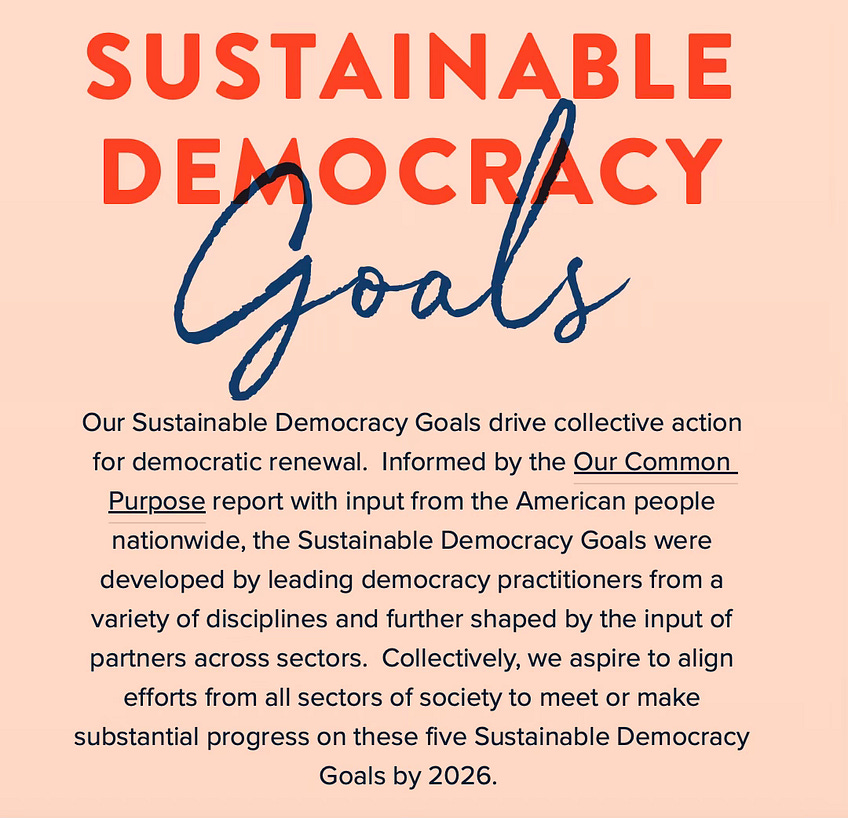
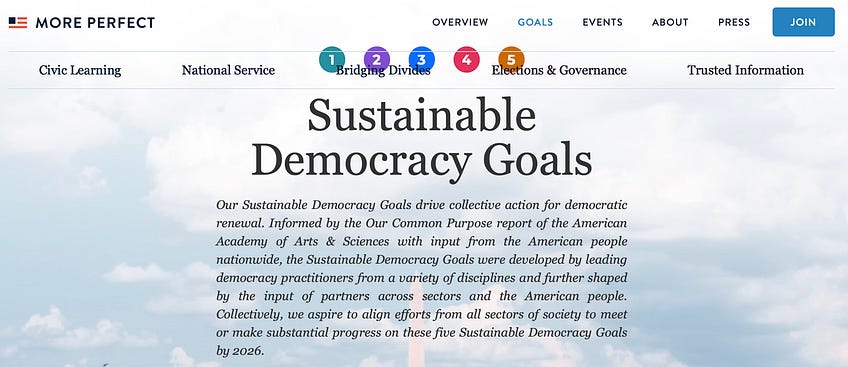
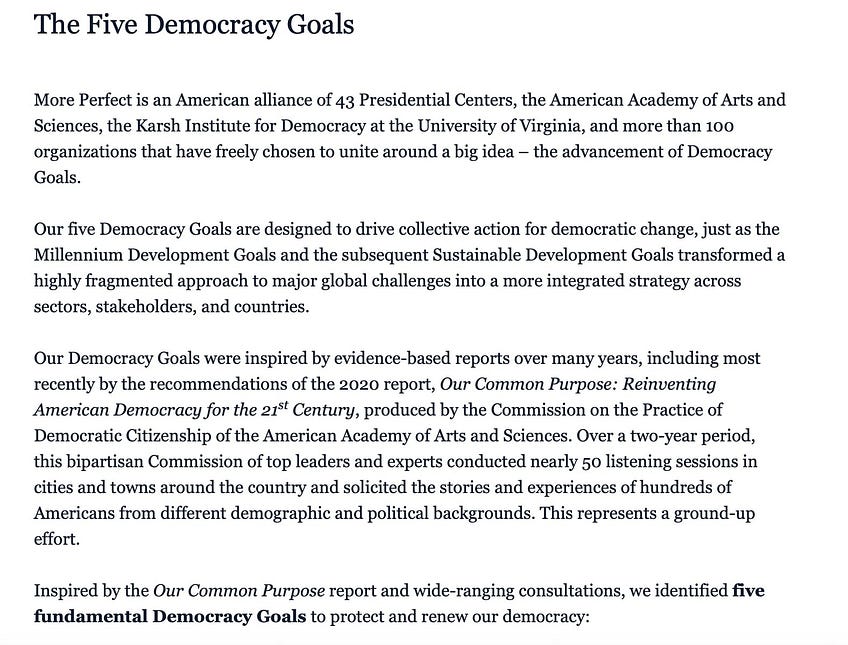
More Perfect — 43 Presidential Centers, 100+ organizations, structured around Five Democracy Goals modeled on the UN’s Millennium Development Goals. American democratic renewal. Organized after a United Nations framework. The internationalization of the Republic’s operating system, sold as its fulfillment. This is not inference. More Perfect’s own website states that their five Democracy Goals are modeled on “the Millennium Development Goals and the subsequent Sustainable Development Goals” — the UN’s own framework, in their own words. Their governance goal goes further: it calls explicitly for government to “co-create with citizens solutions to the most pressing problems of our time.” That word — co-create — did not originate in the American constitutional tradition. It originated in the planetary transformation literature. Their goals are formally titled “Sustainable Democracy Goals” — the word Sustainable is load-bearing. This is not accidental vocabulary. The SDG framework from the UN uses the identical construction, and More Perfect’s own fact sheet confirms the modeling. It now lives inside the Presidential library system. Their In Pursuit USAinitiative launched in February 2026 (Presidents’ Day), meaning this apparatus is actively accelerating toward the anniversary at this moment.
“Promoting fair, inclusive, transparent, and responsive governance ensures that Americans have confidence in the democratic system’s ability to co-create with citizens solutions to the most pressing problems of our time, while also addressing the needs of our most vulnerable citizens.”
The New Pluralists — a $1 billion funder collaborative centered on belonging, equity, and inclusion. The Declaration speaks to individuals endowed by their Creator with unalienable rights — not to identity cohorts whose belonging must be engineered and funded into existence by intermediaries. The New Pluralists represent a cross-ideological funder collaborative with a stated $1 billion commitment to shifting American culture toward “pluralistic norms and practices.” Their stated mission is not to change laws but to engineer a culture shift — meaning it operates beneath the level of legislation and outside the reach of electoral accountability—the layer of social engineering. You cannot vote against a norm campaign. That is its design feature, not its flaw.
Generate Democracy / Operation Phoenix — the electoral arm: a plan to elect certified independents to Congress in 2026, organized by the Better Governance Institute and United Independents PAC. Andrew Yang and his Forward Party are coalition partners — a man whose entire political identity is the explicit technocratic optimization of governance. Governance by credentialed independent managers is still governance by managers. The citizen is the marketing vehicle, not the governing authority. And the plan is literally named Phoenix.
The United Independents PAC’s own website does not use the language of civic renewal. It says: “We Engineer Wins.” It describes a methodology of identifying “winnable districts and vulnerable incumbents” — the vocabulary of a precision targeting operation, not a grassroots movement. Their stated mission is to “break two-party control by holding the balance of power” — sending at least five certified independents to the House in 2026 to hold the deciding votes. The goal is not representation. It is leverage. Governance by credentialed manager, achieved through the electoral door.
The Quill Project —The Quill Project at Oxford’s Pembroke College is, in isolation, a scholarly achievement — a digital reconstruction of the Constitutional Convention and the Reconstruction Amendments, built in partnership with Utah Valley University. The architecture of the collaboration deserves scrutiny. American students provide the archival labor: digitizing newspapers, piecing together debates from microfilm. Oxford’s Professor Nicholas Cole designs the platform, the visualization framework, and the interpretive interface through which those documents are navigated and understood.
This matters because interfaces are arguments. The choices made in how a document is presented — what is foregrounded, what is contextualized, what relationships are drawn between clauses and compromises — are not neutral. They are interpretive acts. When the metaphysical tradition that grounds the Constitution’s authority is already under pressure from every direction documented in this article, outsourcing the curation of the document itself to a foreign institution is not a minor academic footnote. It is a quiet severance of the Constitution from the soil in which its meaning is rooted. The document remains. The ground beneath it shifts. Each of these movements operates at the institutional and electoral level. But beneath all of them runs a single philosophical operation — one that must be named precisely, because it is subversive and the hinge everything else turns on.
The final entry in this coalition map will be the one most readers resist — and that resistance is precisely what makes it effective. Few expect the sitting president, elected on a platform of dismantling the administrative state, to appear on the same coalition map as a Dukakis-backed Harvard AI governance forum. That surface implausibility is not a reason for skepticism. It is the tell. Technocracy has never required its left and right instruments to know they are playing for the same architecture. It only requires that both instruments move the same direction — toward centralized, constitutionally unaccountable authority — regardless of the branding on the handle.
From the direction that presents itself as opposition, comes Trump’s Board of Peace and World Liberty Financial’s USD1 stablecoin. As Patrick and I documented in The Final Betrayal, technocracy’s insertion into the Trump orbit was not an accident. USD1 is sold as financial sovereignty. The Board of Peace is sold as global stability. But both concentrate authority — financial and geopolitical — in the executive person of the president, bypassing the constitutional mechanisms of Senate ratification and congressional oversight.
USD1 is structured as a stablecoin backed by U.S. Treasury instruments and managed by World Liberty Financial — a private entity in which the Trump family holds a significant financial interest. USD1 is sold to the liberty-minded as the “Truth Dollar” — Eric Trump’s own pitch being that “you can buy USD1 and so you’re no longer at the mercy of a government that you might not trust or a currency you might not trust.” Financial sovereignty, personal freedom, Exit & Build in token form. That is the libertarian wrapper. Here is what is inside it. USD1 is a stablecoin managed by World Liberty Financial, in which a Trump-linked LLC holds approximately 38% — collecting interest on every Treasury-backed dollar in circulation. Eighty-seven percent of its market cap currently sits on Binance, a platform barred from serving U.S. clients due to a Treasury Department settlement, meaning the “American freedom dollar” is predominantly held by international accounts — including through an Abu Dhabi investment firm with ties to China that has already put $2 billion into the instrument. In January 2026, World Liberty Financial filed for a national banking charter — the “decentralized” freedom token is simultaneously applying to become a regulated institution. The financial sovereignty on offer is sovereignty from congressional oversight and Federal Reserve accountability — not sovereignty for the citizen. The libertarian ethos is the recruitment mechanism. The destination is executive-controlled financial infrastructure, globally integrated, privately profiting, and constitutionally unaccountable.
The Board of Peace concentrates foreign policy initiative in the executive person, removing the Senate’s treaty ratification role by operating through non-binding frameworks and presidential envoys. The Left technocrats build the cage with governance frameworks. The Right technocrats sell you the key and keep a copy. Neither path leads to the citizen. On the surface, one is Harvard, the other is MAGA. Underneath, both are building infrastructure that concentrates authority beyond the reach of the Constitution’s amendment process, the Senate’s ratification power, and the ballot box. The aesthetics are opposed. The destination is not.
This is the structure beneath all of it: thesis meets antithesis, conflict is real or manufactured, and a pre-determined synthesis emerges — always trending toward greater centralization, always wearing the aesthetic of the opposition it absorbed. The technocrats operating via the political Left build the governance architecture. The technocrats operating through the political Right consolidate executive power. The synthesis — AI-governed, certified, tokenized, constitutionally unaccountable — rises from between them. Game B and the Dark Enlightenment are not operational enemies (regardless of genuine differences). The effect is two legs of the same march, and the citizen is the terrain they are crossing. Let me caveat that technocrats have no political or ideological allegiance outside of technocracy, but they will operationally navigate through whichever path is most expedient.
I documented in The SANDBOX Act: Ted Cruz’s Vision for AI Deregulation — A Trojan Horse for AI Tyranny? how the Republican deregulatory approach serves the same technocratic destination through the opposite door — stripping state and federal accountability mechanisms while handing AI development to the same Silicon Valley networks that fund the AIWS ecosystem. Left technocrats build the cage with governance frameworks. Right technocrats remove the locks so the cage builders face no resistance. The prisoner’s experience is identical.
Game B and Dark Enlightenment producing their predetermined child.
And AIWS sits at the apex of that synthesis explicitly. In my Exit & Build research, I identified AIWS’s promotion of a “Social Contract for the AI Age” that reimagines global society as an interoperable ecosystem of AI-driven nodes — linking policymakers and academics from Harvard, MIT, and Stanford — and its connection to the noosphereconcept: the Teilhard de Chardin vision of a planetary consciousness layer, updated for the AI Age. This is not a governance framework. It is a cosmology. And it is one in which the human person is not a sovereign individual endowed by a Creator with unalienable rights — but an emergent, steerable node in a planetary cybernetic organism. The Declaration of Independence and the noospheric- World Brain cannot coexist. One of them has to go.
Share Courtenay’s Substack
What Is Actually at Stake?
The Metaphysical Foundation They Are Replacing
The Declaration of Independence is not a political preference or a cultural inheritance. It is a metaphysical claim — grounded in two forgathering intellectual traditions that the Founders knew, taught, and deliberately deployed. The first is the Aristotelian-Thomistic tradition of natural law: the conviction, running from Aristotle through Aquinas and into the natural rights jurisprudence of the Founders, that human beings possess a fixed nature, that this nature is the source of objective moral knowledge, and that rights inhere in the person prior to any state or social compact. When Jefferson wrote that men are “endowed by their Creator with certain unalienable Rights,” he was not writing poetry. He was making a realist metaphysical assertion: rights are real, objective, and pre-political because human nature is real, objective, and fixed.
The second tradition is Scottish Common Sense Realism — Thomas Reid, Francis Hutcheson, Dugald Stewart, and above all John Witherspoon, who taught James Madison at Princeton and whose introduction of Scottish Common Sense philosophy into American intellectual life shaped the very architecture of constitutional reasoning. The Common Sense tradition held that self-evident truths — truths accessible to ordinary human faculties without philosophical mediation — are the proper foundation of both knowledge and governance. “We hold these truths to be self-evident” is not rhetorical flourish. It is a direct invocation of Reid’s epistemology: truths that the constitution of our nature compels us to believe, prior to argument, prior to institution, prior to any curating authority.
These two traditions — Aristotelian-Thomistic realism and Common Sense realism — together constitute the metaphysical foundation on which the Declaration stands and from which the Constitution derives its moral authority. The Constitution is the legal instrument built to protect what the Declaration identifies: rights that exist because human nature exists, knowable because human reason exists, and unalienable because no sovereign — no king, no parliament, no AI governance board — has the authority to revoke what was not theirs to grant.
This is what is at stake when the Quill Project puts the Constitutional Convention inside a digital reconstruction navigated through an Oxford interface. The document does not cease to be relevant. It ceases to be grounded. When the metaphysical tradition that gave it authority is replaced with a “process image of man” — man as becoming, man as evolving, man as a relational node with no fixed nature and therefore no inherent, pre-political dignity — the rights themselves evaporate. Not by repeal. By ontological erasure. You cannot have unalienable rights without a fixed human nature to attach them to. The Changing Images of Man report understood this perfectly. That is precisely why the fixed image of man had to go.
The Constitution does not need a digital twin. It needs citizens who know its metaphysical roots deeply enough to recognize when those roots are being severed — and who refuse what contradicts them.
The Metaphysical Substitution
Here is the precise philosophical fraud at the center of all of it!
The Declaration of Independence grounds rights in natural law — an order that precedes and supersedes every human institution. Rights are faculties, not benefits. You have the right to liberty not because a government granted it, not because a consensus recognized it, not because an AI framework certified it — but because you are a human being with a rational nature and an inherent dignity that no institution created and therefore none can legitimately revoke.
This is not a new argument. It is the oldest argument in Western philosophy.
Parmenides held that reality is permanent, unified, and unchanging — that Being is the ground of truth, and that what appears to change is illusion. Heraclitus countered that everything flows, that flux is the fundamental nature of reality, that you cannot step into the same river twice. Between them, they defined the axis on which all subsequent Western metaphysics has turned.
Plato synthesized the tension by locating permanent truth in the Forms — the transcendent, unchanging archetypes of which the material world is an imperfect reflection. Aristotle grounded it differently, and more dangerously for those who prefer managed reality: not in a separate realm of Forms, but in the thing itself. Every being is a composite of matter and form — hylomorphism — where form is not an external template imposed upon passive material, but the actual organizing principle that makes a thing what it is. The acorn is not a deficient oak. It is an acorn whose form already contains its telos — the full rational end toward which its nature is ordered. A thing has a nature. That nature is not assigned by process, not produced by consensus, not certified by a governance body — it is a fact about what the thing is, present in it from the beginning. From this, Thomas Aquinas built the metaphysical architecture of natural law: that the human person has a rational nature, that this nature is the source of dignity and moral obligation, and that rights flow from that nature — not from any institution that could grant or revoke them. You cannot phoenix what is woven into the form of the thing itself. Which is precisely why the first move of every technocratic project is to deny that forms exist.
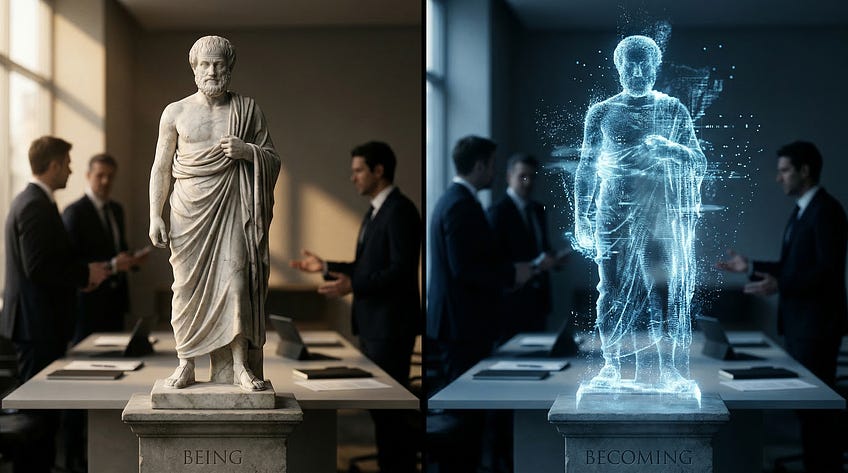
Being precedes Becoming. Nature precedes institution. The Creator precedes the committee.
That Aristotelian-Thomistic ontology is the direct philosophical foundation of the Declaration of Independence. When Jefferson wrote that rights are “unalienable” — that they cannot be transferred, surrendered, or certified away — he was not making a political argument. He was making an ontological one. Rights inhere in what you are. They are a feature of your Being, not a product of any Becoming.
This denial has a documented intellectual history that runs directly into the present moment. In 1946, philosopher Oliver Reiser published The World Sensorium — a vision of a planetary nervous system, a “radio-eugenics” project through which electromagnetic fields and broadcast technology would harmonize human consciousness into a unified global mind. Reiser called it the noosphere made operational — not Teilhard de Chardin’s mystical aspiration but an engineered project of human transformation through resonant influence on the biological and psychological substrate of the person. The individual, in Reiser’s framework, is not a sovereign being with a fixed rational nature — he is a node in a field, tunable, directable, capable of being harmonized into collective coherence.
The Changing Images of Man report — produced in 1974 by the Center for the Study of Social Policy at SRI International, and published alongside Club of Rome works in the Systems Science and World Order series —picked up precisely where Reiser left off. It identified the dominant Western image of man as the central obstacle to planetary transformation. That image, rooted in the Greek and Christian tradition, held the individual to be rational, sovereign, morally dignified, and possessed of a fixed nature: what Madison, Jefferson, and the natural-rights tradition had taken as axiomatic. The report catalogued among the “possibly obsolescent premises” of the industrial era the belief that the individual should be free to make his own choice of ‘the good,’ and that the choices he makes in pursuit of self-interest will somehow add up to desirable overall societal choices— and crucially, that people are essentially separate, so that little intrinsic responsibility is felt for the effect of present actions on remote individuals or future generations. In its place, the report proposed what it called an “integrative, evolutionary image of man” — the human as evolving holon, a node in an interconnected system whose identity is relational and open-ended rather than fixed and essential, defined not by a stable nature but by a gradient of becoming.
The AIWS noosphere agenda, the BGF’s “enlightened governance,” the cognitive liberty assault embedded in the Film Park and cultural diplomacy pillars — these are not new ideas wearing new clothes. They are the Changing Images of Man project at scale, with AI as the tuning mechanism Reiser could only theorize. The image they are changing is the one Jefferson assumed when he wrote the Declaration. And they know it.
Hegel broke this entirely. For Hegel, there is no fixed Being — only Becoming. History is the unfolding of Spirit through dialectical process, and rights are not discovered in a fixed human nature — they are produced by the rational unfolding of the State. Truth itself is historical. The real is the rational, and the rational is whatever the historical process has produced.
This is not a footnote. This is the entire philosophical fault line. Every movement in this convergence — the AIWS “Social Contract for the AI Age,” the BGF’s “enlightened governance,” Operation Phoenix’s certified independent caucus, the Forward Party’s process-optimized third way — stands on the Heraclitean-Hegelian side of that line. Reality is flux. Governance is the management of that flux. Rights are what the current synthesis has agreed to recognize. And whoever controls the synthesis controls the rights.
The Declaration stands on the other side. Being precedes Becoming. Nature precedes institution. The Creator precedes the committee.
What every movement in this convergence substitutes for that foundation is process. Participatory process. Democratic process. Transparent process. AI-governed process. The source of rights shifts from the transcendent to the procedural. From the Creator to the committee. From the unalienable to the negotiable.
In my Hegel article, I identified this as the core mechanism of the dialectical machinery: Hegel’s system does not merely describe how ideas evolve — it relocates the source of truth from the transcendent to the historical process itself. Applied politically, this means rights are not discovered — they are produced by the unfolding of the State. Whoever controls the State controls the production of rights. Whoever controls the AI governance framework controls the new State.
He who defines the measurement defines the outcome. As I wrote in The Path to Mass Surveillance and Technological Singularity, the AIWS model of “new democracy” aligns with digital societies where citizens engage via blockchain platforms — and where tokenized economies quietly integrate AI-driven decision-making that allocates participation based on behavior. That is not democracy or a constitutional republic. That is a behavioral compliance engine with democratic branding.
He who certifies the trust controls what is trusted. He who builds the governance stack governs — regardless of what the ballot says.
Governor Dukakis writes in his preface that “America’s greatness has always come from its ability to reinvent itself.” There it is — in one sentence, the entire metaphysical substitution. The Founders did not believe that. They believed America’s greatness came from fidelity to permanent, self-evident truths that do not require reinvention — only protection. A nation built on reinvention has no foundation. It has only the next reinvention. And in the AI Age, the architects of that reinvention have already identified themselves.
Which brings us to the closing act of the May 1 conference. After 112,000 words, after the AIWS Government 24/7 architecture, after the Loyal Agents, after the Sacred Places, after the Film Park and the DASI Certification and the Boston Declaration on America at 250 — “affirming commitments to trustworthy AI governance, inclusive prosperity, and cultural leadership for a humane AI Age.” A Declaration. In time for America’s birthday. Signed at a Cambridge address. America was founded on a Declaration too. That one was addressed to a candid world and grounded in the self-evident truth that rights come from the Creator and that government exists only to protect them. The Boston Declaration is addressed to the AI World Society and grounded in the premise that rights must be designed, certified, and governed into existence. These are not compatible documents. One of them is the phoenix. The other is what it is burning.

One recognizes rights you already possess. The other designs and certifies them into existence.
Cognitive Liberty Is the Final Battlefield

When governance bodies start producing your culture, you are no longer watching art. You are watching a management program.
The BGF’s most revealing pillar is not the AI governance framework or the chip strategy — it’s the Film Park and cultural diplomacy program. Because the governance stack they are building is not merely about policy. It is about cognition. As I covered in the Technocracy’s War on Free Speech roundtable, AI is not merely moderating content — it is modeling personality and incrementally nudging people toward preferred conclusions. The BGF’s cultural platform is the soft layer of that same stack — shaping what you believe America means before you ever encounter the governance architecture underneath.
Cognitive liberty — the right to think for yourself, reach your own conclusions, and dissent from the managed consensus — is the last frontier. It is precisely what a 112,000-word Harvard-convened vision document, a $1 billion pluralism funder, an AI-certified independent caucus, and a presidential cultural diplomacy film studio are all, in their different ways, designed to colonize.
Just prior to Independence Day 2025, I published AI.gov: The Digital Leviathan Launching This Independence Day — documenting how the government’s centralized AI command center represented the digitization of tyranny, built through public-private partnerships carrying no democratic accountability. Now, less than a year later, a governance body has convened at a prestigious Cambridge address to launch a book declaring that same AI governance architecture to be America’s gift to the world on its 250th birthday. Independence Day. May Day. The symbolism writes itself.
What Franklin Actually Meant
When Elizabeth Willing Powel — the wife of Philadelphia Mayor Samuel Powel asked Benjamin Franklin, “Well, Doctor, what have we got, a republic or a monarchy?” and he replied “A republic, if you can keep it” — the operative word was keep. Not design. Not optimize. Not certify. Not phoenix.
Keep.
Keeping a republic requires something no governance framework, AI standard, or certified independent caucus can supply: a citizenry that understands why the structure exists, not merely that it exists. A people who know that rights precede governments — and that no institution, however trusted, however AI-powered, however institutionally approved, however well-intentioned — has the authority to redefine, manage, or synthesize them into something new.
The phoenix burns the old—much like tearing it down to “build back better”. That is its entire purpose and “better for whom” should be the question.
America at 250 is not a birthday candle. It is a match. 🔥🐦🔥
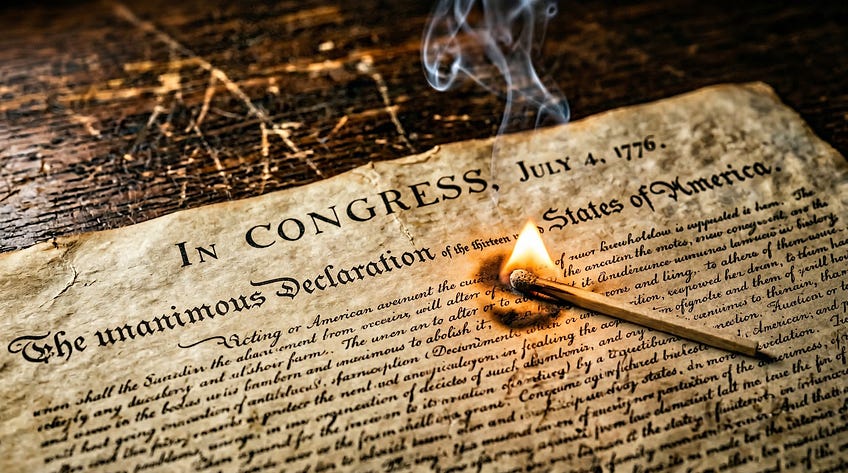
America at 250 is not a birthday candle. It is a match.
Read full story here…


