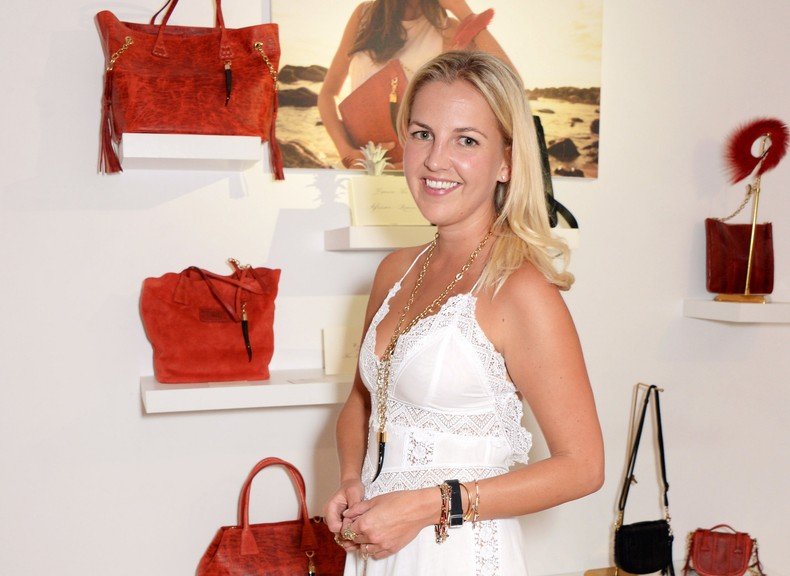
The billionaire heiress from Cape Town is forging her own path: bold, unapologetically African, deeply artistic, and fiercely ambitious.
She is redefining what it means to succeed, proving that privilege does not preclude purpose, and that wealth can be a springboard for creativity, social impact, and a distinctly African vision of luxury.
Born in 1984 to Johann Rupert, chairman of Richemont, the Swiss luxury group behind Cartier and Van Cleef & Arpels, Hanneli grew up immersed in global luxury.
However she quickly realised that inheritance alone does not replace hard work or creativity. Her path would be her own, blending artistic vision with entrepreneurial drive, a deep connection to Africa’s culture, and strong Christian values.


From Canvas to Craft
Before fashion, and even before her ventures into music, there was painting.
Hanneli studied Fine Art at London’s Wimbledon College of Art, graduating in 2007. “I spent a lot of time alone in the studio painting and realised I wanted to do something that would take me back to South Africa,” she told House of Solos. “I wanted to step away from the isolation of painting and focus on job creation and sustainable development through design.”
Her early work, including Flesh Mandalas, explored the ephemeral qualities of human skin and form. “I looked at applying some of the more linear sides of my artwork to fashion,” she explained. “I found I was designing things for myself—bags, necklaces, and people would ask where they came from.”
This curiosity evolved into a fascination with Africa’s history, anthropology, and mystical traditions. Materials like raw hides, shells, and animal bones were not merely aesthetic; they evoked the romance of pre-colonial, unexplored Africa. Her designs became a dialogue between contemporary luxury and ancestral craft, modernity and timelessness.
Athens to Africa
For a time, Hanneli lived in Athens, but her heart pulled her home. “I picked up on a demand for high-end goods from the continent, not just from overseas but from African customers as well. What I didn’t like was that luxury products were being designed and manufactured in established markets using our natural resources. I wanted to do something to add value to the chain here at home,” she recalled.
Back in Cape Town in 2008, she founded Okapi, a luxury handbag and accessories brand named after the elusive “African unicorn.” The label is simple and soulful, with charms, horn pendants, and colours inspired by Karoo sunsets and fynbos greens, all grounded in the philosophy of Ubuntu: “I am because we are.”
However, what makes it truly striking is its full-circle commitment to local craftsmanship. By sourcing and producing entirely in South Africa, from ostrich farms to leather ateliers, Okapi follows a farm-to-table approach to fashion. Every material is traceable, every artisan skilled, and every piece tells a story.
“I wanted to use game skins on the bags. Game skins aren’t commonly used in fashion because the hide is imperfect; sometimes you can see scars from where the animal has been in a fight. I love that thought, it has character and meaning,” she said in an interview.
Merchants on Long: A Hub for African Creativity
In 2010, Hanneli opened Merchants on Long, a concept store on Cape Town’s Long Street. Inspired by London’s Dover Street Market, the store became a showcase of African creativity, offering a Cape-to-Cairo experience, Forbes reported.
Handmade merchandise came from Ethiopia, Nigeria, Sierra Leone, Cameroon, Senegal, and Ghana. Luxurious fashion items sit alongside jewelry, bags, perfumes, homewares, and contemporary African artworks.
“During that period, I discovered many creators across South Africa who shared a similar ethos, but none had a retail presence,” she explained. “So, I decided to open Merchants on Long as a kind of co-op, buying in these designers. The demand was immediate, reflecting both a market hunger for authentic African luxury and the vibrancy of the country’s creative community.”
Before opening Merchants, Rupert traveled extensively across Africa, curating designers whose work reflected personal styles rooted in African heritage rather than European imitation. “I want to grow an African aesthetic,” she said. “I want Africa to be known as a hub for exotics and manufacturing, not only as an export haven for raw materials.”
The Rupert Legacy and Lessons in Business
Johann Rupert, Hanneli’s father, runs Richemont, the world’s third-largest luxury goods company, inherited from Anton Rupert. Forbes estimates the family’s net worth at $6.6 billion.
“Having access and growing up in an environment where you learn about business daily shaped me,” she said. “I learned simple but important lessons from my father—never underestimate your customer and always rely on your instincts.”
These principles have allowed her to embrace risk, innovate, and honor African craftsmanship while navigating a global market.
Ethical Luxury and African Craft
Hanneli Rupert has spent more than a decade showing that high-end fashion can be ethical, locally made, and globally respected, all while staying true to Africa’s heritage.
She has become a leading voice for African craftsmanship, speaking at global forums such as the International Herald Tribune Luxury Conference in Rome and the Women of West Africa Entrepreneurship Conference in Lagos.
She serves as vice-chair of the Michelangelo Foundation, a Swiss nonprofit that celebrates master artisanship, is a member of the Zeitz MOCAA Global Council, a trustee of the South African children’s education charity IMIBALA, and the Chairwoman of the Rupert Museum in Stellenbosch, South Africa.
Today, Okapi stands as a rare example of truly homegrown African luxury, from pasture to atelier. Hanneli’s journey proves that African fashion can share the global stage with European and American luxury without losing its ethics or soul.