-
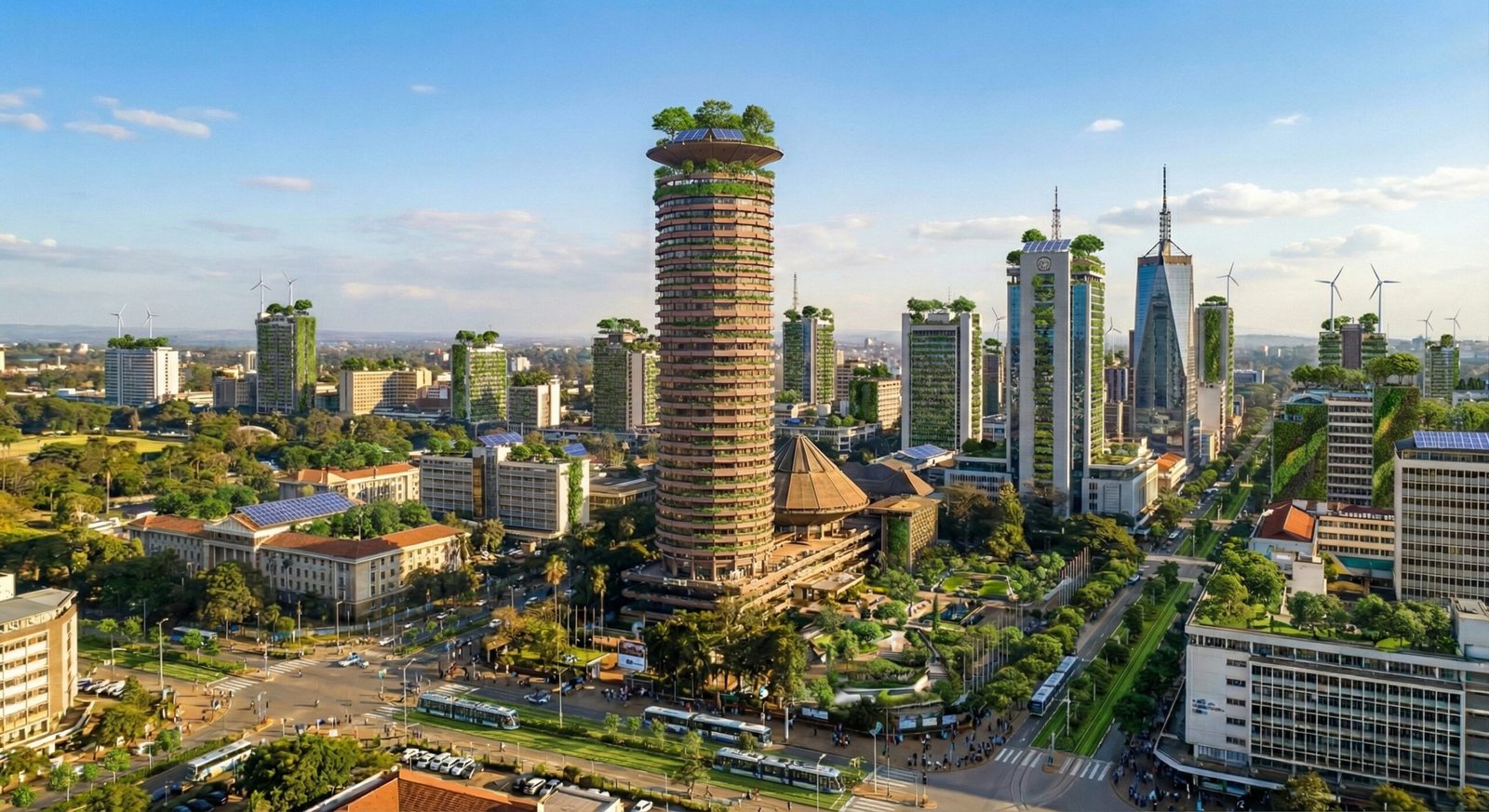
Urban centers like Lagos and Nairobi are tightening building approvals and energy codes, making eco-certifications a practical requirement rather than a branding choice.
-
Sustainable real estate Africa is shifting from voluntary green standards to performance-based compliance, driven by climate risk, investor pressure, and evolving policy frameworks.
-
Green Zones in premium districts are becoming certification hotspots, where developers must prove energy efficiency, resilience, and long-term asset viability to secure financing and top-tier tenants.
At the poshest neighborhoods in Lagos and Nairobi, “green” is no longer just a marketing adjective. It’s becoming a new gatekeeping standard.
The developers who once competed on views, amenities and location have been replaced by those who compete on kilowatt hours and water use, embodied carbon. Banks demand performance before they price loans. Corporate tenants need evidence that a building won’t end up as a stranded asset. And governments, feeling the heat and the pressure from floods and grid stress and air quality, are tightening approvals and codes in ways that begin to resemble a mandate: if you want to build in the best parts of town or on two-thirds of the world’s servable land, prove it.
That is the true story of eco-certifications. They’re not lobbies with plaques. They are a kind of passport to working in the world’s fastest expanding urban markets, nowhere more so than if you work on sustainable real estate Africa, where construction is booming at the same time as cities become more climate exposed.
The built environment is a climate behemoth, globally speaking. Buildings and construction is responsible for some 32% of global energy and approximately has the same share of global CO2 emissions, states UNEP’s recent global status. The reality is forcing cities to treat building performance the way residents do public infrastructure: as something regulated, measurable and increasingly not up for discussion.
What does that mean on the ground in Africa’s commercial capitals?
For the purposes of this article, “Green Zones” refers to two intertwined concepts currently shaping Lagos and Nairobi:
- premium urban corridors where investors and tenants are requiring sustainability proof; and
- city and national authorities’ policy direction as they streamline greener building approvals, energy policies, and compliance requirements.
Sustainable Real Estate Africa and the New Urban Logic Driving Green Mandates
Climate risk is becoming municipal math.
Cities do not require eco-certifications just because they love the paperwork. They do so because, increasingly, the costs of climate impacts are appearing as line items in budgets.
Coastal flooding, heat waves, water stress and grid instability slammed city budgets in equally predictable ways: damaged roads, overloaded drainage systems, public health costs and costly emergency responses. Lagos, a land hugging metropolis on the Atlantic coast, has enshrined climate planning in documents including the Lagos Climate Action Plan, a five year plan that conforms with the Paris Agreement and seeks carbon neutrality by mid century.
When climate risk becomes defined as inevitable, the “cheapest” intervention tends to move upstream to design and materials and energy systems that will be fixed in place for decades of operation before those long term costs lock in.
Also Read:What Africa Got Right (and Wrong) on Climate Finance since Nairobi Declaration
Energy Stress and Sustainable Real Estate Africa
In Nigeria, as in Kenya, power reliability and cost more directly shape real estate than abstract carbon targets. A building made for passive cooling, efficient lighting and smart metering means less demand and operating cost without any need for a miracle in national generation.
Building Energy Efficiency Code of Nigeria BEEC became operative at the federal level in 2017 with pilot scale adoption at states such as Lagos. As codes tighten and enforcement grows, “efficiency by design” is expected as a baseline, not an optional extra.
Finance, Risk and Sustainable Real Estate Africa
Eco-certifications offer a uniform way for banks, insurers and institutional investors to measure performance. A label doubles as underwriting language.
The financial logic is clear in the rapid proliferation of certifications that are meant to be measured and compared. The largest in emerging markets is EDGE Excellence in Design for Greater Efficiencies, which is managed by IFC. At a large green building summit in Lagos, according to IFC’s Nigeria office, certified projects were positioned as components of building resilient, efficient and environmentally friendly development.
That sentiment is increasingly mainstream. In markets where lenders are concerned about operating costs, vacancy risk and long term compliance, certification is becoming a shorthand for “this asset will still be the right one in 10 to 20 years.”
What Eco Certifications Mean for Sustainable Real Estate Africa
Eco-certifications are attractive to municipalities since they turn messy outcomes such as energy, water, materials and indoor air quality into a quantifiable checklist.
Most frameworks do not match word for word, but the flow is there:
- Energy performance: passive design, efficient HVAC, improved lighting, solar ready.
- Water conservation: low flow units, rain water harvesting, leak detection.
- Materials and waste: responsible sourcing, low carbon materials, construction waste management.
- Health: ventilation, daylighting, indoor air quality and occupant comfort.
Cities like the certifications because they solve a governance issue. How do you ensure sustainability claims on a big scale without creating a giant inspection bureaucracy? The third party standards take that burden off the table, especially when combined with local guidelines and enforcement.
Sustainable Real Estate Africa in Lagos Green Zones
Lagos does not have a uniform sanctioned “Green Zones” map that applies to the entire city in the way a formal zoning overlay might. But you will see the term used in the market as shorthand for prestige districts and planned amenity filled developments, places like Victoria Island, Ikoyi, parts of Lekki and much newer master planned projects.
In those corridors, the logic is changing at a rapid clip. If you are high end, you ignore certification at your own peril.
Climate Planning and Sustainable Real Estate Africa in Lagos
Lagos has both an explicit alignment with Paris goals and cross-sectoral climate planning, including energy and resilience. Though climate action plans are not building permits, they set the rules and priorities that manifest in procurement rules, permitting culture and public private development expectations.
At the same time, Nigeria’s energy efficiency journey through BEEC and related technical guidance provides other states and city agencies with a foundation to demand more from new developments.
Also read: Safaricom’s economic, social and environmental impact in Kenya grows to $8.5 billion
Certification Clusters and Premium Assets
The Lagos green zone narrative becomes concrete when one sees where certification is being pursued at scale.
At the Future Cities Africa Green Building Summit in Lagos in July 2025, IFC’s EDGE unveiled the expansion of certified projects and high profile developments in Victoria Island and Eko Atlantic, such as office retrofits and large mixed use projects.
Other coverage also mentioned a combination of 712,395 square meters of certified space in 37 projects in Nigeria as well as savings on energy, water and CO2. The more conservative reading would be to consider audited total square meters and savings.
These are not random projects. They are concentrated where the market incentivizes them, choice business and residential districts, export oriented zones and prestige projects that seek international tenants and capital.
A quotation describing the linkage of policy and finance:
“IFC is dedicated to creating a sustainable future and incentivizing developers to build green, climate conscious buildings.”
That line matters because it is indicative of what many city officials and financiers are coalescing around now. Green standards are not CSR. They are infrastructure planning.
Why Lagos Requirements Are Likely to Intensify
Lagos’ growth is relentless. So are the features that constrain it: drainage, transport congestion and exposure to climate. When those pressures increase, permitting becomes more conditional. City agencies do not have to say “mandatory EDGE” to effectively mandate performance. They can do so through:
- stricter energy and ventilation standards as conditions of approval
- resilience expectations for flood prone areas
- procurement standards for public buildings
- bonuses such as expedited approval, density bonuses and tax incentives for certified projects
In application, mandatory comes as a series of gates that render non certified buildings slower and riskier to build and difficult to finance.
Sustainable Real Estate Africa in Nairobi Green Zones
In Nairobi, the term “Green Zone” has long been part of the real estate lexicon, referring to leafy lower-density neighbourhoods with high demand and diplomatic corridors. But the Nairobi sustainability direction is showing new momentum in policy formation and high level certification wins that send a signal to the market.
Nairobi’s First EDGE Certified Government Office
Nairobi’s county government was awarded an IFC EDGE plaque and certificate for the Governor’s office in February 2024, referred to as Africa’s inaugural EDGE certified green government office building.
The ceremony matters not only for the building, but for the message. When city hall is willing to be measured against a global standard, the conversation becomes easier with the private sector.
The certification was portrayed in the same report as an early gain from implementing a Nairobi Climate Action Plan.
From Guidelines to Enforceable Standards
The direction that Nairobi is taking with green buildings is only symbolic but one that has seen city officials working on city-specific guidelines, with the objective of incorporating them into approvals. The city has worked with partners to develop green building guidelines and committed to implement them for new construction, phasing in their adoption up to 50 percent compliance first.
That is how mandates are born in practice. First as guidelines, then as required documents, and after that compliance checks leading to enforcement.
County and National Signals Supporting Sustainable Real Estate Africa
At the county level, Nairobi has been advancing broader sustainability policy discussions including draft legislation that refers to requirements for building-scale renewables and green building codes. The Nairobi City County Sustainable Energy Bill 2025 includes provisions on mandating building scale renewables via green building codes and new developments to have on-site renewable energy systems.
At the national level, Kenya has been processing regulatory direction on greener and more resilient buildings such as the Climate Change Green and Resilient Buildings Regulations 2023 that conceptualize ideas such as Certification of Sustainability.
Whether every provision is enforced rapidly is a separate issue. The direction is clear. The state is building a system in which sustainability can be inspected and documented.

Why Nairobi Green Zones Are Certification Hotspots
In Nairobi, affluent areas such as Upper Hill, Westlands and Kilimani and tree lined residential corridors linked to diplomatic and corporate demand are where there is the most commercial rationale for certification:
- Tenants care about operating costs and image.
- The value of the land merits the extra design work.
- International investors want comparability.
The city’s adoption of guidelines into approvals suggests that developers who plan ahead will confront fewer surprises down the road.
The Strategic Value of Eco Certifications in Sustainable Real Estate Africa
1) They reduce political risk
When a city adopts the framework of an outside third party, it becomes easier for policy makers to say, “This is the standard,” instead of having unpredictable confrontations with well resourced developers. It also reduces accusations of arbitrary decision making since the checklist is there for everyone to see.
2) They pave a way for green finance
Projects that are eco certified may be packaged for green loans, sustainability linked lending and climate funds. The draw is that certification links capital to verifiable results, not just pledges.
3) They prevent stranded assets
If global climate rules grow more stringent, buildings that do not meet basic efficiency standards will lose value or require expensive retrofits. For fast growing African cities, the expense of building correctly in the first place is far lower than retrofitting an entire skyline.
Balancing Affordability and Sustainable Real Estate Africa
Here is the tension. If certifications drive up prices, are they making housing less affordable?
They can, especially if positioned as boutique upgrades. But they can also reduce lifetime costs with energy and water savings and push the market toward healthier indoor environments.
The most realistic policy response in Lagos and Nairobi will be tiered:
- require basic performance such as passive design, metering and water efficiency from the majority of new construction
- set higher performance standards for large buildings, premium centers and public buildings
- provide incentives, technical assistance and streamlined approvals to minimize cost friction
Done right, the requirement becomes less about elitism and more about preventing waste from being locked into the city.
What Sustainable Real Estate Africa Leaders Should Watch in Lagos and Nairobi
In Lagos
- Clearer linkage of approvals to climate resilience and energy efficiency priorities as climate plans mature.
- Emergence of certification clusters along Victoria Island Lekki corridors and in major mixed use developments where capital markets require evidence.
- Growth in building performance documentation due to energy efficiency code adoption momentum.
In Nairobi
- Scaling green building requirements during the approvals process, transitioning from partial to full compliance on a graduated scale.
- County policy moving renewables and green building codes from aspiration to requirement.
- National frameworks for sustainability certification and professional accreditation.
Lagos and Nairobi are not requiring eco-certifications because it is trendy. They are doing it because the future of cities is hotter, wetter, more power constrained and more scrutinized from a financial standpoint.
Eco-certifications translate sustainability into a language that cities and their financiers can mandate. In Lagos’ luxury corridors and in Nairobi’s green zones now supported by city and national policy, the message to developers is crystallizing. Buildings need to perform, not simply look good.
For investors and real estate leaders focused on sustainable real estate Africa, the takeaway is clear. The projects that will define the next decade are those designed for regulation before regulation arrives, efficient, resilient and verifiably green.