
The Grand African Nemo 2025 naval exercise — the largest annual maritime security event in West and Central Africa — is concluding across the Gulf of Guinea, having brought together 19 African coastal navies and seven international partner navies for a week of coordinated operations aimed at strengthening regional security, maritime governance, and inter-agency cooperation.
The exercise, held between 10–17 November, forms a key annual component of the Yaoundé Architecture for Maritime Security, the regional framework jointly developed by ECOWAS, ECCAS and the Gulf of Guinea Commission to combat illicit activities at sea.
This year’s edition drew participation from the entire length of the Gulf of Guinea, with navies and maritime administrations from Senegal to Angola involved. African coastal states included:
Senegal, Gambia, Guinea-Bissau, Guinea, Sierra Leone, Liberia, Côte d’Ivoire, Ghana, Togo, Benin, Nigeria, Cameroon, Equatorial Guinea, São Tomé & Príncipe, Gabon, Republic of Congo, Democratic Republic of Congo, and Angola.
Seven partner nations supported the exercise with naval assets, aircraft, or specialist teams:
France, Italy, Spain, Portugal, Denmark, Mauritania, and Morocco.
Several international maritime agencies also contributed expertise, including the UN Office on Drugs and Crime (UNODC), INTERPOL, the European Union (through its EnMar and SEACOP programmes), the European Fisheries Control Agency (EFCA), regional fisheries bodies (FCWC and COREP), and the French pollution-response agency Cedre.
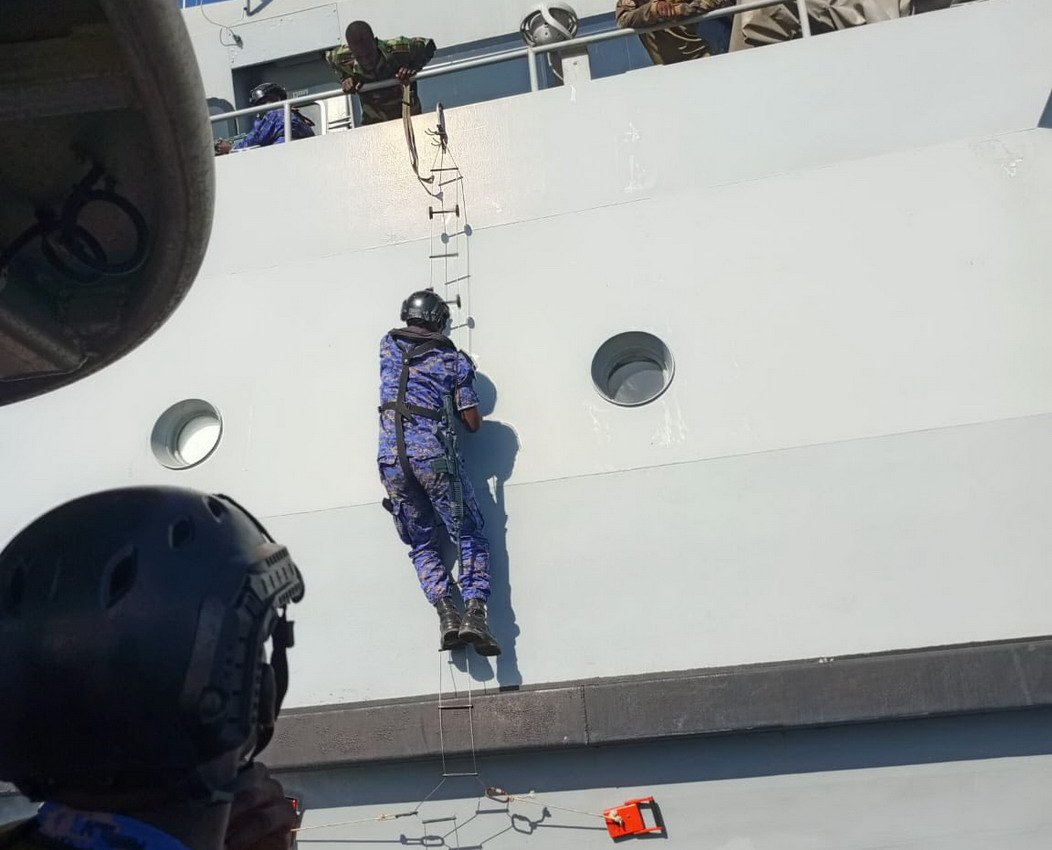
Grand African Nemo 2025 concentrated on improving the region’s ability to conduct coordinated State-Action-at-Sea operations. Training scenarios covered the full spectrum of maritime security challenges facing the Gulf of Guinea, including:
• Counter-piracy and armed robbery at sea
• Narcotics and contraband interdiction
• Illegal, unreported and unregulated (IUU) fishing
• Pollution response and environmental protection
• Search-and-rescue (SAR)
• Boarding and inspection procedures, and….
• Information sharing through the Yaoundé Inter-regional Coordination Centres.
More than 55 naval and coastguard units and 11 aircraft were deployed for the exercise, conducting simultaneous drills across multiple maritime zones. Live operations were supported by land-based command posts and Maritime Operation Centres (MOCs) linked through the Yaoundé network.
France, as the primary external supporter of the Yaoundé Architecture, again played a significant enabling role in GANO 2025. Its Mistral-class amphibious assault vessel FS Tonnerre was deployed to the Gulf of Guinea and operated in cooperation with several African navies during the exercise.
The vessel hosted the SIREN programme — a regional embarked training course involving around 40 officers from Gulf of Guinea navies — combining command-and-control instruction with at-sea practical exercises.
During the operational phase, Tonnerre took part in coordinated drills including a simulated narcotics interdiction conducted jointly with the Nigerian Navy, reflecting the growing operational cooperation between Abuja and Paris following the recently concluded Exercise Crocodile Lift 2025.
Given its position as the region’s most capable naval power, Nigeria again featured prominently in Grand African Nemo 2025. Nigerian assets included:
Naval transport ship NNS Kada
Patrol and support vessel DB Abuja
Two Special Boat Service (SBS) units
Two naval helicopters
Nigeria participated in several multi-lateral scenarios, including maritime interdiction, boardings, and information-sharing exercises in Zone E of the Yaoundé security structure, as well as joint operations with Tonnerre.
Now in its eighth edition, Grand African NEMO has become the foremost multinational maritime security exercise in West and Central Africa. Its multi-layered structure — combining theory, simulation, and live operations — is designed to strengthen:
• National maritime law enforcement capacity
• Coordination between neighbouring coastal states
• Interoperability between African navies and international partners
• The effectiveness of the Yaoundé Architecture’s information-sharing systems
• Regional resilience against piracy, trafficking, and illegal fishing
With piracy currently at its lowest recorded levels in the Gulf of Guinea but other maritime crimes on the rise, regional authorities and partners continue to view Grand African Nemo as a critical annual event for reinforcing cooperative security mechanisms.
Written by Africa Ports & Ships and republished with permission. The original article can be found here.