

– Advertisement –
The Nigerian Institution of Surveyors (NIS) has identified inadequate land data and skill gaps in sustainability as key limitations faced by land surveyors while discharging their duties in Nigeria.
The institute also listed poor public recognition and lack of multi sectoral growth for robust practice among the challenges faced by practitioners.
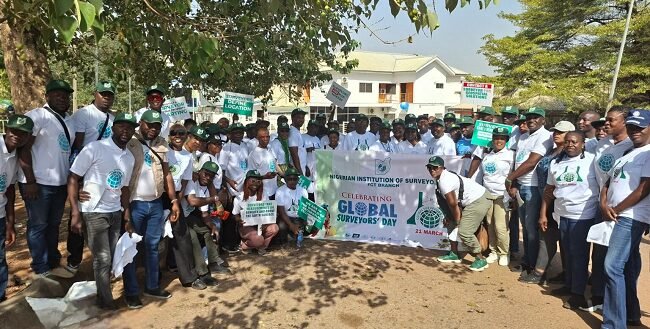
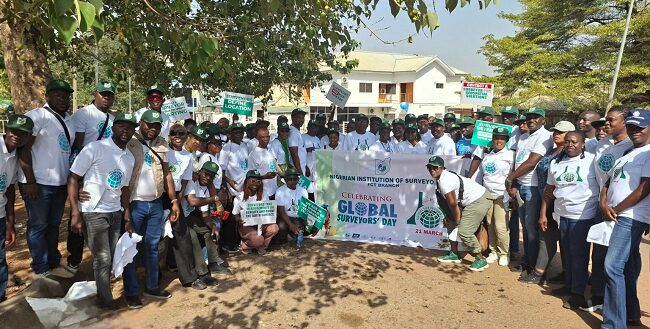
Pius Eze, NIS President, made these known on Saturday, March 21, in Abuja at a rally to commemorate the 2026 Global Surveyors’ Day with the theme, “Surveyors’ Challenges in Multi-Sectorial Growth”.
According to him, surveyors’ work defines locations, boundaries, builds infrastructure, and drives progress.
This, he said, was by providing data for planning purposes and decision making at all levels by governments, captain of industries for any meaningful and sustainable developments.
In addressing the challenges, Eze advocated capacity building and multi-sectorial collaborations for development
“The multi sectoral approach in our Profession is the only way to guarantee robust practice, achieve the intents of Survey Coordination Act, creation of National Survey Data Bank, to be called ‘The Survey of Nigeria’.
“This is for planning, decision making and national development,” he said.
Eze said that the challenges notwithstanding, NIS believed in creating technology and service delivery that would not just meet today’s demands but sets the stage for tomorrow’s possibilities.
He, therefore, enjoined all surveyors to regularly equip themselves with deserving intellect and tools that would empower them, simplify their workflows, and maximise their productivity.
“Be assured, NIS is committed to building the foundation for the next generation of Surveying excellence,” he said.
Eze explained that the Global Surveyors Day remarkably celebrated annually every March 21, aimed to recognise the vital contributions of surveying and geo-informatics to the society.
He said that the Day, initiated in 2018 by the International Federation of Surveyors (FIG), highlighted the profession’s role in shaping communities, pioneering technologies and tactical security response.
The president added that it also highlighted academic research, maritime and blue economy initiatives, oil and natural resources, digital mapping and supporting sustainable development worldwide.
Also speaking, the Chairman of the NIS, Federal Capital Territory branch, Yakubu Atanda, noted that NIS contributes to national security and development through mapping and data generation.
Atanda stressed the importance of collaboration between citizens and government in land management.
He acknowledged improvements in the enabling environment for surveyors and stressed the need for greater cooperation between stakeholders to enhance national development.
He noted that surveyors operate across multiple sectors, including the military, security agencies, and civil institutions, contributing significantly to national planning and security architecture.
Atanda expressed optimism that ongoing mapping and geospatial initiatives would help address developmental challenges and improve decision-making processes across the country.
He also called on citizens to respect land use regulations, warning that encroachment on designated lands delays development and complicates government projects.
In her remarks, Dr Charity Olla, a fellow of the institution, praised surveyors as unsung heroes behind Nigeria’s infrastructure and security systems.
Olla noted that their work ensures land ownership security, disaster mitigation through floodplain mapping, and precision in military and aviation operations.
“Behind every road, every building, and every navigation system are surveyors whose efforts often go unnoticed.
“Without proper land titles and accurate mapping, development and security would be impossible.”
Olla, however, raised concerns about the safety of surveyors in the field, citing incidents of harassment, assault, and theft of equipment.
She called for improved security measures and insurance coverage for professionals operating in high-risk environments.
She also addressed gender inclusion in the profession, noting that women surveyors were increasingly making significant strides.
She said that through initiatives like Women in Surveying, the institution is promoting the profession to younger generations and encouraging more female participation.
By Angela Atabo


