Global fashion retailers are dramatically restructuring their supply chains, with Ethiopia emerging as the primary beneficiary of a cost-driven exodus from traditional manufacturing hubs. New data from the International Textile Manufacturers Federation shows manufacturing costs in China have surged 23% year-over-year to $4.2 per hour, while Ethiopia maintains competitive labor rates at $0.85 per hour.
Ethiopia Captures $2.8 Billion in New Orders
H&M Group announced a $450 million commitment to Ethiopian suppliers in January, followed by Zara parent Inditex securing $380 million in production contracts through 2028. Combined with existing partnerships from Primark, C&A, and emerging direct-to-consumer brands, Ethiopia’s textile export value reached $2.8 billion in 2025, representing 340% growth from 2023 levels.
“The economic fundamentals have shifted permanently,” said Maria Santos, Chief Procurement Officer at Inditex. “Ethiopian productivity has improved 85% since 2023 while maintaining cost advantages of 65-70% versus our traditional suppliers.”
Infrastructure Investment Drives Competitive Edge
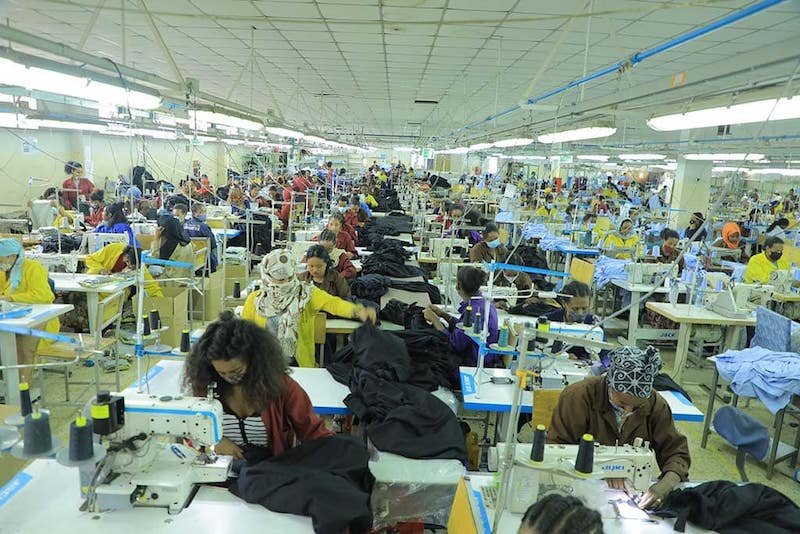
The Ethiopian government’s $1.2 billion infrastructure program, supported by World Bank financing, has transformed the sector’s logistics capabilities. The Hawassa Industrial Park now processes 45 million garments annually, while new rail connections to Djibouti port have reduced shipping times to European markets by 12 days.
Industrial park occupancy rates have reached 89%, with 73 international tenants including South Korean giant Youngone Corporation and Turkish manufacturer Akkok Group. Average setup times for new production lines have decreased from 18 months to 8 months, according to the Ethiopian Investment Commission.
Quality Certifications Accelerate Adoption
Ethiopian facilities have achieved critical industry certifications, with 67% of major suppliers now holding WRAP (Worldwide Responsible Accredited Production) certification and 52% meeting OEKO-TEX standards. This represents a 340% increase in certified capacity since 2024, addressing previous concerns about production quality and labor standards.
Regional Competition Intensifies
Kenya and Rwanda are aggressively competing for displaced production, with Kenya announcing a $800 million textile zone in Mombasa and Rwanda launching tax incentives targeting Asian manufacturers. However, Ethiopia’s first-mover advantage and established supplier relationships provide significant competitive moats.
“Bangladesh remains cost-competitive at $1.15 per hour, but political instability and climate risks are driving diversification strategies,” explained Dr. James Mitchell, textile supply chain analyst at McKinsey Global Institute. “Ethiopia offers political stability and drought-resistant manufacturing regions.”
Financial Impact on Global Retailers
Cost savings from Ethiopian sourcing are directly impacting retailer margins. Fast Retailing (Uniqlo) reported gross margin improvements of 4.2 percentage points in Q4 2025, primarily attributed to supply chain optimization. Similarly, Next PLC cited Ethiopian partnerships as contributing £89 million in annual cost reductions.
Private equity firms are taking notice, with Advent International leading a $275 million funding round for Ethiopian textile manufacturer PVH Ethiopia, valuing the company at $1.1 billion. Additional investment rounds totaling $650 million are expected throughout 2026.
Sustainability Meets Economics
Ethiopia’s renewable energy capacity, with 95% of power generation from hydroelectric sources, aligns with brands’ sustainability commitments while offering energy costs 40% below regional averages. This dual benefit of environmental compliance and cost reduction is accelerating adoption among ESG-focused retailers.
The country’s cotton production has increased 156% since 2023, reducing raw material import dependencies and further improving cost competitiveness for vertically integrated operations.
Forward-Looking Market Implications
For investors, Ethiopian textile opportunities present compelling risk-adjusted returns with manufacturing capacity expected to double by 2028. However, infrastructure bottlenecks and skilled labor shortages remain key risks requiring monitoring.
Policymakers should anticipate continued supply chain regionalization, with African textile hubs potentially capturing 15-20% of global fast fashion production by 2030. This shift represents a fundamental rebalancing of global trade flows with implications extending beyond textiles into broader manufacturing sectors.