

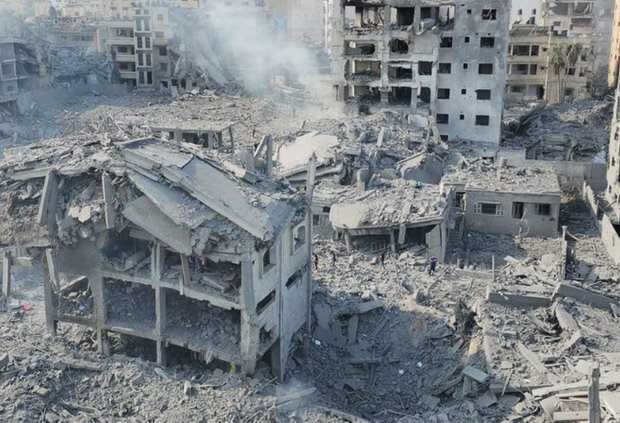

Global conflicts doubled over the past five years and are still rising, with one in eight people now exposed to conflict. 2025 is expected to see an increase in conflict levels, especially in the early part of the year, according to research by ACLED.
The Armed Conflict Location and Event Data (ACLED) organisation said it recorded nearly 200 000 violent incidents for 2024 — a 25% increase compared to 2023. Its updated 2024 Conflict Index (measuring deadliness, danger to civilians, geographic diffusion, and armed group fragmentation) revealed that Palestine is the most dangerous place in the world, with over 81% of its population exposed to conflict. Palestine, Myanmar, Syria, and Mexico hold the highest positions in the Index.


ACLED data revealed that 81% of Palestine’s population is exposed to conflict, 35 000 fatalities are recorded in the past 12 months (over 50 000 since Hamas’ attack on 7 October 2023), and civilians remain under daily assault from bombings and incursions. On average, 52 conflict incidents occur in Palestinian territories per day. Because of Palestine’s — and specifically Gaza’s — level of violence compared to other conflicts and the lack of a ceasefire between combatants, it is very likely to continue being an intense conflict into 2025.
While conflict increased by 25% globally, the sharpest increases in 2024 were recorded in Lebanon (958%), Russia (349%), and Israel (247%). At least 233 597 people were reportedly killed as a result of conflict in 2024, up 30% from 179 099 fatalities in 2023, ACLED data showed.
How much conflict is occurring in the world?
In the past five years, conflict levels have almost doubled. For 2020, ACLED said it recorded 104 371 conflict events; in 2024, for the same period, nearly 200 000.
Over 233 000 deaths is a conservative estimate of reported fatalities resulting from these events in the past year. This is largely due to three very large conflicts beginning or restarting during that time — Ukraine, Gaza, and Myanmar — coupled with continued violence in many other countries with high rates of conflict — including Sudan, Mexico, Yemen, and Sahel countries, and very few conflicts ending. Civilian exposure to violence, conflict incidents, and the number of armed groups involved in violence are proliferating, ACLED found.
All forms of conflict events have increased, but bombings now represent over 90 000 events in 2024, are close to double the rate of battles, and triple the rate of direct violence against civilians. As states engage more with challengers domestically and internationally, warfare has become more sophisticated and widespread. Bombing and ‘remote violence’ nearly doubled as of 2022, growing by over 25% per annum since 2022.
Most protests are not included in the Index, but over 143 000 protests occurred in 2024, and major protest movements were linked to pro-Palestine agendas.
In 2024, over 3 billion people across 70 countries went to the polls to vote in national elections, with many more casting their ballots to elect local representatives. Over a third of the countries where a national election was held in 2024 experienced at least one act of electoral violence, affecting authoritarian and unstable states as well as established democracies.
Countries with elections in 2024 had — on average— a 63% increase in national political violence compared to over 21% increases across countries without elections. Increases in violence occur when governments or political opposition groups are willing to use violence to remain in power or seize it when they believe that the vote has been rigged. Political interests then arm militias and mobilize their supporters well before election day. Post-election, countries often return to their pre-election disorder rate, ACLED said.
“Yet, electoral violence is not overly effective: Election results in countries like India and Senegal — where incumbent governments lost their absolute majority and presidency despite widespread violence — suggest that violence does not stop democratic choice and change. But the patterns of conflict overall confirm that living in a democracy is not insurance against conflict. Most conflict is not occurring in ‘poor’ or ‘isolated’ autocratic states but in ‘partially free’ countries,” the organisation found.
Most conflict is also now occurring in middle-income countries, and it is growing more strongly in middle- and high-income countries. “In short, more development and democracy do not constrain violence. Conflict adapts to political circumstances, changing form and direction according to perpetrators’ agendas.”
Movement around the Index
Over the course of 2024, Lebanon rose significantly in the Index, entering into the ‘extreme’ list, whereas it previously had hosted ‘high’ levels of conflict. Libya and Peru have also become worse, both because of increases in fatalities as a result of political violence. Levels of violence overall declined in Yemen despite remaining a site of very high conflict levels. Yemen has decreased consistently year-on-year — from more than 10 000 in 2020 to just over 2 000 in 2024 — but its violence is expanding into new areas and against new competitors in the Red Sea.
The most violent places are experiencing quite different conflict types, ACLED found: From bombing campaigns across the Middle East, mob violence in India, a cartel civil war in Mexico, internal jihadi competition coupled with (formerly Wagner) mercenaries in the Sahel, Red Sea antagonisms, an inter-state stalemate in Ukraine, to Sudan’s violence upon civilians.
“Communities and governments can be equally and deeply challenged by multiple gangs that extort, build illicit economies, kill civilians, and destroy public space and politics, as they are by an established insurgent group with a hierarchical military structure and national political agenda. Each form of conflict is detrimental and widespread, resulting in a larger share of the global population being exposed to continued political violence,” ACLED stated.
The conflicts that proliferated in 2024 starkly demonstrate the differences between being in power and being in control. In the Sahel, governments in Mali, Burkina Faso, and Niger are in power but hardly in control of the local areas: rather, jihadi groups, external mercenaries, and local arrangements create a chess board of control and competition. Governments in Myanmar, Mexico’s new president, and Israeli Prime Minister Benjamin Netanyahu’s coalition are all running into the abyss of ‘control vs. power.’ The results are drastic increases in violence rates and more violent groups, while influence over how violence evolves and ends is elusive.
2025: What to expect
Recent levels of violence have been unprecedentedly high, with several ‘record breaking’ months in the past year. In the beginning of 2025, conflict event rates are expected to grow by 15% due to more bombings and battles, and result in approximately 20 000 reported fatalities per month, ACLED predicted.
“Throughout 2025, levels of violence are expected to remain very high relative to the recent historical norm, and an annual increase of 20% is likely. However, the places, contenders, and forms of increased conflict in 2025 could be drastically different than the pattern in 2024,” the organisation concluded.



