

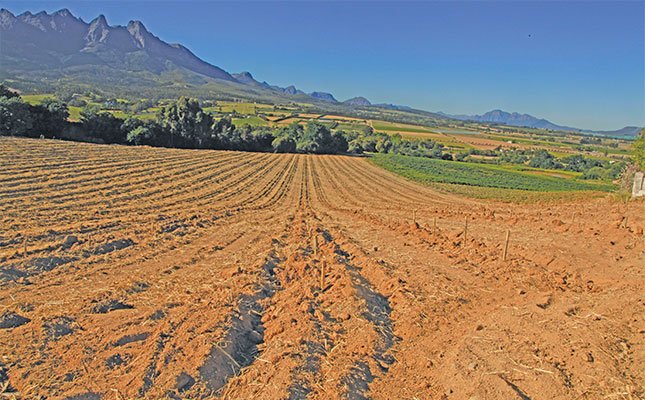
Vineyard success is built from the ground up, starting with the correct planting and care of new vines. Glenneis Kriel reports on the advice of viticulturist Marko Roux on how growers can give vines the best possible start.


– ADVERTISEMENT –
Growing a healthy root system is essential for producing high-quality, high-yielding wine grapes. Yet many farmers still make mistakes by planting vines incorrectly or handling them poorly before planting.
These errors weaken root development, creating a ‘factory’ that is too fragile to support the vine properly. As a result, such vines struggle to reach their full productive potential and are less resilient during floods, heatwaves and droughts. In most cases they also have a much shorter lifespan than those with well-established root systems.
While farmers are aware of this, mistakes during planting continue, even on top wine farms. During a presentation at a Vinpro regional meeting earlier this year, Marko Roux, independent viticulturist and viticulturist adviser of Hexberg Nursery in Wellington, Western Cape, said he regularly encountered such vineyards on different farms that had to be replaced within one to four years of planting, or showed early signs of non-viability.
Since farmers have little control over skyrocketing input costs, high vineyard establishment costs of up to R400 000/ha and market prices that do not keep up with these costs, he advised farmers to focus on factors they can control – in this case, giving vines a proper start by planting them correctly.
Planting mistakes
To start with, Roux said that the initial process, from collecting the vines from the nursery to transporting them to the field for plantation, should be managed meticulously to prevent vines from drying out, as failure to do so could negatively influence the success rate and the health of especially fine roots.
Some people suggest planting vines as they arrive from the nursery, but Roux advised the trimming of the roots as a simple action to prevent many potential problems that may follow.
“A general dormant nursery vine that arrives at a client with 40cm long roots would require a hole of at least 50cm to 70cm deep to allow proper root development. Digging such deep holes is labour intensive and time-consuming, making the planting process unnecessarily difficult and expensive,” he said.
A good rule of thumb, according to him, is to leave about 150mm to 200mm – roughly the length of a fist plus thumb – of roots on dormant vines.
The trimming process should also be carefully controlled to prevent mistakes and ensure uniform length.
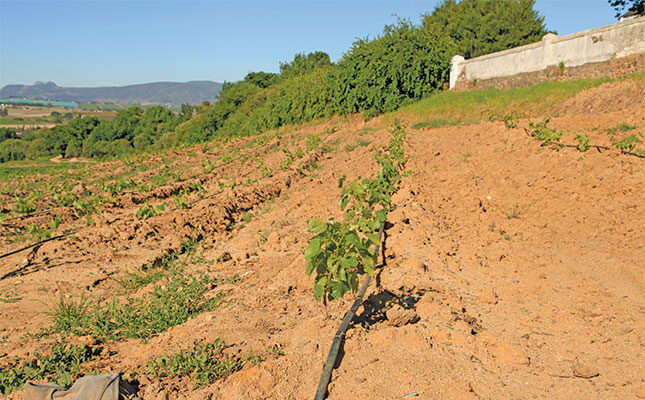
“Break the bunches of vines apart to align graft unions and ensure uniformity,” he said.
Common mistakes during planting include planting vines too deep, with the graft union below the soil, or too shallow, with roots exposed above ground.
Another error, and by far the biggest ongoing problem, is planting vines in shallow ‘potted’ holes that restrict the roots from spreading beyond the hole.
Roux said the hole should ideally be as wide as a large-sized garden fork and preferably dug with a fork to prevent the formation of compact soil layers: “The sides should be
loosened with a fork, both in sandy or clay-rich soils, and the hole made deep enough for the roots to point downward.”
When placing the vines, the roots should be spread evenly around loose soil in the centre of the hole to prevent J-root formation or one-sided root development. The graft union should ideally sit about 5cm above the soil surface.
Vine roots should have good contact with the soil by lightly compressing the soil around the vines, and with good initial watering to remove excess air from the macro pores around the roots.
Workers should refrain from overly compacting the soil in the planting hole, especially in wet conditions, as that would negatively affect the soil structure when drying again.
Roux said that the use of a soil cover, in the form of a mulch or plastic, has been found to improve the colonisation of roots in the topsoil, resulting in more fine roots in the first 20cm of soil, as well as better water usage.
The use of black plastic, although not a popular method anymore, as soil cover, for instance, has been found during research to result in vines having three times more roots than those planted without plastic after only one year, and better shallow and deeper root distribution after 18 months. In addition, the vines were in production a year earlier and maintained this advantage until year five.
Despite this, Roux pointed out that it was observed during field conditions that it was better to only apply mulch from the second leaf in cool climate areas, as low soil temperatures can negatively impact growth.
Some of the most common other mistakes after planting include insufficient fertilisation in the first year, and the use of high-frequency pulse irrigation, which Roux described as highly negative for young vine development in the long term.
Inadequate weed control is another culprit, as local research has found that competition for water and nutrients can reduce vine root growth by up to 50%, with the finer, more delicate roots suffering the most.
Mechanical planting
With so much that can go wrong during manual planting, it is no surprise that an increasing number of producers are turning to mechanical vineyard planters for greater consistency.
“People weren’t sure whether planting machines, mostly imported from France and Germany, would work in our soils when they first arrived in South Africa around 2013,” said Roux. “But when used correctly, they’ve proven their worth, and their popularity is growing rapidly.”
Although he doesn’t necessarily advocate for mechanical planting above manual planting, he said that mechanical planters can eliminate much of the human error traditionally associated with manual planting.
The machines also remove the need for root pruning by creating a deep, well-shaped planting hole that allows vines with roots of up to 60cm to be planted correctly, with the roots facing down.
Planting can take place even in stony soils, and the process is generally more uniform than hand labour.
However, Roux noted that the method is not without drawbacks. Final spacing is not always perfect; graft union heights and placement can vary and should be checked and corrected if wrong during planting; and the use of heavy tractors increases the risk of soil compaction.
Mechanical planting is also best suited to flatter land and crucially requires favourable soil moisture conditions, as overly wet soils are not ideal. This often has an influence on the timing and availability of the machine.
Because the machines represent a significant investment, most producers prefer to hire contractors who own them.
Roux said the results justify the cost: “I’ve been consistently surprised with the short- and long-term performance of vineyards planted mechanically, with good growth and general performance and also a high initial success rate.”
Vineyard planting machine experiences
Mechanical vineyard planters are becoming more common in South Africa, but reactions from operators and contractors are mixed, with some praising their precision and efficiency while others highlight challenges and limitations.
Jayde Hamman of German Machine Services, which specialises in mechanical vineyard planting, told Farmer’s Weekly that they use the Wagner Pflanzen-Technik Champion Balance because it is a rugged machine, well suited to South Africa’s diverse vineyard conditions.
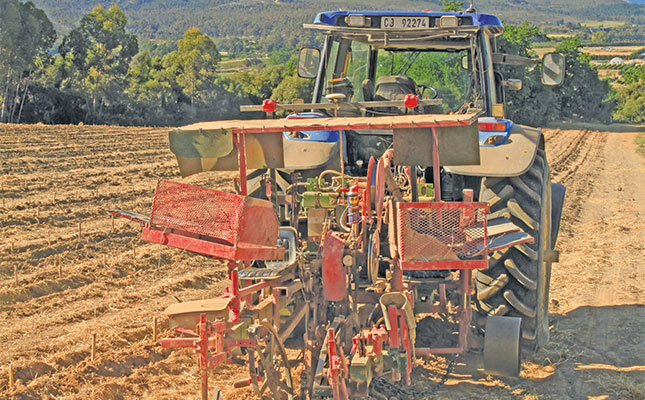
Its real-time kinematic GPS guidance system is among the most accurate on the market, allowing it to plant with high precision.
The machine, imported from Germany, costs around R2 million. Hamman charges about R3,20 per vine, plus R21/km for transport from Paarl to the client’s farm. Clients also supply diesel, which works out to roughly 12c per vine. These costs exclude VAT.
Hamman said the main benefit of using the machine is that vines are planted quickly and efficiently, at a rate of 6 000 to 10 000 vines per day, depending on soil conditions.
“We achieve a take percentage of 95% to 100%, which is much higher than what is typically seen with manual planting,” he said.
Proper soil preparation, he added, remains crucial.
“Nutrient imbalances must be corrected before planting, and the soil should be tilled up to a metre deep and, if possible, levelled. The machine can plant in all soil types and handle inclines of up to 36%.”
Not all contractors are convinced, however. Jaco le Roux said he stopped offering vineyard planting services after just one season, even though most of his clients were satisfied with the planting results.
“We imported a French machine, which had a good take percentage, but it didn’t plant as neatly in some conditions as we had hoped. The problem for us is that we are a relatively big company, so we don’t have specialised manpower available to operate the machines, which is needed for success.”
Post-planting root care
Even after vines are established, attention to root health can make a big difference in production and vineyard performance.
Roux said that the principle of periodic deep tillage to stimulate root growth, an endlessly debated topic among viticulturists, dates back centuries. Columella, a Roman writer on agriculture, recommended loosening the soil to encourage new root development back in 76CE.
In the late 1960s, experiments in Armenia showed that deep tillage of 4cm to 50cm substantially improved water retention and soil temperature in stony soils. The treatment also promoted root regrowth, leading to better vine growth above ground and increased berry and bunch mass.
Roux emphasised that there was no ‘recipe’ for deep tillage to perform root pruning. However, soil moisture is critical to success. If the soil is too dry, the rip will fail to penetrate effectively and result in the soil breaking very coarsely; if too wet, the soil can smear and compact, reducing the beneficial effect on root growth.
Generally, deep tillage can be done up until early May and should be avoided during spring. At most, only every second row should be ripped each year, with the ripper shank (single or double) positioned on the inside of the tractor track, not too close to the vine row itself.
Roux concluded his presentation by emphasising the importance of not restricting root development in the first two years after planting, as this lays the foundation of the vine and future production.
“The reality for South African wine farmers is that our soils tend to recompact very quickly compared to other wine countries due to our old and highly weathered geology.
“For this reason, it is essential that farmers capitalise on the first few years after establishment and allow the best possible initial root development by sticking to the basics and remembering that timing is crucial, especially during establishment.”
Roux also encouraged producers and technical advisers to spend more time and effort to see what is happening below the soil surface and monitor root growth closely: “I take inspiration from the late Prof Eben Archer, who always said: ‘Remember we are not farming vines only, we are farming vine roots!’”
For more information email Marko Roux at [email protected].
Get trusted farming news from Farmers Weekly in Google Top Stories.
➕ Add Farmers Weekly to Google
✔ Takes 10 seconds · ✔ Remove anytime


