

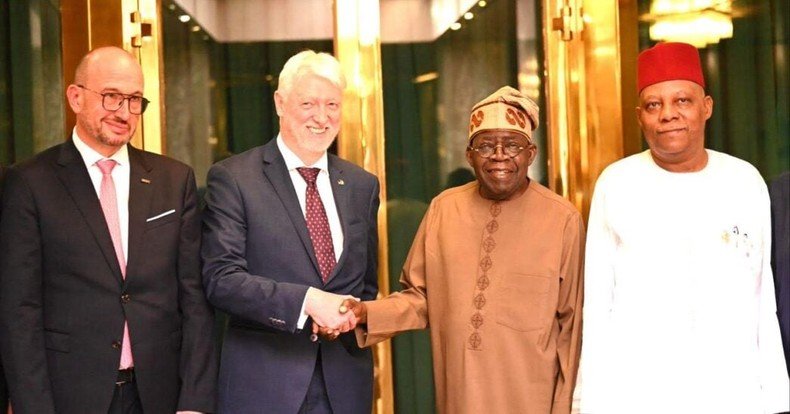
Germany’s Deputy Head of Mission in Nigeria, Johannes Lehne, said on Wednesday that the $2.3 billion Siemens power agreement between Nigeria and Germany remained largely dormant until President Bola Tinubu’s administration revived it after taking office.
Speaking at the Sub-Saharan Africa International Petroleum Exhibition and Conference (SAIPEC) in Lagos, Lehne said the bilateral partnership had stalled before gaining renewed traction under the current government.
“The strange thing was that this partnership was dormant until the beginning of President Tinubu’s time, where actually we revived this,” Lehne said, adding that the Presidential Power Initiative (PPI) aims to reactivate Nigeria’s transmission system and expand electricity access.
Originally conceived under former President Muhammadu Buhari, the government-to-government deal was designed to modernise Nigeria’s transmission and distribution infrastructure.
Siemens set phased capacity targets of 7,000 megawatts (MW), rising to 11,000 MW and ultimately 25,000 MW, a significant increase from the country’s roughly 4,000 MW supply.


Earlier review signalled project challenges
In 2023, Minister of Power Bayo Adelabu said the federal government would review the agreement, citing shifts in economic and regulatory conditions since the contract was signed.
“The situation is no longer the same as we had in 2018. What we are doing is to have a holistic review of the entire scope of this project and amend it to suit the current situation,” Adelabu said on ARISE News.
He attributed delays to the COVID-19 pandemic, political transition and sector reforms. However, a pilot phase progressed, involving the importation of 10 mobile substations and 10 transformers expected to raise transmission capacity by about 1,300 MW once fully installed.
Germany eyes deeper energy cooperation
Lehne said Germany has expanded energy cooperation with Nigeria through an Energy Support Programme, drawing on Berlin’s experience in diversifying supply and scaling renewables such as solar, wind and geothermal.
He argued that many countries are undergoing “energy addition” rather than a full transition away from fossil fuels, noting that gas will remain a key industrial feedstock in Germany for decades.
Following the Russia-Ukraine crisis, Germany diversified its energy imports and rapidly built liquefied natural gas terminals. Lehne said Berlin is open to sourcing gas from Nigeria as part of its long-term energy security strategy.
“It is not clever to put all your eggs in one basket,” he said.
Nigeria’s gas potential yet to translate into output
Also speaking at the conference, Jennis Anyanwu, deputy director of gas utilisation at the Nigerian Upstream Petroleum Regulatory Commission, said Nigeria’s primary challenge is converting vast reserves into economic value.
The country holds about 210.54 trillion cubic feet of proven gas reserves; the largest in Africa; with potential resources estimated at up to 650 TCF.
Yet production stands at roughly 7.5 billion cubic feet per day, leaving Nigeria outside the top global producers.
“We rank number one in Africa in terms of reserves, but we are not number one in production,” Anyanwu said.
He added that the Petroleum Industry Act has reduced fiscal uncertainty, lowered royalty rates and improved regulatory clarity, helping to de-risk gas investments.
While the revived Siemens initiative is expected to strengthen Nigeria’s power infrastructure, analysts say execution, financing and policy consistency will be critical to achieving its long-standing capacity targets.


