


Exercise Will for Peace 2026 may be over, but the fallout continues, with a Board of Inquiry (BoI) and a Parliamentary debate on the cards to examine whether the South African National Defence Force (SANDF) defied an instruction from President Cyril Ramaphosa.
Iranian warships took part in Will for Peace alongside those from South Africa, Russia, the United Arab Emirates, and China last week, despite reports of a presidential order to exclude the Iranian vessels. Conflicting SANDF statements raise concerns that civilian authority was ignored, leading to Defence and Military Veterans Minister Angie Motshekga establishing a Board of Inquiry to investigate.
Various government sources have been quoted as saying Ramaphosa convened a meeting on Friday 9 January with national security advisor Sydney Mufamadi, Motshekga, minister in the presidency Khumbudzo Ntshavheni and international relations and co-operation minister Ronald Lamola. The Sunday Times reported Ramaphosa instructed that Iran should only serve as an observer in Will for Peace, alongside Brazil, Ethiopia and Indonesia. The meeting came as Iran faced international criticism for cracking down on protestors, killing at least 2 500.
The Sunday Times reported that sources close to Ramaphosa say his instruction was not heeded, prompting Motshekga on Friday 15 January to announce the establishment of a board of inquiry to investigate whether the president’s instructions were ignored – if they were indeed ignored, this could signal a collapse of authority, discipline and accountability.
Defence spokesperson Siphiwe Dlamini said in a statement that “The minister of defence would like to place on record that the instruction was clearly communicated to all parties concerned, agreed upon, and was to be implemented and adhered to as such”.
“Due to the seriousness of these allegations and reports in the media, the minister has established a board of inquiry to look into the circumstances surrounding the allegations and establish whether the instruction of the president may have been misrepresented and/or ignored,” with the board given seven days to submit its report.
Iranian vessels were observed to take part in the sea phase of the exercise last week, despite Ramaphosa’s instruction. The President is Commander-in-Chief of the SANDF and should have final say in military matters. Iranian sailors were also observed taking part in the closing ceremony of Will for Peace on Friday 16 January in Simon’s Town. The ceremony also involved sailors from the South African, Chinese, Russian, and United Arab Emirates’ navies.
The Iranian corvette, IRIS Naghdi, that appeared to take part in the sea phase of Will for Peace, was in Simon’s Town harbour on Friday, while its two other naval vessels were anchored in False Bay.
On Tuesday 13 January, the SANDF shared a social media post confirming Iran was taking part in the sea phase of Will for Peace, but the post was subsequently removed.
Ramaphosa’s spokesperson, Vincent Magwenya, is quoted by City Press as saying, “It is important to note that the naval exercise was led by China and not by South Africa. The invitations to the participating BRICS countries were handled by China. South Africa agreed to participate in the use of its waters.” He added that Motshekga was told Iran would not actively take part in the exercise.
“The board of inquiry will, therefore, look at what transpired from the time the instruction was given by the president via the minister to the time the exercise started,” he said.
It is not clear if China, as the exercise lead, ignored Ramaphosa’s instruction or dragged its feet in implementing it. Reports suggest a formal request for Iran to downgrade its participation was conveyed on Saturday 10 January.
Chris Hattingh, Democratic Alliance (DA) Spokesperson on Defence & Military Veterans, said what is now unfolding around Exercise Will for Peace 2026 looks less like confusion and more like defiance within the SANDF.
Contradictory explanations, deleted SANDF communications, and a shifting official story is made worse by the Chief of the Navy, Vice Admiral Monde Lobese, publicly hailing Iran’s participation, only for events to unfold in a manner that appeared to defy a reported presidential instruction, Hattingh stated. “When senior officers publicly signal one direction and events on the ground follow that direction, Parliament is entitled to ask a hard question: was lawful civilian authority ignored?”
“If orders from the Commander-in-Chief can be sidestepped, diluted, or quietly ignored, then civilian oversight becomes meaningless,” Hattingh observed, prompting the DA to call for an urgent parliamentary debate to determine who gave the final approval, whose instructions were followed, and why did senior SANDF leadership appear to act in defiance of a presidential directive.
The Economic Freedom Fighters’ (EFF’s) Carl Niehaus has written to the Chair of the Portfolio Committee on Defence and Military Veterans and the Joint Chairs of the Joint Standing Committee on Defence to request an urgent joint meeting of both committees to receive a briefing from Motshekga about the truth concerning “the deeply embarrassing diplomatic disaster about how the participation of Iran in the Will for Peace 2026 BRICS naval exercises have been so embarrassingly mishandled. The dubious decision by the Honourable Minister to appoint a Board Of Inquiry (BOI) should under no circumstances be allowed to be abused to prevent, or delay, this critical briefing from taking place,” he stated.
SA left to deal with the aftermath
Defence analyst Dean Wingrin said Iran purposefully and publicly went to sea with the rest of the Will for Peace exercise fleet, to an exercise area in False Bay that is out of eyesight. It thus makes no difference whether they participated or observed, the mere fact they were seen to join the exercise fleet gives the impression of defiance of the SA President’s instruction.”
“Whether a direct instruction or not, Iran ought to have known of the president’s intent (reported that they were informed) and, as a guest in South African waters, abide by South Africa’s wishes.”
Photos from the day of arrival in Simon’s Town were telegraphed around the world, Wingrin noted. “That’s what Iran wanted: Wave the flag to the world at a time they are killing thousands of their citizens at home. Their exercise objective achieved before the maritime exercise even commenced. Now South Africa is left to deal with the aftermath.
“It’s not about kowtowing to the US. You totally miss the point if you think that. It’s about balancing trade and commerce with your largest trading partners (who employ thousands in SA) with a political supporter with negligible trade. Got to be pragmatic for all South Africans,” he concluded.
African Defence Review Director Darren Olivier said Magwenya’s statements confirm that Ramaphosa’s instruction, delayed by Chinese obstruction, was that Iran shouldn’t actively participate. This instruction was ignored by the SANDF, Iran, UAE, Russia, and China.
“It’s impossible to overstate what a big deal this is. According to all the evidence shared publicly and reported so far, senior leaders in the SANDF conspired with Iran, Russia, the UAE, and China to disobey an order from Ramaphosa and nobody in any position did anything about it.
“The public, media, and Parliament should be up in arms over this and demanding more answers. And everyone involved must be removed from their posts, with real consequences that will both re-assert civilian control over the military and prevent anything like this happening again.
“Unfortunately, the Presidency is going along with the Board of Inquiry launched by Defence Minister Motshekga, meaning that she escapes accountability at least for the time being. Given that it was her responsibility to ensure that the instruction was carried out, it’s a mistake.
“Finally, given how disrespectfully China, Russia, the UAE and Iran have treated South Africa in its own waters, this should be the end of SA’s participation in this and other exercises with any of those four countries until they’re willing to agree to and accept new boundaries.”
Olivier believes South Africa should also pause any deep Chinese involvement in the SANDF, including both the upgrade at De Brug, and the rumoured possibility of a partnership over the Simon’s Town Dockyard, and recall its military students from Russia.
“A country can’t tolerate this level of interference,” he said, adding “It’s also time for a review and reset of exercises. I would recommend, on the naval side, keeping only IBSAMAR, ATLASUR, Good Hope, and Oxide. I think Shared Accord with the US should be paused until the next administration, but I expect the US wouldn’t propose it anyway.”
Olivier believes it is time for Parliament to step up and get involved in determining who did what and when. “Just as importantly, and something the Presidency has not clarified, why neither the President nor the Minister of Defence took any action for an entire week while the exercise continued.”
Exercise Will for Peace began on 9 January and concluded on the 16th. All BRICS and BRICS Plus members had been invited to take part in the exercise, Reuters reported on 10 January. Russia, China, South Africa, Brazil and India form the group’s core, while Plus adds Egypt, Ethiopia, Iran, Indonesia, Saudi Arabia and the United Arab Emirates (UAE).
India’s Ministry of External Affairs in response to media queries regarding India’s non-participation in Will for Peace quotes spokesperson Randhir Jaiswal as saying, “We clarify that the exercise in question was entirely a South African initiative in which some BRICS members took part. It was not a regular or institutionalised BRICS activity, nor did all BRICS members take part in it. India has not participated in previous such activities. The regular exercise that India is a part of in this context is the IBSAMAR maritime exercise that brings together the navies of India, Brazil and South Africa. The last edition of IBSAMAR was held in October 2024.”
Will for Peace was divided into two phases. The harbour phase ran from 9 to 12 January, which mainly included an opening ceremony, ship visits, cultural and sports activities, professional and technical exchanges, and other events. The sea phase with live fire drills took place from Tuesday to Thursday. This included recapturing a hijacked commercial vessel and releasing hostages.
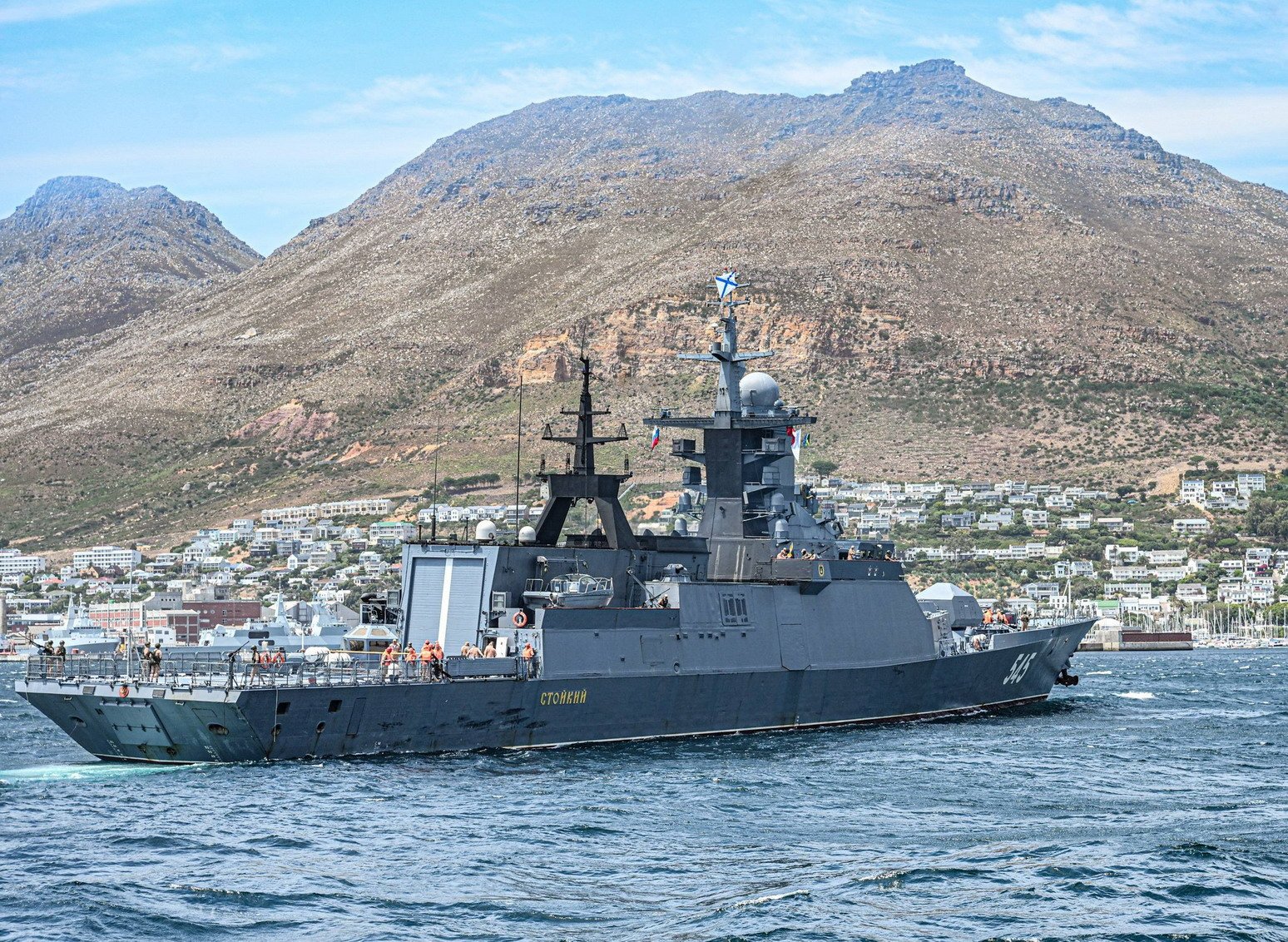
China deployed the Type 052DL guided-missile destroyer Tangshan (122) and the Type 903A replenishment ship Taihu (889). Russia contributed the Steregushchiy-class corvette Stoikiy (F545), embarked with a Ka-27PL anti-submarine warfare helicopter, along with the Altay-class oiler Yelnya (A168). A Gowind-class corvette of the United Arab Emirates Navy, Bani Yas (P110), was also present.


