– Advertisement –
While world leaders negotiate behind closed doors in the Blue Zone of COP30, Indigenous Women from across the planet are demonstrating that solutions to climate change already exist, and they are in the territories.
From the Amazon to the Arctic, from Africa to the Pacific Islands, Indigenous Women are leading initiatives for restoration, adaptation, and climate justice that are transforming the global conversation. Their message is clear: they are not victims of the crisis, but architects of structural solutions.
“For decades, Indigenous Women have sustained the systems that keep life in balance. Today, we are not asking to be included: we demand recognition that without us, no transition will be possible,” stated Lucy Mulenkei (Kenya), Vice Chair of the International Indigenous Women’s Forum (FIMI).

Beyond Discourse: The Solution is in the Territories
Outside the negotiation halls – where the participation of Indigenous delegations remains limited – a parallel agenda of concrete action is taking shape.
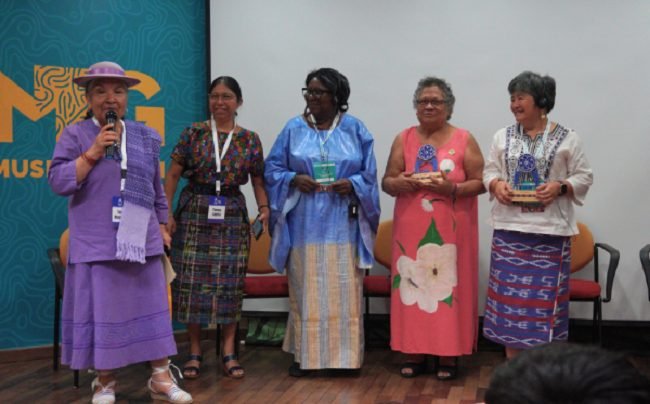
At the First Global Summit of Indigenous Women and Youth Protectors of the Territory, held in Belém, hundreds of women leaders presented five routes for climate transformation that combine governance, science, spirituality, and community-based financing.
“We did not come to ask for a seat. We came to remind you that the Earth already speaks, and many of its voices are women’s,” declared Tarcila Rivera Zea (Peru), President of FIMI and founder of CHIRAPAQ.
Five Routes Where Indigenous Women are Transforming the Climate Agenda
- Territorial Governance and Ecological Restoration
From the Andes to the Sahel, Indigenous Women are restoring forests, mangroves, and páramos, guided by the principle of care as a form of governance. In Mexico, Otomí women maintain a network of sacred hills where pilgrimages combine spirituality, reforestation, and the protection of water sources. In Ecuador and Brazil, networks of Amazonian women are mapping the spiritual and ecological links of their territory to guide conservation based on traditional knowledge.
“To restore a forest is to restore the dignity of the territory,” expressed Rivera Zea.
2. Indigenous Science and Climate Monitoring
In the Russian Arctic, young Indigenous women scientists are combining satellite technology with ancestral observation to monitor warming and ice loss. Researcher Aivanae Emmynka explained that the stories of elder women about the cycles of walruses and birds align with scientific data showing an 89% reduction in the walrus population and an average temperature increase of 0.6°C (33.08°F) over two decades.
“Our grandmothers watch the sky; we measure the data. It is the same knowledge translated into another language,” noted Emmynka.
3. Water Resilience and Food Sovereignty
In Papua New Guinea, young women are combining traditional techniques with modern rainwater harvesting systems to face water scarcity and rising sea levels. In Tanzania, Maasai leader Nidini Kimesera Sikar (Tanzania) is promoting the recovery of native seeds and the creation of community banks of medicinal and food knowledge.
“When the forest disappears, so does our pharmacy and our history. Every tree holds a cure,” stated Sikar.
4. Financial Justice and Sovereignty of Solutions
Direct access to climate finance remains one of the biggest gaps. According to the UN Permanent Forum on Indigenous Issues (2024), only 1.4% of global gender funds reach Indigenous Women’s organisations.
“The money continues to flow into colonial structures. The women who restore forests, protect rivers, and feed communities should be the flrst to receive it,” noted Joan Carling, a leader of the Indigenous Peoples Pact of Asia (AIPP).
FIMI and its allies propose that at least 10% of the new $1.8 billion global fund for terrestrial ecosystems be channeled directly to Indigenous initiatives led by women.
“We don’t want to be beneflciaries; we want to be the designers of climate flnance,” stressed Teresa Zapeta (Guatemala), Executive Director of FIMI.
5. Intersectional Justice and Real Inclusion
During the event, Olga Montúfar (Mexico) and Pratima Gurung (Nepal) reminded attendees that climate justice will only be possible if it recognizes multiple forms of discrimination.


They demanded the effective implementation of CEDAW General Recommendation No. 39, which recognizes the rights of Indigenous Women, in accessible and culturally relevant formats.
Its translation into more than 20 Indigenous languages, Braille, and visual materials represent a historic step toward truly inclusive climate action.
From Resistance to Global Leadership
During the Summit’s opening, the Brazilian Minister of Indigenous Peoples, Sônia Guajajara, highlighted the leadership of Indigenous Women in climate action and reaffrmed her support for solutions driven from the territories.
“This moment was built with the leadership of Indigenous Women. The solutions we need cannot exist without our presence,” Guajajara pointed out.
From Belém, these women leaders are calling for a new pact of global co-responsibility, where climate action is based on the political, territorial, and financial recognition of their leadership
“We don’t just resist. We govern, we restore, we teach. We are not a topic at COP30: we are its answer,” declared Teresa Zapeta.