

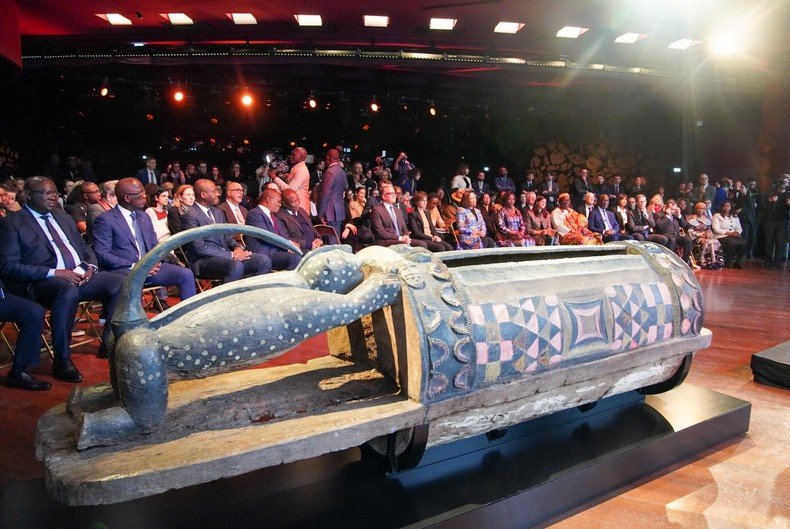
The Djidji Ayôkwé, a massive talking drum carved from iroko wood, stands over three metres tall and weighs around 430 kilograms.
For the Ebrié community, it has long served as a ceremonial centerpiece, traditionally used to signal danger, mobilize communities, and call villages together for important events.
According to the BBC, the drum was removed from Ivory Coast in 1916 and taken to France in 1929 then eventually placed on public display in Parisian museums, including the Trocadéro and later the Quai Branly.
Previous high-profile restitutions include Benin’s royal artifacts, a historic sabres to Senegal, and Germany’s handover of more than 1,100 Benin Bronzes to Nigeria.
Italy has also repatriated church relics and manuscripts looted from Ethiopia during the 1930s.
A Historic Homecoming for the Ebrié People
The Djidji Ayôkwé arrived in Abidjan on a chartered plane inside a specially reinforced crate marked “fragile,” where it was greeted by local chiefs, traditional dancers, and members of the Ebrié community.
Ivory Coast’s Culture Minister Françoise Remarck described the moment as “an extraordinary day for our heritage and a long-overdue act of justice.”
“We are living through a moment of justice and remembrance that finally marks the return of the Djidji Ayôkwé to its land of origin.” he told the BBC
Aboussou Guy Mobio, chief of the Adjamé-Bingerville community, said: “After a long stay away from this land, it is returning to its own people and it is an honour for us and a relief to welcome it. This is the missing piece of the puzzle that is returning today … Receiving this sacred instrument is a relief, but it is also another form of connection with our ancestors who were very close to this instrument.”
The drum is the first of 148 items Ivory Coast hopes to reclaim from French collections. Its return was made possible after the French parliament passed a special law authorizing the restitution of colonial-era cultural artifacts.
France is also moving forward with a broader legal framework to simplify future repatriations, which is now awaiting consideration by the National Assembly.
For the Ebrié people, the Djidji Ayôkwé is more than an artifact, it is a restored piece of identity and history, marking the end of about 110-year separation from its homeland.


